A Moment of Quietude: Modigliani's 'Landscape' – A Study in Melancholy
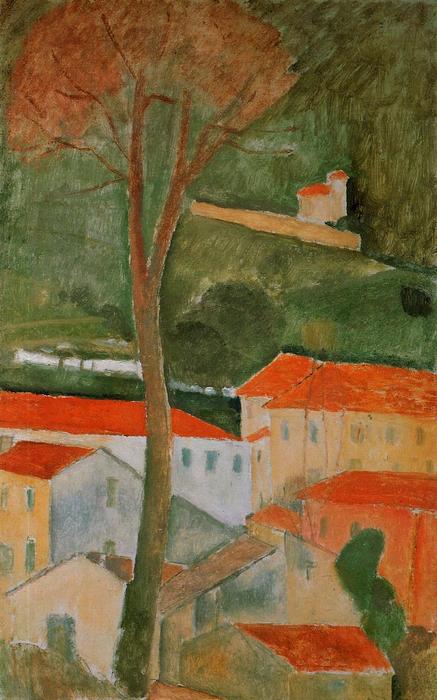
Amedeo Modigliani’s ‘Landscape,’ painted in 1919, offers a poignant glimpse into the artist’s deeply felt world. This seemingly simple depiction of a hillside and its modest dwelling is far more than just a topographical rendering; it's an intensely personal expression of longing and isolation, characteristic of Modigliani’s oeuvre during his tragically brief but profoundly influential career. The painting’s subdued palette – dominated by earthy browns, muted greens, and the striking red of the building’s roof – immediately evokes a sense of quiet contemplation, mirroring the artist's own internal struggles.
- Subject Matter: The scene presents a classic Italian landscape, featuring a gently sloping hillside punctuated by a small building. This deliberate choice of subject matter reflects Modigliani’s fascination with the natural world and his desire to capture its inherent beauty alongside human presence.
- Composition: The placement of the two figures adds an element of narrative tension. Their positioning draws the viewer's eye across the canvas, creating a dynamic balance between the static landscape and the fleeting presence of humanity.
The Artist’s Vision – Modigliani’s Style and Technique
Painted in the final year of his life, ‘Landscape’ exemplifies Modigliani’s distinctive artistic style, which evolved rapidly during his time in Paris. Influenced by Post-Impressionism and African sculpture, he developed a highly stylized approach characterized by elongated figures, simplified forms, and expressive brushwork. Notice the deliberate distortion of perspective – a hallmark of his technique – that lends the scene an almost dreamlike quality. The use of thick impasto in areas, particularly around the trees and building, adds textural richness and emphasizes the physicality of the landscape. Modigliani’s mastery of oil paint is evident in the subtle gradations of tone and color, creating a sense of depth and atmosphere.
Historical Context – A Life Marked by Loss
‘Landscape’ was created during a pivotal period in Modigliani's life, a time marked by both artistic breakthroughs and profound personal hardship. Born in Livorno in 1884, he faced constant illness throughout his youth, contributing to the melancholic tone that permeates much of his work. His relationships were often fraught with difficulty, and his untimely death from syphilis in 1920 at the age of thirty-six cut short a brilliant career. The painting can be interpreted as a reflection of this sense of fragility and impermanence – a poignant reminder of the fleeting nature of beauty and life itself.
Symbolism and Emotional Impact
The red roofed building, a common motif in Modigliani’s work, is often seen as representing shelter, protection, or perhaps even a yearning for domestic tranquility. The two figures, seemingly lost within the vastness of the landscape, evoke a sense of isolation and loneliness – emotions that resonate deeply with viewers. ‘Landscape’ isn't simply a depiction of a place; it’s an exploration of human emotion, rendered with Modigliani’s characteristic sensitivity and artistic skill. It invites contemplation on themes of solitude, beauty, and the enduring power of melancholy.