A Gaze Through Time: The Soul of Pierre Edouard Baranowski
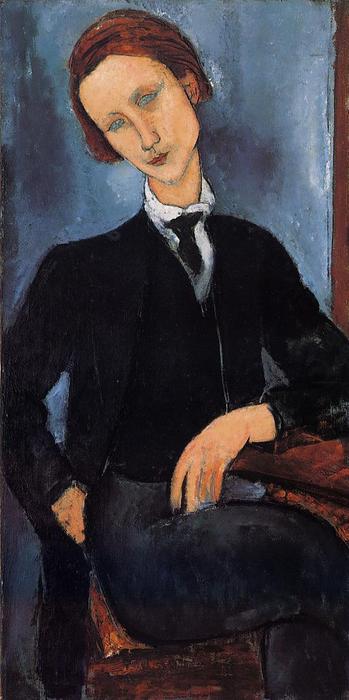
In the quiet, evocative realm of Amedeo Clemente Modigliani’s 1918 masterpiece, Pierre Edouard Baranowski, we encounter more than a mere portrait; we enter a profound dialogue between the subject and the viewer. This oil on canvas, measuring an elegant 111 x 56 cm, serves as a haunting window into the Expressionist movement, capturing a moment of stillness that feels both eternal and deeply intimate. The painting does not seek to replicate the physical world with photographic precision; instead, it strives to map the internal landscape of the human spirit. Through his signature use of elongated forms and a deliberate reduction of detail, Modigliani invites us to look past the surface of the skin and into the very essence of the sitter’s quiet intensity.
The technical mastery of this piece lies in its deceptive simplicity. Modigliani employs a rhythmic, flowing brushstroke that lends a sense of sculptural weight to the figure. The subject is defined by those iconic, stretched proportions—the graceful, elongated neck and the stylized facial features—that have become the hallmark of his oeuvre. This technique creates a dreamlike, almost surreal atmosphere, where the boundaries between reality and emotion begin to blur. The color palette is a masterclass in subtlety, utilizing muted ochre tones, deep browns, and soft grays to build a sense of melancholic warmth. These earthy, somber hues do not merely decorate the canvas; they anchor the painting in a mood of introspection, making it an ideal centerpiece for spaces designed for contemplation and sophisticated repose.
The Legacy of Expressionism and Personal Narrative
To understand the emotional gravity of Pierre Edouard Baranowski, one must consider the turbulent life of its creator. Born in Livorno, Italy, Modigliani’s identity was shaped by a rich Sephardic Jewish heritage and a life often shadowed by physical frailty and bohemian struggle. His move to Paris in 1906 placed him at the heart of an artistic revolution, where he absorbed the radical ideas of Nietzsche and Baudelaire, translating their intellectual rebellion into visual form. This painting is a product of that era—a time when artists were breaking away from academic rigidity to find truth in abstraction and emotion. The almond-shaped eyes and simplified features seen in this portrait are not mere stylistic choices; they are symbols of a modern way of seeing, one that prioritizes the psychological depth of the individual over the superficiality of the external world.
For the discerning collector or interior designer, this work offers an unparalleled opportunity to introduce a sense of historical prestige and emotional resonance into a curated environment. Whether placed in a sunlit gallery or a moody, contemporary study, the painting acts as a focal point of quiet strength. It possesses the rare ability to command attention through its understated elegance rather than through loud or jarring colors. Owning a high-quality reproduction of this work means bringing home a piece of the École de Paris—a fragment of a legendary era that continues to inspire awe, providing a timeless aesthetic that complements both classical and modern decor with effortless grace.