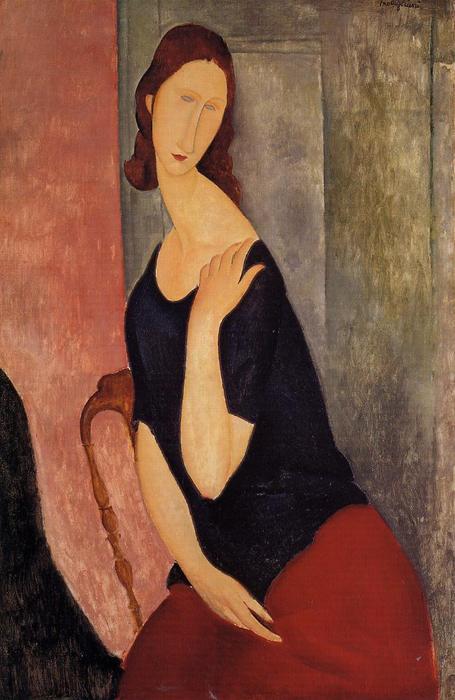
Explore Amedeo Modigliani’s ‘Portrait of Madame L,’ a captivating Cubist portrait featuring elongated forms & expressive color. Discover this iconic artwork's unique style and timeless beauty.
Explore the captivating art of Amedeo Modigliani (1884-1920): iconic portraits & sculptures defined by elongated forms, expressive eyes, and a hauntingly beautiful style. Discover his legacy! #Modigliani #Expressionism
A Captivating Portrait in the Style of Modigliani
This striking portrait, rendered in a style deeply reminiscent of Amedeo Modigliani, presents a compelling study of feminine introspection. The artwork immediately draws the viewer into a quiet contemplation, achieved through its distinctive stylistic choices and masterful execution. While titled “Portrait of Madame L,” the work embodies the essence of Modigliani’s signature approach to portraiture – an exploration of form, emotion, and the human condition.
Stylistic Influences & Artistic Technique
The painting is unequivocally rooted in the Cubist aesthetic, yet diverges from strict adherence to its principles. It showcases a clear influence from Modigliani’s unique blend of Expressionism and Cubism. Simplified forms, particularly in the depiction of the figure and chair, are flattened and fragmented, creating an abstracted representation that prioritizes geometric structure over realistic detail. The artist employs elongated proportions – a hallmark of Modigliani's work – subtly stretching the subject’s form to enhance its elegance and emotional resonance.
The technique is characterized by visible brushstrokes and impasto, where paint is applied in thick layers, building texture and adding dynamism to the composition. This tactile quality invites close inspection and emphasizes the artist's hand in creating the work. The color palette, while expressive rather than naturalistic, utilizes broad areas of reddish-pink for the background, a dark blue/black for the dress, and pale yellow tones for the skin, all contributing to a harmonious yet subtly unsettling visual experience.
Subject & Composition
The subject is a woman presented in a seated pose, her gaze directed slightly downward, suggesting a state of quiet contemplation. The vertical composition emphasizes her elongated form, drawing the eye upwards and reinforcing a sense of dignified stillness. The background, though abstract, provides context without distracting from the central figure. The interplay between geometric shapes – rectangular planes defining the chair, wall, and portions of the body – creates a visually engaging arrangement that is both structured and fluid.
Historical Context & Modigliani’s Legacy
Amedeo Modigliani (1884-1920) was an Italian painter and sculptor who rose to prominence in the Parisian art scene during the early 20th century. He became known for his distinctive portraits, characterized by elongated necks, almond-shaped eyes, and a sense of melancholic beauty. His work challenged conventional artistic norms and paved the way for future generations of artists exploring abstraction and emotional expression. This piece echoes Modigliani’s explorations during his most prolific period, particularly in its sensitivity to form and psychological depth – reminiscent of works like “Portrait of Madame Rachele Osterlind” and "Portrait of Madame Survage".
Emotional Impact & Symbolic Resonance
The painting evokes a sense of quiet introspection and subtle melancholy. The subdued color palette and the subject’s contemplative pose contribute to this emotional atmosphere. While lacking overt narrative elements, the artwork invites viewers to project their own interpretations onto the figure, fostering a personal connection with the work. Symbolic meaning is less explicit than evocative; the painting isn't *about* something specific, but rather *feels* a certain way – thoughtful, reserved, and quietly powerful.
Ideal for Collectors & Interior Design
This artwork would be a valuable addition to any art collection, particularly those focused on early 20th-century modernism or the works of Amedeo Modigliani. Its sophisticated aesthetic and subtle emotional depth make it an ideal focal point for interior design schemes seeking to create an atmosphere of refined elegance and intellectual curiosity. The painting’s color palette complements a range of décor styles, from minimalist contemporary spaces to more traditional settings.