A Portrait of Melancholy: Unveiling Rosa Porprina
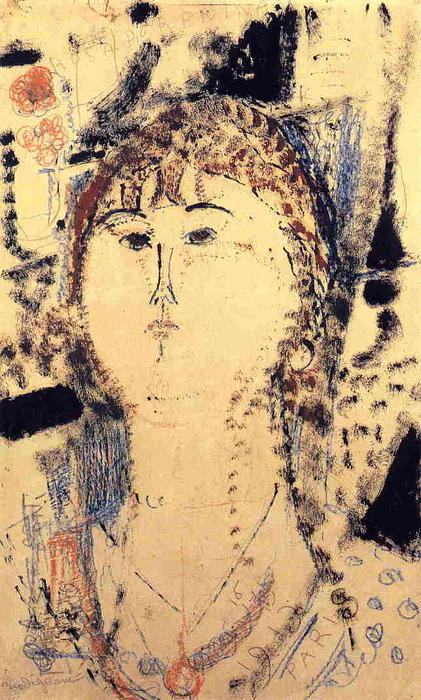
Amedeo Modigliani’s “Rosa Porprina” (1915) is not merely a portrait; it's an exquisitely rendered distillation of longing, a visual embodiment of the artist’s own deeply felt sense of isolation and beauty. This intimate depiction of a woman’s face, rendered in his signature elongated style, immediately draws the viewer into a world of quiet contemplation. The painting captures a moment suspended between sadness and serenity – a palpable vulnerability that speaks volumes despite its restrained palette.
The Artist's World: Modigliani and His Influences
Born in Livorno, Italy, in 1884, Amedeo Modigliani’s life was tragically short but profoundly impactful on the art world. He navigated a childhood marked by financial instability following his father’s business collapse and recurring bouts of illness – pleurisy and typhoid fever were constant companions. These experiences undoubtedly shaped his artistic sensibility, fostering an acute awareness of fragility and mortality. Crucially, Modigliani was exposed to the intellectual currents of the time through his mother and grandfather, who introduced him to the works of Nietzsche, Baudelaire, and Lautréamont – figures who challenged conventional notions of beauty and explored themes of alienation and desire. This exposure fueled his rejection of academic realism in favor of a more expressive, psychologically charged style.
Style and Technique: The Language of Longing
“Rosa Porprina” exemplifies Modigliani’s distinctive artistic language. His elongated forms – particularly the face and neck – create an arresting sense of distortion, lending a subtly unsettling quality to the portrait. This deliberate exaggeration isn't arbitrary; it serves to amplify the emotional intensity of the subject. The painting is executed in oil on canvas with meticulous attention to detail, yet the brushstrokes retain a fluidity that prevents the image from feeling overly polished or artificial. Notice the subtle shifts in color – the deep reds and blues evoke a sense of mystery and introspection, while the black accents provide dramatic contrast and emphasize the contours of the face. The use of chiaroscuro—the interplay of light and shadow—further enhances the painting’s emotional depth, highlighting the woman's features and creating an atmosphere of quiet drama.
Symbolism and Emotional Resonance
The title itself, “Rosa Porprina” (Crimson Rose), hints at themes of beauty, passion, and perhaps even a fading bloom. The woman’s pensive expression – her slightly downturned mouth and shadowed eyes – suggests a deep well of emotion, hinting at unspoken thoughts and hidden sorrows. The necklace she wears adds a layer of intrigue, potentially symbolizing adornment, remembrance, or a connection to the past. The inclusion of the clock on the wall and the vase nearby introduces elements of domesticity and routine, subtly juxtaposing the woman’s inner world with the external realities of her life. Ultimately, “Rosa Porprina” is a powerful meditation on beauty, melancholy, and the enduring mysteries of the human heart – a testament to Modigliani's ability to capture profound emotion within a deceptively simple composition.