A Portrait of Quiet Contemplation
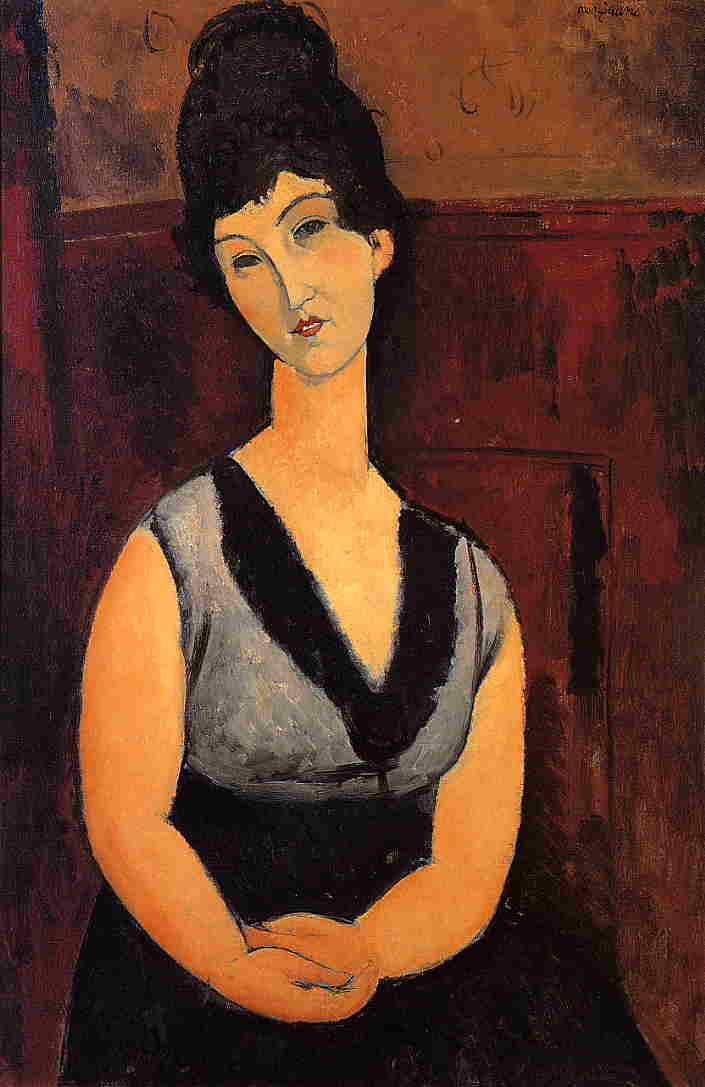
In the vast landscape of early 20th-century modernism, few works capture the profound ache of human introspection as poignantly as Amedeo Clemente Modigliani’s 1916 masterpiece, The Beautiful Confectioner. This oil on canvas, measuring a commanding 100 x 75 cm, does far more than merely depict a seated woman; it invites the viewer into a private sanctuary of thought. As one gazes upon the subject, there is an immediate sense of being a silent witness to a moment of deep, inward-looking stillness. The woman sits before a simple wooden wall, her posture suggesting a retreat from the chaotic world outside, her gaze directed not toward the observer, but into the depths of her own psyche. It is a painting that breathes with the weight of unspoken emotion, making it an extraordinary centerpiece for any collection dedicated to the beauty of the human spirit.
The stylistic essence of this work is firmly rooted in the Expressionist tradition, a movement that sought to peel back the layers of outward reality to reveal the raw, often uncomfortable truths of the inner self. Modigliani, a master of this emotive distortion, eschews the photographic precision of realism in favor of a more rhythmic and symbolic language. His signature technique—the deliberate elongation of figures and the creation of mask-like, almond-shaped eyes—is present here, lending the subject an ethereal, almost otherworldly grace. This aesthetic choice serves to detach the figure from a specific time or place, elevating her from a mere confectioner to a universal symbol of melancholy and grace. For the discerning collector or interior designer, this piece offers a sophisticated tension between classical elegance and modern psychological depth.
Technique, Palette, and Atmospheric Depth
The technical execution of The Beautiful Confectioner reveals Modigliani’s meticulous command over his medium. Through the delicate layering of thin oil glazes, the artist achieved a subtle gradation of color that lends the canvas an almost luminous, translucent quality. The palette is intentionally muted and somber, dominated by earthy browns, creamy highlights, and deep blacks. This restrained use of color does not diminish the painting's impact; rather, it focuses the viewer's attention on the interplay of light and shadow across the subject's face and the textured wooden backdrop. The contrast between the smooth, elongated lines of the woman’s form and the grounded, rustic texture of the wall creates a visual harmony that is both soothing and intellectually stimulating.
Beyond its formal beauty, the painting carries a heavy historical resonance. Created during the tumultuous years of World War I, the work reflects the broader anxieties and the sense of fragmentation prevalent in European culture at the time. The influence of thinkers like Nietzsche and Baudelaire is palpable in the way Modigliani embraces a certain tragic beauty—a rejection of superficial prettiness in favor of an uncompromising honesty. To hang a high-quality reproduction of this work in a curated space is to introduce a sense of historical gravity and intellectual sophistication. It serves as a focal point that encourages slow looking, providing a moment of meditative calm amidst the frenetic pace of contemporary life.