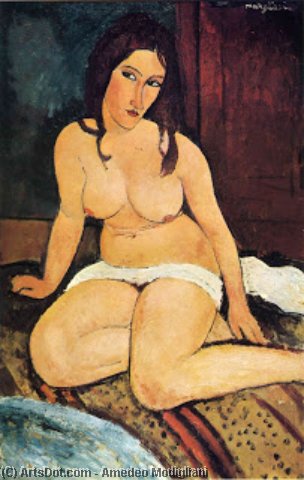
A haunting Modigliani portrait of a nude woman dominates this intimate scene, capturing the artist’s signature elongated forms and melancholic beauty from the early 20th century. Explore this captivating artwork and bring its timeless elegance into your space.
Explore the captivating art of Amedeo Modigliani (1884-1920): iconic portraits & sculptures defined by elongated forms, expressive eyes, and a hauntingly beautiful style. Discover his legacy! #Modigliani #Expressionism
A Study in Longing: Unveiling Modigliani’s “Untitled (3793)”
This arresting portrait, tentatively designated "Untitled (3793)," offers a profound and unsettling glimpse into the artistic vision of Amedeo Modigliani, one of the most poignant figures of early 20th-century Modernism. Painted in 1917, during a period marked by both creative fervor and personal struggle for the artist, the work immediately draws the viewer into a world of melancholic beauty and quiet contemplation. The central figure, a woman seated upon a bed, embodies Modigliani’s signature style – elongated forms, almond-shaped eyes, and a deliberate simplification of features that transcends mere representation to capture an essence of profound emotional depth. Her posture, relaxed yet subtly tense, suggests a vulnerability coupled with an undeniable sense of self-awareness, inviting the viewer to engage in a silent dialogue about beauty, desire, and perhaps, unfulfilled longing. The presence of two secondary figures – one in the background and another near the upper right corner – adds layers of complexity, hinting at relationships, observations, or even the artist’s own internal reflections.
Technique and Materials: A Masterclass in Linear Expression
Modigliani's technique is immediately recognizable through his masterful use of charcoal and pastel on canvas. He employed a rapid, almost frantic application of these materials, building up layers of dark pigment to create a dramatic chiaroscuro effect – a stark contrast between light and shadow that intensifies the emotional impact of the portrait. The deliberate lack of blending or softening contributes to the work’s raw energy and sense of immediacy. Unlike the polished surfaces favored by some of his contemporaries, Modigliani embraced imperfections, allowing the texture of the charcoal and pastel to remain visible, further emphasizing the physicality of the image. This technique wasn't simply a stylistic choice; it reflected his deep engagement with the subject matter, translating his emotional response directly onto the canvas. The use of black and white tones amplifies the sense of isolation and introspection, aligning with Modigliani’s exploration of themes like loneliness and mortality.
Symbolism and Context: Echoes of Baudelaire and Beyond
Born in Livorno, Italy, in 1884, Amedeo Modigliani was deeply influenced by the intellectual currents of his time. His early exposure to the works of Baudelaire, Nietzsche, and Lautréamont – figures who challenged conventional notions of beauty and morality – profoundly shaped his artistic sensibility. The woman depicted here can be interpreted as a reflection of these influences: a study in idealized beauty tinged with sadness and disillusionment. Her large breasts, a recurring motif in Modigliani’s work, have been suggested to represent fertility, sensuality, or perhaps even the burden of female vulnerability within a patriarchal society. The ambiguous setting – a simple bed – further contributes to the painting's enigmatic quality, inviting speculation about the woman’s identity and her relationship with the figures surrounding her. This portrait aligns with Modigliani’s broader exploration of themes related to love, loss, and the human condition, reflecting his own personal struggles and anxieties.
Emotional Resonance: A Timeless Portrait of Melancholy
“Untitled (3793)” transcends its historical context to offer a timeless meditation on beauty, sorrow, and the complexities of human emotion. Modigliani’s ability to capture such profound psychological depth through seemingly simple forms is what continues to captivate viewers over a century later. The painting's inherent melancholy resonates with a universal sense of longing – a desire for connection, understanding, or perhaps simply an escape from the anxieties of modern life. This reproduction offers a unique opportunity to experience firsthand the emotional power of Modigliani’s work, allowing it to become a focal point within any interior space, prompting contemplation and inspiring reflection.