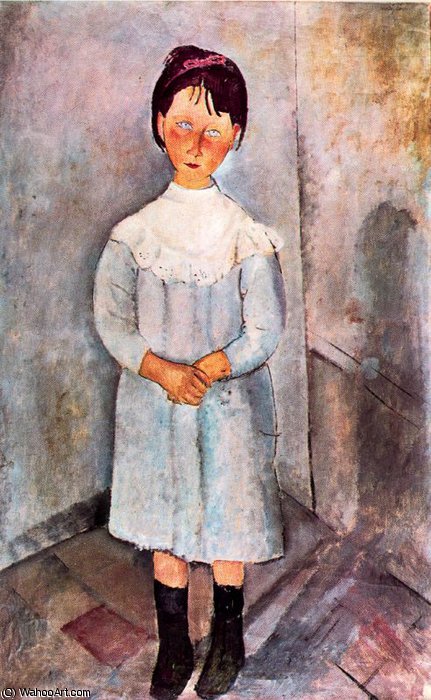
Admire Amedeo Modigliani's iconic portrait 'untitled (5881)', capturing youthful beauty and solemn gaze. Explore the melancholic style of this celebrated Expressionist painter & sculpture, influenced by African art.
A Portrait of Quiet Intensity: Exploring Modigliani’s Untitled (5881)
Amedeo Clemente Modigliani's “untitled (5881)” stands as a testament to the artist’s singular vision—a hauntingly beautiful depiction of a young girl that transcends mere representation, delving into themes of melancholy and contemplation. Painted sometime between 1916 and 1917 during his Parisian exile, this portrait encapsulates the spirit of Expressionism while simultaneously echoing influences from African sculpture and Byzantine iconography.
Subject Matter & Composition
The artwork centers on a young woman—likely Modigliani’s muse Jeanne Hébert—whose gaze is directed squarely at the viewer. Her posture exudes stillness, conveying an aura of profound seriousness that invites interpretation. Surrounding her are two figures in the background: one positioned to the right and another centrally located. These additions contribute to a sense of intimacy and subtly heighten the girl's isolation within the frame.
Stylistic Innovation & Technique
Modigliani’s distinctive style is immediately recognizable through his elongated facial features—a hallmark characteristic of his oeuvre. The almond-shaped eyes dominate the composition, conveying an unnerving gaze that seems to penetrate beyond superficial appearances. Similarly, the neck and jaw are subtly stretched, creating a sculptural effect reminiscent of African masks—a deliberate stylistic choice reflecting Modigliani’s fascination with primitive art forms.
Historical Context & Artistic Influences
Created during the turbulent years leading up to World War I, “untitled (5881)” reflects the anxieties and uncertainties of the era. However, its aesthetic roots extend far beyond immediate historical concerns. Modigliani’s artistic sensibility was profoundly shaped by Nietzsche’s philosophy—particularly his concept of the Übermensch—and Baudelaire’s exploration of beauty amidst decay. These intellectual currents fueled his desire to depict human emotion with uncompromising honesty.
Emotional Resonance & Legacy
"untitled (5881)" possesses an undeniable emotional power, capturing a moment of quiet introspection that speaks to the universal experience of longing and vulnerability. Its muted palette—primarily ochre, ivory, and brown—further enhances its melancholic atmosphere. Today, reproductions of this masterpiece continue to inspire artists and collectors alike, cementing Modigliani’s place as one of the most influential figures in modern art.