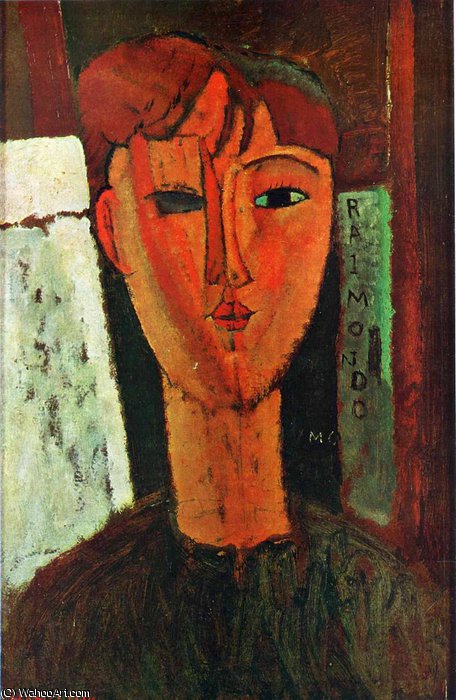
A haunting portrait by Amedeo Modigliani, 'Untitled (7852),' captures a woman's intense gaze and striking red face with expressive brushstrokes. Explore this iconic Expressionist masterpiece.
A Portrait of Melancholy: Unveiling Modigliani’s ‘Untitled (7852)’
Amedeo Modigliani's “Untitled (7852)” is not merely a portrait; it’s an immersion into the very soul of longing. Painted in 1917, during his most intensely productive period, this arresting image of a woman – a frequent subject of his work – embodies the artist’s signature style: elongated forms, subtly distorted features, and a profound sense of quiet sorrow. The painting immediately commands attention with its stark contrast—the vibrant, almost aggressive red of her face set against the cool, muted green of the wall behind her. This deliberate juxtaposition speaks to a core theme within Modigliani's oeuvre – the tension between passion and restraint, beauty and decay.
Expressionist Roots and Technical Mastery
While often categorized as an early example of Cubism, “Untitled (7852)” is firmly rooted in Expressionism. Modigliani’s use of flattened planes, simplified forms, and intense color was a direct response to the anxieties and uncertainties of the modern age. His technique involved meticulous layering of oil paint, built up through countless glazes – a process that allowed him to achieve an almost luminous quality, particularly evident in the subtle shifts of tone across her face. The deliberate lack of detail beyond the essential features—closed eyes, slightly parted lips—forces the viewer to confront the raw emotion conveyed by the subject’s posture and expression. Note the careful rendering of the skin tones, a hallmark of Modigliani's approach, conveying both realism and an underlying sense of vulnerability.
Symbolism of the Female Figure
Modigliani’s female figures are frequently interpreted as representations of idealized beauty tinged with melancholy. The woman in “Untitled (7852)” is not a portrait of a specific individual, but rather a composite archetype – a symbol of feminine grace and suffering. Her upward gaze suggests a yearning for something beyond the confines of her earthly existence, perhaps an unattainable ideal or a spiritual connection. The closed eyes evoke a sense of introspection and detachment, while the open mouth hints at unspoken words or suppressed emotions. This ambiguity is central to the painting’s enduring power.
Historical Context and Modigliani's Legacy
Created in the tumultuous years following World War I, “Untitled (7852)” reflects the broader artistic currents of the time – a rejection of traditional academic values and an exploration of psychological states. Modigliani’s life was tragically short, marked by poverty, illness, and ultimately, premature death at the age of 36. Despite his struggles, he left behind a remarkably influential body of work that continues to captivate audiences worldwide. This painting stands as a testament to his artistic genius and his ability to translate profound emotion onto canvas, solidifying his place among the most significant figures in modern art. Its haunting beauty and emotional depth make it a compelling addition to any collection or a striking focal point for interior design.