A Haunting Beauty: Unveiling Amedeo Modigliani’s “Untitled (9028)”
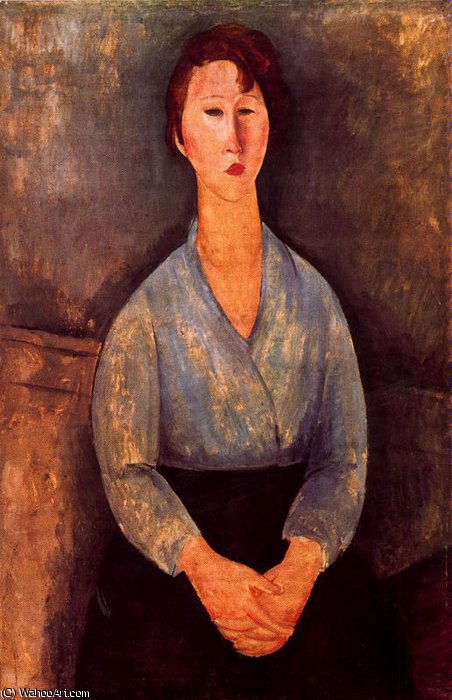
Amedeo Clemente Modigliani's "Untitled (9028)" is not merely a portrait; it’s an exquisitely rendered distillation of melancholy, longing, and the enigmatic nature of human experience. Painted in 1917-1918, during his most prolific Parisian period, this work embodies the core tenets of Modigliani's distinctive style – elongated forms, piercing gazes, and a profound sensitivity to light and shadow. The painting’s power lies not just in its technical mastery but also in the palpable sense of isolation and introspection it evokes, inviting viewers into a world of quiet contemplation.
The subject, a woman presented with an arresting, almost unsettling expression, dominates the canvas. Her features – the subtly elongated nose, the almond-shaped eyes, the delicate chin – are hallmarks of Modigliani’s signature style, deliberately departing from traditional representational forms. The muted color palette—primarily blues and browns—contributes to a sense of somber elegance, reinforcing the painting's emotional weight. Notice how the light catches on her face, highlighting the subtle planes and creating an illusion of depth despite the relatively flat composition.
The Language of Form: Modigliani’s Sculptural Approach
Modigliani’s artistic journey was deeply intertwined with sculpture. He initially trained as a sculptor, and this influence is strikingly evident in his paintings. The elongated forms, particularly those of the face and neck, are reminiscent of his three-dimensional works. This deliberate distortion wasn't simply an aesthetic choice; it served to heighten emotional expression, suggesting vulnerability and a yearning for something beyond reach. The painting’s composition feels almost like a captured moment from a sculpture – frozen in time, conveying a sense of arrested movement.
Consider the way he renders the fabric of her dress. It's not rendered with meticulous detail but rather as a flowing, almost ethereal element that contrasts subtly with the more rigid structure of her face. This juxtaposition further emphasizes the tension between inner emotion and external appearance – a recurring theme in Modigliani’s oeuvre.
A Glimpse Behind: Context and Symbolism
The woman's gaze, directed off-camera, is perhaps the most compelling element of the painting. It suggests a private world, a moment of introspection or perhaps a memory that haunts her. The presence of two figures in the background – one on the left, another to the right – adds layers of complexity and hints at a social context, though their identities remain deliberately obscured. These secondary figures could represent companions, observers, or even projections of her own internal state.
Modigliani’s life was marked by hardship and loss, including the untimely death of his beloved partner Jeanne Hébuterne in 1920. This personal tragedy undoubtedly informed his art, imbuing it with a pervasive sense of melancholy and longing. “Untitled (9028)” can be interpreted as an exploration of these themes – a poignant meditation on beauty, sorrow, and the fragility of human connection.
Capturing the Essence: Reproduction and Artistic Value
ArtsDot offers meticulously hand-painted reproductions that strive to capture not just the visual likeness but also the emotional essence of Modigliani’s “Untitled (9028).” Our artists painstakingly recreate the subtle nuances of light, shadow, and texture, ensuring a faithful representation of this iconic work. The choice of materials – archival canvas and pigments – guarantees that the reproduction will endure for generations to come.
Whether adorning a gallery wall or gracing a private residence, this reproduction offers an intimate connection to one of the 20th century’s most captivating artists. It's more than just a print; it’s a window into Modigliani’s world – a world of haunting beauty and profound emotional depth.