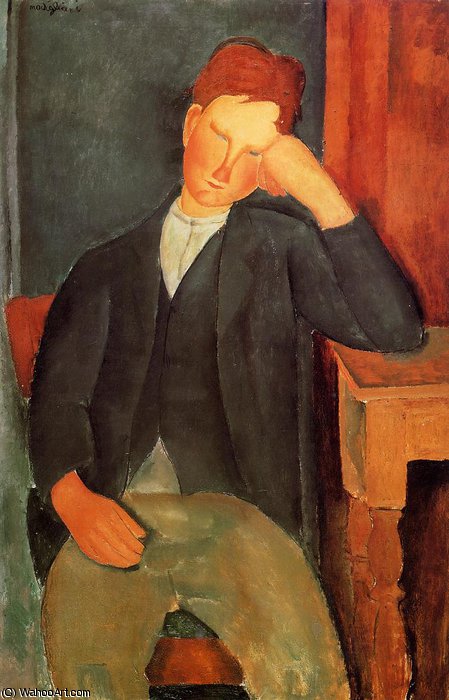
A Meditation on Quietude: The Soul of Modigliani’s Young Peasant
In the quiet corners of the Tate Modern resides a masterpiece of profound stillness, Amedeo Clemente Modigliani’s 1918 work, "Young Peasant" (often referred to as The Young Apprentice). To gaze upon this portrait is to step into a moment of suspended animation, where the frantic energy of the early 20th century dissolves into a singular, melancholic breath. The painting captures a young man seated in a state of deep introspection, his head resting heavily upon his hand—a posture that serves as a universal shorthand for fatigue, contemplation, or perhaps a soul grappling with unspoken anxieties. There is an undeniable vulnerability in his gaze, an invitation to the viewer to share in his private moment of repose.
The emotional resonance of the piece lies in its ability to transform a simple domestic scene into a psychological landscape. Modigliani, a painter whose life was famously etched with longing and hardship, imbues the sitter with a sense of weight that transcends the physical. The warm, reddish wall behind the figure provides a striking yet comforting counterpoint to the muted, somber tones of the man’s face and torso. This deliberate use of color creates an atmosphere of cozy isolation, making the painting feel less like a distant historical artifact and more like a living, breathing presence that can anchor the mood of any sophisticated interior.
The Legacy of Cézanne and the Art of Elongation
Technically, "Young Peasant" is a brilliant dialogue between Modigliani’s burgeoning Expressionist voice and the structural foundations laid by Paul Cézanne. One can observe the influence of the French master in the way Modigliani simplifies planes and utilizes elongated forms to capture the essence of his subject rather than mere surface detail. The composition is grounded by the sturdy, geometric presence of the chair, which acts as a stabilizing force against the figure's subtle, slumped posture. His brushwork, characterized by smooth transitions and a deliberate flattening of perspective, strips away unnecessary ornamentation to focus the viewer’s attention on the rhythmic harmony of the subject.
For the discerning collector or interior designer, this painting offers a masterclass in tonal balance. The interplay between the warm background and the cool, muted palette of the sitter creates a visual tension that is both stimulating and serene. It is a work that does not demand attention through loud colors or chaotic movement, but rather commands it through its quiet authority. Whether placed in a sunlit gallery or a dimly lit study, a high-quality reproduction of this piece brings with it an air of intellectual depth and timeless elegance, making it an ideal centerpiece for those who appreciate art that speaks to the complexities of the human condition.