The Piercing Gaze of the Renaissance
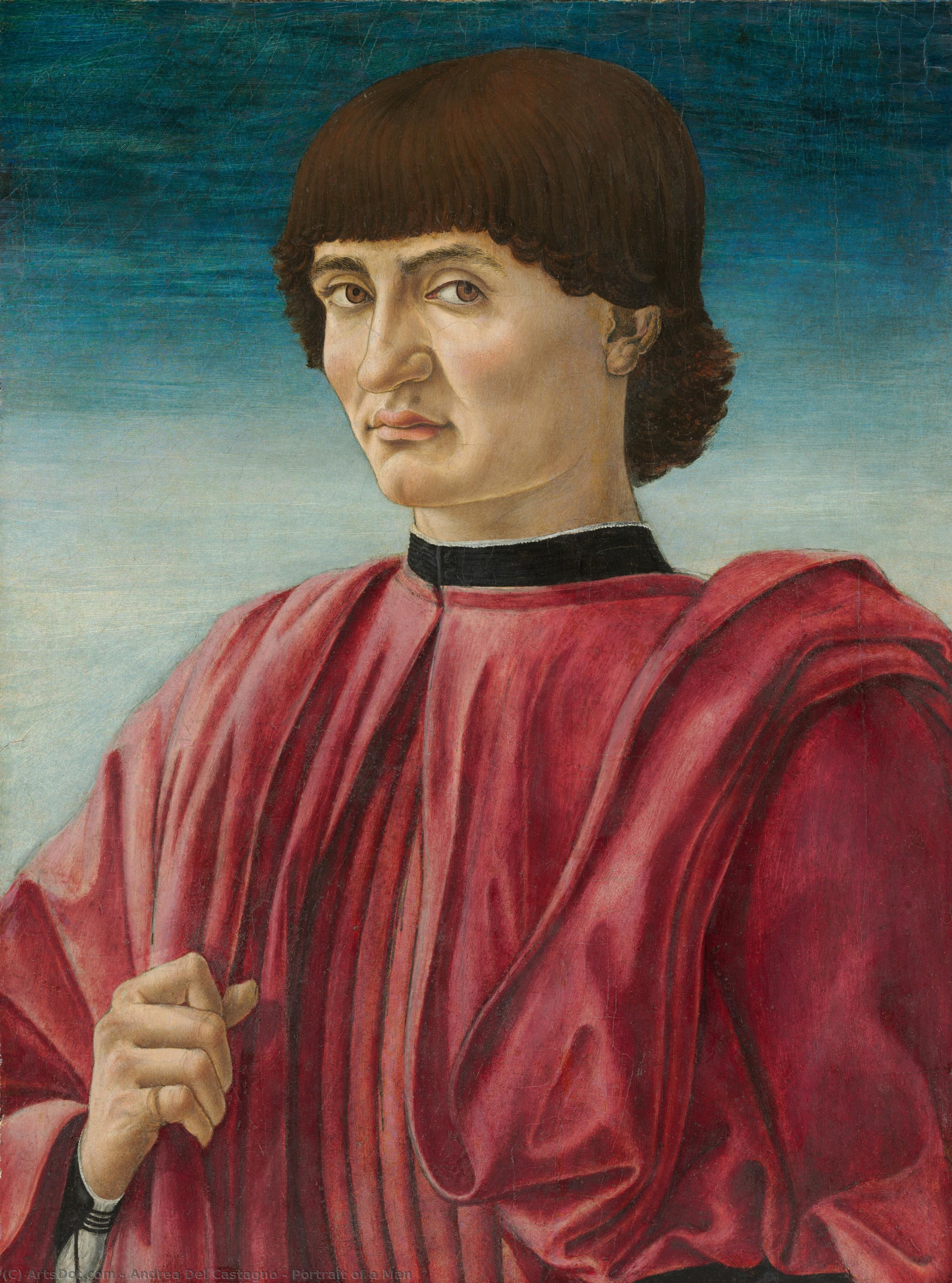
In the quiet corridors of art history, few portraits command attention quite like Andrea del Castagno’s Portrait of a Man. Painted around 1450, this masterpiece serves as a profound window into the soul of the Early Florentine Renaissance. The subject, captured from the chest upward, possesses an intensity that transcends the centuries. His gaze is not merely observational; it is confrontational, meeting the viewer with a sharp, unwavering focus that seems to pierce through the very surface of the panel. Clad in a voluminous, deep rose-red garment, the man’s presence is anchored by a striking contrast between the warmth of his attire and the cool, ethereal gradient of the background, which shifts from a dark aquamarine to a pale, arctic blue.
The technical mastery displayed in this work speaks to Castagno's reputation as a pioneer of dramatic realism. Utilizing the delicate yet precise medium of tempera on panel, the artist achieved a sculptural quality that was revolutionary for his time. Every fold of the heavy red fabric is rendered with meticulous care, creating a sense of weight and tactile reality. The play of light across the man’s high cheekbones and the angular structure of his nose lends the portrait a three-dimensional vitality. Even the subtle details—the soft curl of hair at the nape of his neck and the glint of a gold ring on his pinky finger—are executed with a precision that invites the eye to linger, discovering new layers of craftsmanship upon every viewing.
A Legacy of Drama and Realism
To understand this portrait, one must understand the man behind the brush. Andrea del Castagno, often remembered by the chilling moniker "Andrea degli Impiccati" due to his grim early commissions involving executed citizens, brought a unique sense of gravity and tension to his work. This piece embodies that characteristic Florentine strength. There is no soft sentimentality here; instead, we find a rugged, honest depiction of human character. The composition, with its tight framing and the subject's hand clutching his garment, suggests an internal psychological state—perhaps one of resolve, vigilance, or quiet dignity.
For the discerning collector or interior designer, this painting offers more than mere decoration; it provides a focal point of intellectual and emotional depth. The rich, saturated palette of crimson and gold, set against the tranquil blues, makes it an exquisite addition to a sophisticated space, whether it be a private library or a contemporary gallery setting. A high-quality reproduction of this work allows the timeless elegance of the Renaissance to breathe within a modern environment, serving as a constant reminder of the enduring power of human expression and the masterful hand of a Florentine master.