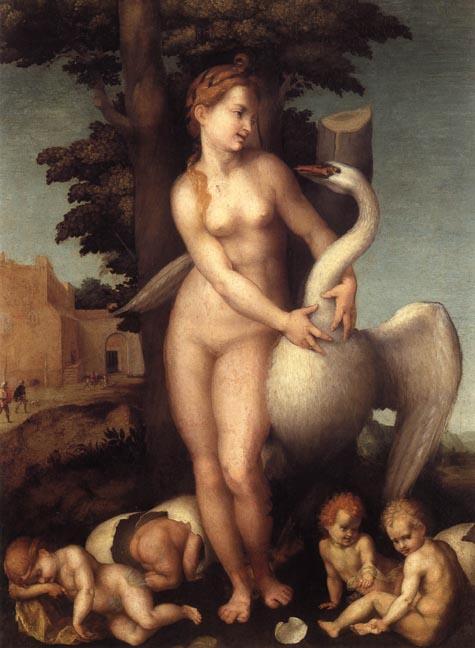
Leda and Her Children: A Renaissance Masterpiece of Myth and Beauty
Andrea del Sarto’s “Leda and her Children,” painted in 1515-1520, is more than just a depiction of a classical myth; it's a profound meditation on motherhood, beauty, and the very essence of creation. Housed today within the Museo del Cenacolo di San Salvi in Florence, this monumental fresco offers a rare glimpse into the artist’s masterful technique and his deep understanding of human emotion – a testament to the burgeoning Renaissance spirit that valued both classical ideals and humanist observation.
The scene unfolds with breathtaking realism. Leda, the Queen of Sparta, is presented as a figure of serene grace, her nude form rendered with an astonishing attention to detail. She’s not depicted in a moment of overt sensuality but rather in a state of contemplative repose, holding the swan – Zeus transformed into his avian guise – that brought about this extraordinary union. The composition is carefully balanced; Leda occupies the central space, drawing the viewer's eye immediately, while her three children—two playfully tumbling on the ground and one reaching out towards the egg—create a dynamic interplay of movement and stillness. The artist’s skill lies not just in capturing the physical likenesses but also in conveying the palpable sense of familial connection and burgeoning life.
Technique and Style: A Synthesis of Renaissance Innovation
Del Sarto was renowned for his frescoes, particularly his ability to achieve a remarkable luminosity and depth through the use of monochrome grisaille. This fresco is no exception; he masterfully employs subtle shifts in tone and shadow to sculpt the figures, giving them an almost three-dimensional quality. The background landscape, though somewhat simplified, provides a vital context, grounding the scene within a believable world. Notably, the painting demonstrates a fascinating interplay of influences – elements reminiscent of Leonardo da Vinci’s meticulous observation of anatomy are combined with the more decorative tendencies of Florentine Mannerism. The use of sfumato—a hazy, atmospheric effect—is particularly evident in the drapery and the figures' forms, contributing to the overall sense of depth and realism.
Mythological Symbolism: Echoes of Ancient Greece
The story depicted is a cornerstone of Greek mythology. Leda, daughter of King Tyndareus, was seduced by Zeus in the form of a swan, resulting in the birth of Helen of Troy (the most famous of her children) and two twin sons, Castor and Pollux. The presence of the egg—a potent symbol of fertility and new beginnings—underscores this divine origin. The swan itself is laden with symbolism: it represents both beauty and deception, a reminder of the transformative power of love and the potential for unexpected consequences. Del Sarto doesn’t simply illustrate a myth; he imbues it with profound meaning, exploring themes of desire, paternity, and the cyclical nature of life.
Emotional Resonance: A Portrait of Maternal Grace
Despite its mythological subject matter, “Leda and her Children” resonates deeply with viewers through its portrayal of maternal grace. Leda’s expression is one of quiet contentment—a sense of acceptance and profound love for her offspring. The children, in turn, embody the innocence and vitality of youth. The painting captures a fleeting moment of domestic harmony, suggesting that even amidst divine intervention and extraordinary circumstances, the bonds of family remain enduringly powerful. It’s a scene brimming with tenderness, inviting us to contemplate the beauty and complexity of motherhood—a timeless theme explored through the lens of Renaissance artistry.
Reproductions of this masterpiece offer an exceptional opportunity to bring this iconic work into your home or office, allowing you to appreciate its exquisite detail and profound emotional depth. Consider a high-quality hand-painted reproduction for a truly authentic experience – a lasting tribute to one of the Renaissance’s greatest artistic achievements.