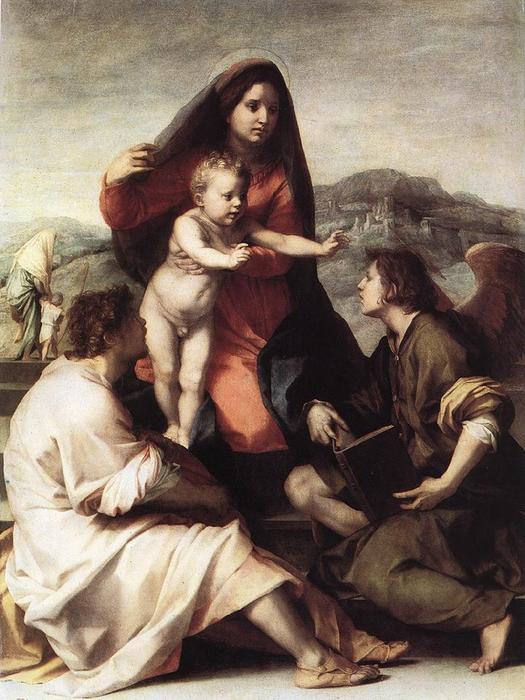
The Serene Majesty of Madonna della Scala
Andrea del Sarto’s “Madonna della Scala,” painted in 1522 for the chapel of the Scalzo family at the Ospedale della Scala in Florence, is more than just a devotional image; it's a profound meditation on grace, humility, and the delicate balance between earthly and divine realms. Commissioned by Lorenzo di Bernardo Jacopi, a wealthy banker, the painting reflects the burgeoning humanist ideals of the era while retaining a deeply rooted spiritual sensibility. The work’s placement within an orphanage—a space dedicated to nurturing young souls—elevates its significance beyond mere religious iconography, suggesting a yearning for purity and guidance.
The composition itself is remarkably sophisticated, employing a masterful use of *grisaille*, a technique favored by del Sarto – the employment of monochrome pigments. This deliberate choice emphasizes form and structure over vibrant color, lending the scene an almost sculptural quality. The figures are rendered with exquisite detail, their drapery cascading in elegant folds that seem to defy gravity. Notice particularly the subtle modeling of Mary’s face, capturing a quiet serenity and maternal tenderness. The angel's wings, delicately painted, possess an ethereal glow, hinting at his celestial origins while simultaneously grounding him within the earthly scene.
A Narrative of Family and Faith
At the heart of the composition lies the Holy Family: Mary, holding the infant Jesus, is flanked by Saint Matthew, identifiable by his scroll containing the Gospel of Matthew, and an angel. The inclusion of Saint Elizabeth, depicted kneeling and gesturing towards a young John the Baptist, adds another layer to the narrative. This scene draws upon the Proto-Gospel of James, an apocryphal text that recounts the miraculous conception of John the Baptist through Elizabeth’s union with Zechariah. The depiction of this event—a fleeing infant escaping Herod's decree—underscores themes of vulnerability, protection, and divine intervention.
Del Sarto skillfully employs perspective to create a sense of depth, drawing the viewer into the intimate tableau. The landscape in the background, rendered with atmospheric haze and distant mountains, provides a symbolic backdrop – a representation of the vastness of God’s creation and humanity's place within it. The use of light is particularly noteworthy; it illuminates the figures from an unseen source, casting gentle shadows that enhance their three-dimensionality and contribute to the painting’s overall sense of solemnity.
Symbolism and Artistic Innovation
“Madonna della Scala” is a testament to del Sarto's innovative approach to fresco painting. He masterfully integrated quotations from Michelangelo and Raphael, subtly weaving these influences into his own distinctive style. This demonstrates not only his deep understanding of the artistic canon but also his ambition to surpass his predecessors. The harmonious balance between figures and space, combined with the meticulous attention to detail, exemplifies del Sarto’s commitment to achieving a sense of visual perfection.
The painting's placement within the Ospedale della Scala—a charitable institution dedicated to caring for orphaned children—further enriches its meaning. It suggests that art can serve as a source of solace and inspiration, offering a glimpse into a world beyond earthly suffering. “Madonna della Scala” remains a powerful reminder of the enduring themes of faith, family, and the pursuit of beauty – qualities that continue to resonate with viewers centuries after its creation.
A Timeless Masterpiece
Today, “Madonna della Scala” resides in the Museo del Prado in Madrid, Spain. Its journey through history reflects the painting’s enduring appeal—from its initial commission for a wealthy banker to its eventual acquisition by the Spanish crown. Reproductions of this iconic work offer an accessible way to experience the artistry and spiritual depth of Andrea del Sarto's masterpiece. Whether displayed as a focal point in a grand salon or cherished within a smaller, more intimate space, “Madonna della Scala” continues to captivate with its serene beauty and profound message.