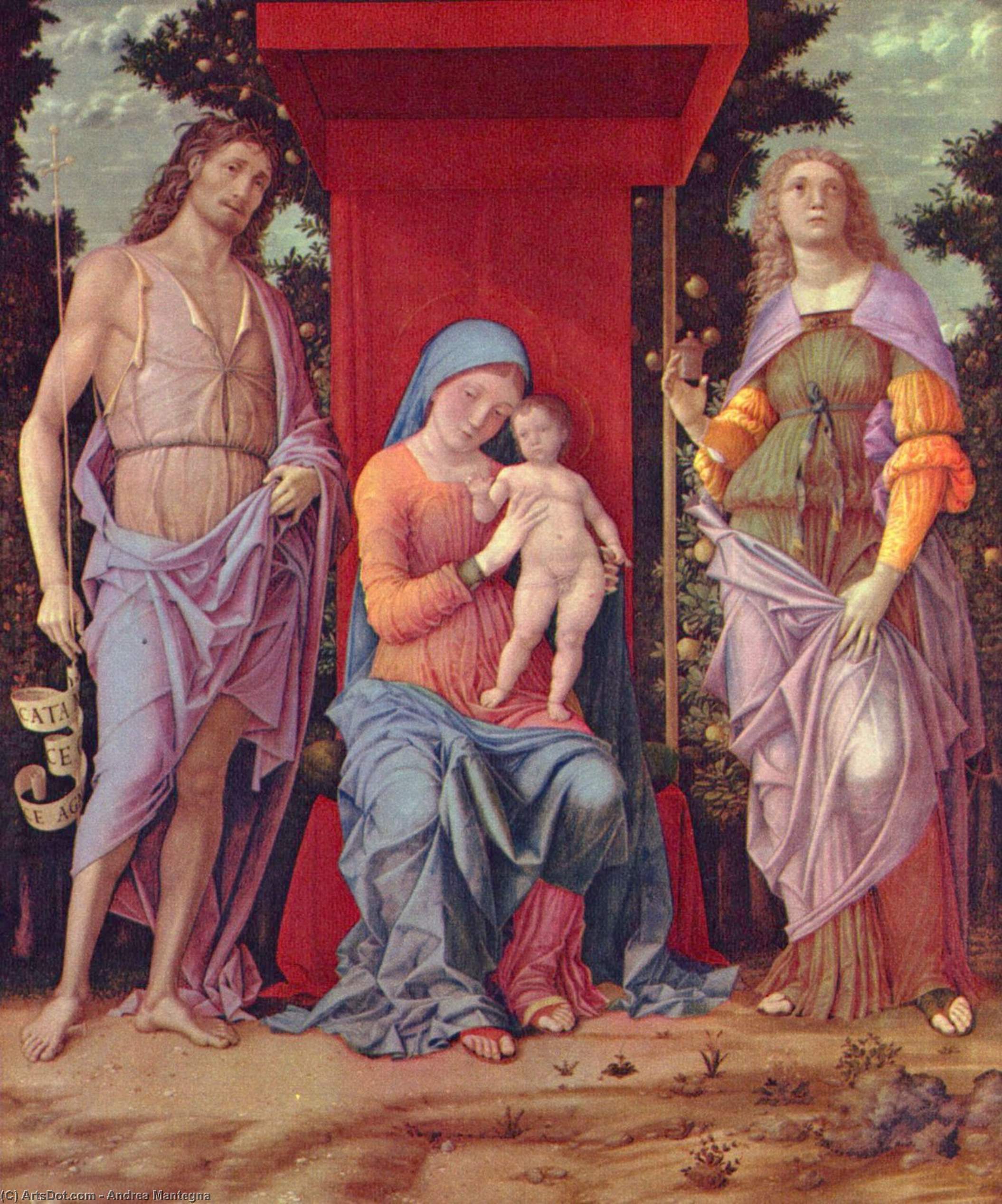
Madonna mit Hl. Maria Magdalena und Hl. Johannes dem Täufer
Andrea Mantegna (1431-1506): Renaissance master of perspective & sculptural detail. Explore iconic works like 'Lamentation' and the Camera degli Sposi!
Explore European art from the 13th-19th centuries at London's National Gallery! Discover masterpieces by Van Gogh, Rembrandt & more – free entry!
Andrea Mantegna’s Madonna mit Hl. Maria Magdalena und Hl. Johannes dem Täufer: A Masterpiece of Perspective and Symbolism
Andrea Mantegna's *Madonna mit Hl. Maria Magdalena und Hl. Johannes dem Täufer*, a tempera painting measuring 136 x 114 cm, resides within the National Gallery in London, United Kingdom—a testament to his enduring legacy as one of the foremost artists of the Renaissance. More than just a depiction of biblical figures, this artwork represents Mantegna’s groundbreaking exploration of linear perspective and his remarkable ability to conjure an illusion of depth within a seemingly flat surface. It's a visual triumph that continues to captivate viewers centuries later.
Composition and Perspective: A Revolutionary Approach
Mantegna fundamentally altered artistic conventions by meticulously adjusting the horizon line, mirroring techniques pioneered in Roman architecture—specifically the Pantheon—to imbue his canvases with an unprecedented sense of grandeur and realism. This deliberate manipulation wasn’t merely stylistic; it was driven by a profound conviction that art should strive for accuracy and fidelity to observed reality. The pyramidal composition draws the eye upwards towards Mary, emphasizing her centrality as the Virgin Mother and anchoring the scene in stability. Notice how Mantegna subtly guides our gaze across the canvas, creating an immersive experience that transcends mere representation.
Symbolism Woven into Every Detail
The painting’s rich symbolism elevates it beyond a simple narrative illustration. The inclusion of a red pillar—a deliberate reference to Roman triumphal arches—adds a striking visual contrast and underscores the solemn dignity of the occasion. Scattered apples symbolize abundance and fertility, hinting at Mary's role as Mother Earth and foreshadowing the divine promise of salvation. Furthermore, the book held by Mary Magdalene serves as a potent emblem of faith and scripture, reinforcing the spiritual significance of the scene. Each element contributes to a layered interpretation that invites contemplation and rewards careful observation.
Technique: Tempera Paint – Precision and Luminosity
Mantegna’s masterful use of tempera paint—a medium known for its brilliance and permanence—is crucial to understanding the painting's aesthetic impact. Unlike oil paints, which blend seamlessly over time, tempera pigments remain vibrant and unaltered, preserving their original luminosity for generations. Mantegna achieved this remarkable effect through painstaking layering and blending techniques, meticulously controlling pigment dispersion to achieve unparalleled tonal accuracy. The resulting surface possesses a velvety smoothness that captures the subtle nuances of light and shadow—a hallmark of Mantegna’s distinctive artistic style.
Historical Context: Renaissance Antiquity Revisited
Mantegna's artistic vision was profoundly shaped by his immersion in Roman archaeology, fueled by his marriage into the Bellini family and his unwavering fascination with classical ruins. He sought to revive the spirit of Rome within the burgeoning Italian Renaissance, mirroring the humanist ideals that championed reason and observation alongside faith. This dedication to accuracy—evident throughout *Madonna mit Hl. Maria Magdalena und Hl. Johannes dem Täufer*—reflects a broader cultural movement aimed at rediscovering and celebrating the glories of antiquity, marking Mantegna as an artist who truly embodied the transformative energy of his era.
Legacy: An Enduring Influence on Renaissance Art
Andrea Mantegna’s *Madonna mit Hl. Maria Magdalena und Hl. Johannes dem Täufer* stands as a cornerstone of Renaissance art—a masterpiece that continues to inspire artists and scholars alike. Its innovative perspective, meticulous technique, and profound symbolism solidified Mantegna's reputation as a visionary innovator who elevated painting to new heights of artistic achievement. For those seeking to appreciate the beauty and intellectual depth of this iconic artwork, exploring his other masterpieces – *The Adoration of the Magi* and *The Circumcision of Christ* – offers invaluable insight into the enduring power of Renaissance artistry.