A Renaissance Encounter: Decoding Mantegna’s ‘Mars, Venus, and Diana’
Andrea Mantegna's ‘Mars, Venus, and Diana’ is a captivating drawing that encapsulates the spirit of the Italian Renaissance – a period obsessed with classical mythology, humanism, and artistic innovation. This work isn’t merely a depiction of gods; it’s a carefully constructed narrative brimming with symbolism and emotional resonance. The artwork offers a glimpse into Mantegna's mastery of line, form, and storytelling, making it a compelling subject for art enthusiasts, collectors, and those seeking to infuse their spaces with historical elegance.
Subject & Composition: A Mythological Triangle
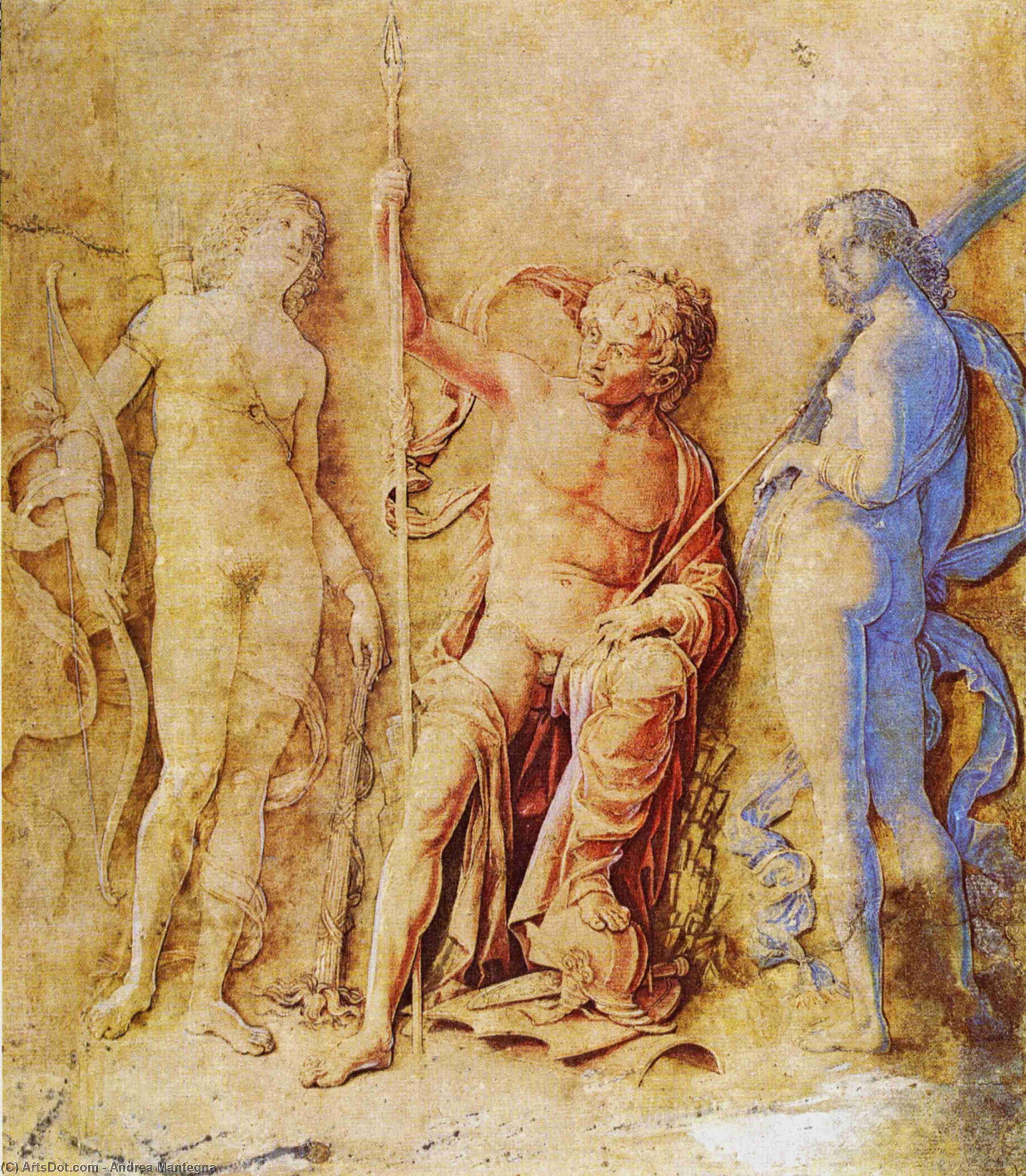
The scene unfolds with Mars, the god of war, centrally positioned and commanding attention with his spear – a symbol of strength and conflict. To his left stands Venus, goddess of love and beauty, radiating serenity and grace. On the right, Diana, the huntress and protector of wild animals, is poised with bow and arrow, embodying independence and skill. The composition isn’t simply a grouping of deities; it's a dynamic interplay of contrasting forces. Two additional figures subtly populate the scene – one near the top, perhaps an observing deity or mortal witness, and another at the bottom right, adding depth and intrigue. The inclusion of hunting tools like the bow and arrow further emphasizes themes of pursuit and power.
Style & Technique: Mantegna’s Distinctive Approach
Mantegna was renowned for his meticulous draftsmanship and innovative use of perspective. In ‘Mars, Venus, and Diana,’ this is strikingly evident. The figures are rendered with anatomical precision and a sculptural quality, reflecting Mantegna's early training as a sculptor. His technique involves delicate lines and subtle shading to create volume and form. While the exact medium remains debated (likely pen and ink with washes), the overall effect is one of refined elegance and controlled energy. This isn’t a flamboyant display of color; it’s a study in tonal variation and linear grace, characteristic of Renaissance preparatory drawings.
Historical Context & Symbolism: Echoes of Antiquity
Created during the 15th century, this artwork reflects the burgeoning humanist movement that swept through Europe. Artists and scholars alike turned to classical literature and mythology for inspiration, seeking to revive the ideals of ancient Greece and Rome. The choice of Mars, Venus, and Diana isn’t arbitrary. These deities represent fundamental aspects of human experience – war, love, and the wildness of nature. Their juxtaposition invites contemplation on the complex relationship between these forces.
The painting can be interpreted as an allegory for the balance (or imbalance) between passion, reason, and instinct.
Emotional Impact & Interpretation
‘Mars, Venus, and Diana’ evokes a sense of quiet drama and intellectual curiosity. The figures aren't engaged in overt action; their power lies in their presence and symbolic weight.
The artwork invites viewers to decipher the narrative, to consider the relationships between these powerful deities, and to reflect on the timeless themes they represent. It’s a piece that rewards close observation and encourages ongoing interpretation. The subdued palette and refined technique contribute to an atmosphere of contemplative beauty, making it suitable for both private collections and sophisticated interior designs.
Mantegna's Legacy & Related Works
Andrea Mantegna (1431-1506) was a pivotal figure in the Renaissance, known for his groundbreaking work in perspective and his ability to imbue classical subjects with emotional depth. His other masterpieces, such as ‘Judith and Holofernes’ and ‘Descent into Limbo,’ demonstrate his mastery of dramatic composition and anatomical detail. His series of 'Triumphs of Caesar' further showcases his historical insight and artistic genius. Exploring these works alongside ‘Mars, Venus, and Diana’ provides a deeper understanding of Mantegna’s unique contribution to art history.
- Judith and Holofernes: A powerful depiction of courage and triumph over adversity.
- Descent into Limbo: A haunting exploration of the afterlife and human suffering.
- Triumphs of Caesar: An ambitious series celebrating Roman power and glory.