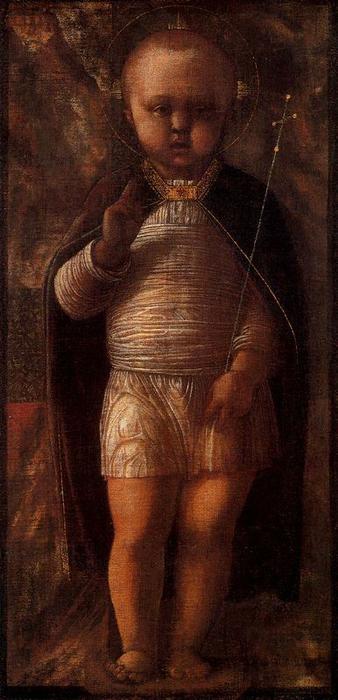
Discover Andrea Mantegna’s ‘Redentor Niño,’ a captivating Renaissance masterpiece depicting Christ as a young savior. Explore its symbolism, perspective, and the artist's unique sculptural style – a divine encounter brought to life.
Andrea Mantegna (1431-1506): Renaissance master of perspective & sculptural detail. Explore iconic works like 'Lamentation' and the Camera degli Sposi!
A Divine Encounter: Exploring Mantegna’s *Redentor Niño*
This captivating painting, *Redentor Niño* (Child Redeemer), offers a glimpse into Andrea Mantegna's masterful approach to religious iconography. While details regarding its precise date and size remain elusive, the artwork powerfully conveys a profound theological message through striking visual elements characteristic of the Italian Renaissance.
Subject & Composition
The central focus is a young Jesus Christ, depicted not as an infant in arms, but standing – a deliberate choice emphasizing his preordained role and divine authority. He holds a miniature crucifix, foreshadowing his Passion and sacrifice. The inclusion of a crown upon his head immediately elevates the scene beyond a simple childhood portrait; it signifies his kingship and messianic destiny. An angelic figure attentively watches over him, suggesting divine guardianship and protection. Further figures are subtly placed in the background – two individuals towards the upper left corner and another on the right – their presence adding depth to the narrative without distracting from the central subject. A small bird near the center introduces a delicate touch of naturalism, perhaps symbolizing peace or the Holy Spirit.
Mantegna’s Distinctive Style & Technique
Andrea Mantegna (1431-1506) was renowned for his innovative use of perspective and sculptural approach to painting. Though specifics about *Redentor Niño*'s technique are unknown, we can anticipate qualities consistent with his oeuvre. Mantegna favored a bold, volumetric treatment of form, imbuing his figures with a sense of weight and presence. His landscapes often exhibit hard, reflective surfaces, and his attention to anatomical detail is meticulous. It’s likely this work showcases similar characteristics – a robust quality in the rendering of both Jesus and the angel, and a carefully constructed spatial arrangement. Mantegna's exploration of perspective—often adjusting the horizon line—would have been employed here to create a sense of grandeur and solemnity.
Historical & Religious Context
During the Renaissance, artists frequently revisited biblical narratives, imbuing them with humanist ideals and artistic innovation. Mantegna’s work reflects this trend. The depiction of Christ as a *Redentor Niño* – a child redeemer – was not uncommon, serving to emphasize both his humanity and divinity. This image would have resonated deeply with viewers in the 15th and 16th centuries, offering a powerful symbol of hope and salvation. Mantegna’s association with the court of Mantua placed him at the heart of Renaissance artistic patronage, allowing him to experiment with new techniques and explore complex theological themes.
Symbolism & Emotional Impact
The symbolism within *Redentor Niño* is rich and layered. The crucifix represents Christ's ultimate sacrifice for humanity’s sins. The crown signifies his royal lineage and divine authority. The angel embodies divine protection and guidance. Even the bird, a common symbol of peace and the Holy Spirit, contributes to the overall message of hope and redemption.
Emotionally, the painting evokes a sense of reverence and contemplation. The direct gaze of the child Jesus, combined with the solemnity of the scene, invites viewers into a moment of profound spiritual reflection. The artwork’s power lies in its ability to convey complex theological concepts through a visually arresting and emotionally resonant image.
For Collectors & Designers
A high-quality reproduction of *Redentor Niño* would be a stunning addition to any art collection or interior design scheme. Its Renaissance aesthetic lends itself well to both traditional and contemporary settings. The painting’s rich symbolism and emotional depth make it a conversation starter, while its masterful composition ensures visual harmony and balance. Consider pairing this piece with complementary colors – deep blues, golds, and reds – to enhance its dramatic impact. Its timeless beauty will undoubtedly elevate any space.