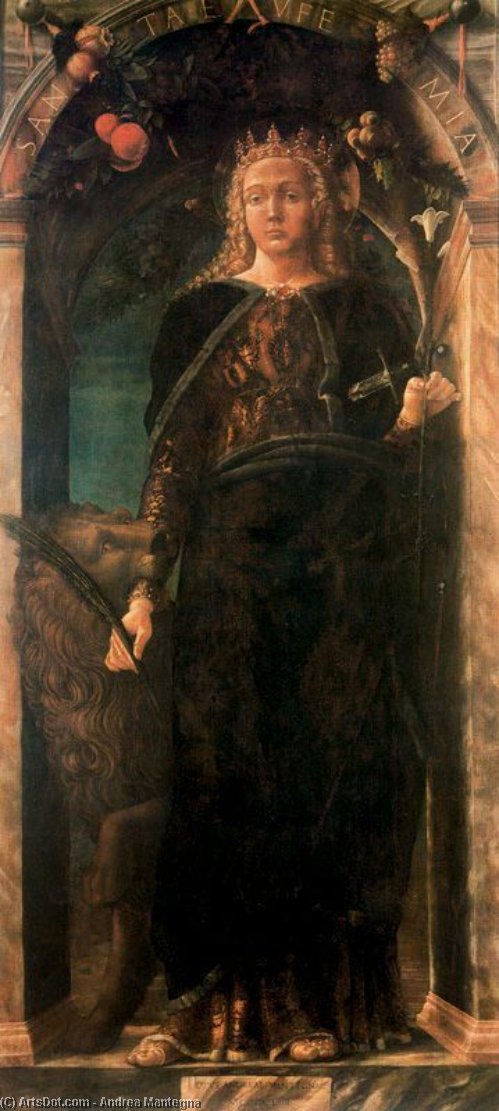
St. Eufemia: A Renaissance Echo of Antiquity
Andrea Mantegna’s St. Eufemia stands as a testament to the artist's singular devotion to reviving classical ideals within the burgeoning Italian Renaissance. More than merely replicating Roman forms, Mantegna undertook an ambitious project—a meticulous reconstruction of visual language rooted in the grandeur and precision of antiquity. This fascination wasn’t simply aesthetic; it stemmed from his formative years under Francesco Squarcione, whose workshop served as a crucible for artistic innovation, prioritizing archaeological accuracy above all else. Surrounded by fragments of Rome’s fallen glory, Mantegna conceived St. Eufemia not just as a portrait but as an embodiment of intellectual rigor and sculptural mastery—a deliberate homage to the architectural principles championed by Vitruvius.
- Subject Matter: The painting depicts Saint Euphemia, venerated as the patron saint of Padua, portrayed with serene dignity amidst a richly ornamented setting. Her gaze directs towards the viewer, conveying an aura of solemn contemplation and spiritual devotion.
- Style & Technique: Mantegna’s masterful use of linear perspective—a revolutionary achievement at the time—creates an illusionistic depth that transcends the confines of canvas. The artist employs meticulous detail in rendering textures, particularly the drapery folds and the castle-like structure behind Saint Euphemia, demonstrating a profound understanding of sculptural modeling techniques honed through his study of Roman sculptures.
- Historical Context: Painted circa 1480, St. Eufemia reflects the humanist spirit of the Renaissance, characterized by an interest in reviving classical learning and celebrating human beauty. It aligns with Mantegna’s broader artistic program—a concerted effort to emulate the monumental grandeur and intellectual sophistication of Roman art.
- Symbolism: The inclusion of apples scattered throughout the composition carries symbolic weight, representing fertility, abundance, and divine providence – concepts central to Renaissance thought. Similarly, the bird perched atop the castle symbolizes aspiration and spiritual elevation, reinforcing the painting’s overarching theme of sanctity and timeless beauty.
A Window into Roman Idealism
Mantegna's unwavering commitment to archaeological observation distinguishes him from many contemporaries who favored idealized representations divorced from verifiable reality. He painstakingly recreated architectural elements—such as arches and columns—drawing inspiration directly from Roman ruins, mirroring the artistic fervor of his time. This dedication is palpable in St. Eufemia’s backdrop – a stylized castle that echoes the monumental temples of Rome, underscoring Mantegna's ambition to recapture the spirit of antiquity.
Emotional Resonance & Artistic Legacy
Beyond its technical brilliance, St. Eufemia possesses an undeniable emotional impact. The saint’s serene countenance and unwavering gaze invite contemplation, conveying a sense of spiritual peace and reverence. Mantegna’s meticulous attention to detail—particularly in capturing the subtle nuances of drapery folds—elevates the painting beyond mere visual representation; it aspires to evoke a feeling of awe and admiration for the sublime beauty of God's creation. As a cornerstone of Renaissance art, St. Eufemia continues to inspire artists and collectors alike, serving as an enduring symbol of intellectual curiosity and artistic excellence.
Further Exploration
For those seeking deeper insight into Mantegna’s oeuvre and the broader context of Renaissance art, we encourage you to visit
Andrea Mantegna’s Artist Database or explore
Piazza Andrea Mantegna in Mantua, Italy—home to Mantegna's Camera Picta and Basilica di Sant'Andrea. Don’t miss the opportunity to immerse yourself in the artistic heritage of this remarkable Renaissance master!