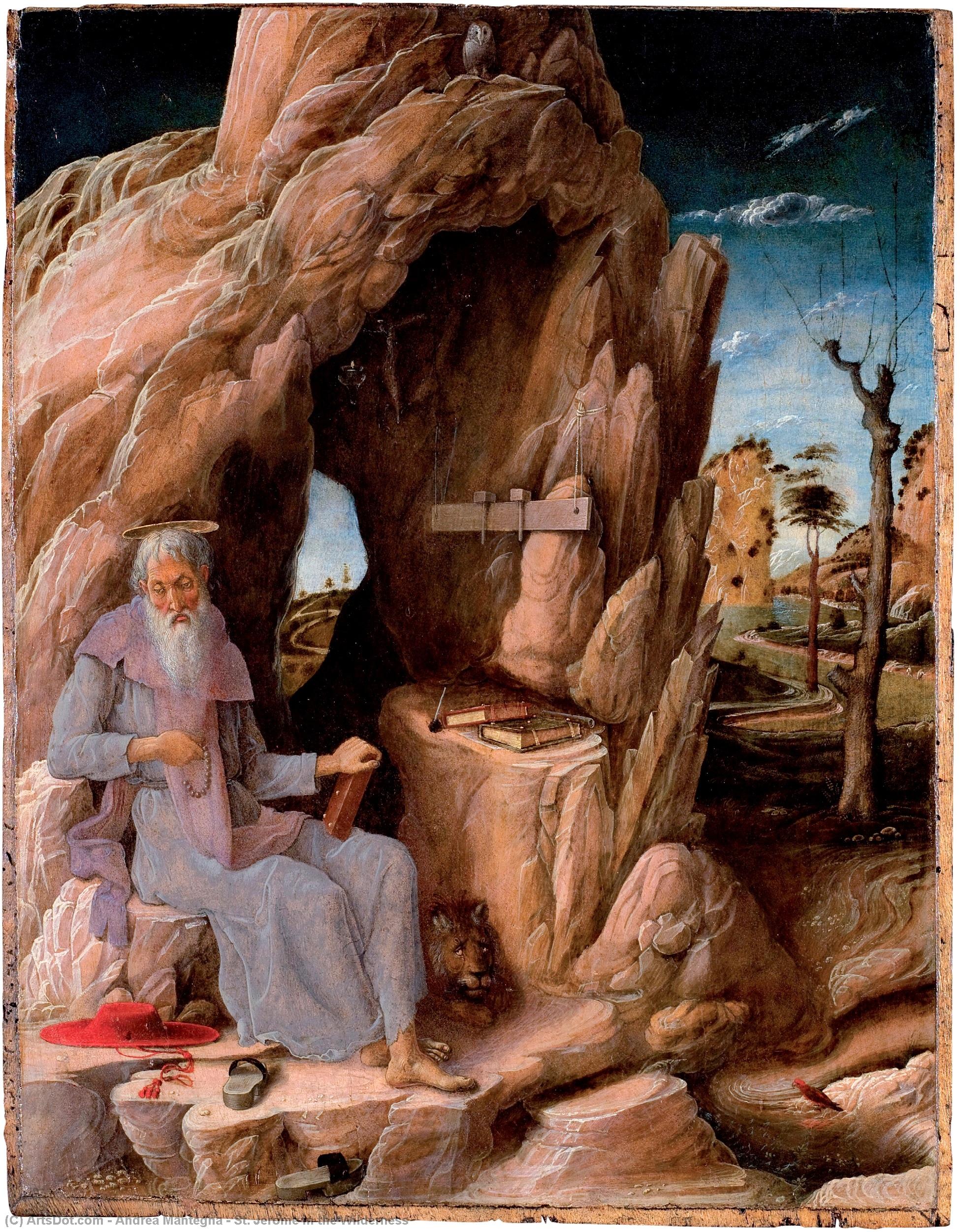
A profound sense of solitude permeates Andrea Mantegna's 1448 masterpiece St. Jerome in the Wilderness, where Renaissance precision meets classical idealism, inviting you to explore this timeless work of devotion.
Andrea Mantegna (1431-1506): Renaissance master of perspective & sculptural detail. Explore iconic works like 'Lamentation' and the Camera degli Sposi!
A Testament to Solitude and Classical Idealism: Exploring Andrea Mantegna’s St. Jerome in the Wilderness
Andrea Mantegna's "St. Jerome in the Wilderness," painted in 1448, transcends mere depiction; it embodies a profound philosophical statement woven into the fabric of Renaissance artistic expression. More than just a portrait of Saint Jerome—a figure revered for his ascetic devotion and biblical scholarship—the painting represents a cornerstone of Mantegna’s unwavering commitment to reviving the grandeur of Roman antiquity within the burgeoning humanist movement. This remarkable tempera on panel artwork, currently residing in the Museu de Arte Sao Paulo, Brazil, offers an unparalleled glimpse into the artistic sensibilities of its time.
The Scene: A Landscape Steeped in Symbolism
The composition immediately arrests the viewer’s gaze with its masterful use of perspective—a technique pioneered by Mantegna and firmly establishing itself as a hallmark of Renaissance art. Jerome is positioned prominently on a rocky outcrop, bathed in diffused light that lends an ethereal quality to the scene. He sits motionless, his head bowed downwards, suggesting deep contemplation or prayer – actions central to Jerome’s spiritual life and mirroring the contemplative stance favored by classical sculpture. Surrounding him are sparse rocks and a cave, deliberately chosen elements that underscore Jerome's isolation from worldly distractions and symbolize the desert landscape of his pilgrimage—a visual representation of inner struggle and divine communion. The subtle inclusion of a boat in the distant background adds another layer of complexity, hinting at both geographical location (likely near the Adriatic Sea) and perhaps representing the journey of faith itself.
Mantegna’s Technique: Sculptural Precision and Atmospheric Depth
Mantegna's artistic prowess is evident in every brushstroke. He meticulously renders textures with astonishing accuracy—the rough surface of the rock, the folds of Jerome’s robe—creating a palpable sense of physicality that contrasts sharply with the idealized forms prevalent in earlier art. The artist skillfully employs chiaroscuro – dramatic interplay between light and shadow – to sculpt Jerome's figure and imbue the landscape with atmospheric depth. This technique wasn’t merely aesthetically pleasing; it was fundamentally rooted in Mantegna’s meticulous study of Roman sculpture, where artists painstakingly recreated three-dimensional forms on a two-dimensional surface. The careful layering of colors contributes to this illusion of depth, enhancing the painting's emotional impact and conveying Jerome’s inner turmoil with understated grace.
Historical Context: Renaissance Revival and Humanist Ideals
Painted during the High Renaissance, “St. Jerome in the Wilderness” reflects the broader humanist preoccupation with reviving classical ideals—particularly those championed by Plato and Aristotle—and celebrating human reason alongside divine faith. Mantegna's work stands as a testament to the intellectual ferment of Padua at the time, where scholars were actively engaged in rediscovering lost texts and reconstructing knowledge from antiquity. Jerome’s depiction aligns perfectly with this humanist ethos: he embodies moral fortitude, intellectual contemplation, and unwavering devotion—qualities considered essential for achieving spiritual enlightenment. The painting serves as a powerful reminder that art could not only reflect beauty but also communicate profound philosophical truths.
Emotional Resonance: A Portrait of Inner Reflection
Ultimately, “St. Jerome in the Wilderness” succeeds in capturing a deeply felt emotion – solitude – coupled with an unwavering belief in divine grace. Mantegna’s masterful execution compels viewers to contemplate themes of faith, perseverance, and the pursuit of inner peace. The painting's quiet dignity speaks volumes about the artist’s conviction that true spiritual fulfillment resides not in outward grandeur but in inward contemplation. It remains a timeless masterpiece, inviting us to revisit its enduring beauty and consider its profound message about the human condition.