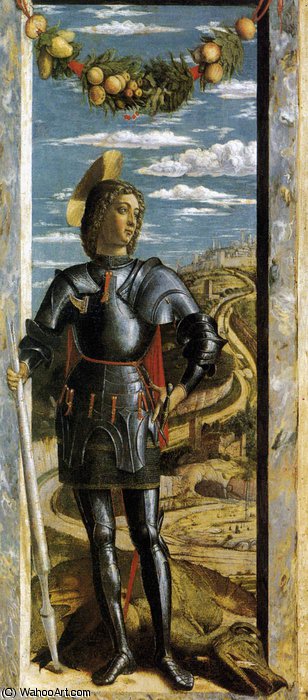
This stunning reproduction captures Andrea Mantegna’s iconic ‘St. George,’ a testament to his dedication to archaeological accuracy and sculptural realism—a hallmark of his artistic vision. Inspired by the Roman ruins he studied alongside Francesco Squarcione, Mantegna brilliantly blends classical ideals with humanist sensibilities.
Until 1470 – St George: A Testament to Roman Echoes
Andrea Mantegna’s “St George,” painted around 1467, isn't merely a depiction of a chivalric legend; it’s an audacious declaration of artistic ambition—a fervent return to the grandeur and precision of antiquity. This monumental fresco, housed in Padua’s Cappella Santissima Vergine della Madonna delle Grazie, exemplifies Mantegna’s singular approach to painting: he didn’t simply imitate classical ideals; he painstakingly reconstructed them, channeling the spirit of Rome into a canvas that transcends its time.
- Subject Matter & Narrative: The artwork portrays St George slaying the dragon, a cornerstone of Christian iconography symbolizing courage and triumph over evil. However, Mantegna elevates this familiar tale beyond mere storytelling by imbuing it with an unsettling stillness—a deliberate rejection of the dynamism favored by many contemporaries.
- Style & Technique – Sculptural Illusion: What distinguishes “St George” is its masterful manipulation of perspective. Mantegna employs a technique known as *trompe l'oeil*, creating an illusion of depth that mimics the monumental scale of Roman temples and basilicas. The figures appear to emerge from the wall itself, blurring the boundaries between painting and sculpture—a stylistic hallmark that reflects Mantegna’s profound admiration for classical architecture.
- Material & Color Palette – Restrained Elegance: Painted in tempera on plaster, Mantegna utilized a palette characterized by muted earthy tones—ochres, siennas, and umbers—reflecting the influence of Roman frescoes. These colors contribute to an atmosphere of solemn contemplation, emphasizing the spiritual significance of the scene rather than indulging in flamboyant ornamentation.
- Historical Context – The Renaissance Forge: Padua during Mantegna’s era was a crucible of artistic innovation, fueled by the rediscovery of classical ruins and texts. The artist's workshop served as an epicenter for scholarly debate and experimentation, mirroring the broader intellectual currents shaping the Early Renaissance. This context underscores the importance of Mantegna’s unwavering commitment to archaeological accuracy—a pursuit that distinguishes him from many artists preoccupied with fashionable trends.
Symbolism: Beyond Mythic Confrontation
The inclusion of apples – one on each side of St George – carries a potent symbolic resonance. Apples have long been associated with immortality and Edenic innocence, representing the triumph of virtue over temptation. Their placement strategically frames the dragon slaying, reinforcing the narrative’s moral dimension and highlighting St George's unwavering devotion to his faith.
- The Dragon: Representing evil and pagan idolatry, the dragon embodies the forces opposing Christian righteousness. Its depiction is deliberately stylized—a simplified form that prioritizes expressive gesture over anatomical realism—emphasizing its symbolic role rather than engaging in detailed observation of reptilian anatomy.
- St George’s Armor: Mantegna meticulously renders St George's armor with painstaking detail, mirroring the sculptural precision characteristic of Roman sculpture. This deliberate stylistic choice underscores the artist’s desire to emulate classical ideals and imbue his work with a sense of timeless grandeur.
Emotional Impact – A Moment Frozen in Time
"St George" transcends its narrative content to evoke a profound emotional response—one of solemn contemplation and spiritual reverence. Mantegna's masterful use of perspective creates an immersive experience for the viewer, transporting them back to the grandeur of ancient Rome while simultaneously anchoring them in the immediacy of the biblical tale. The painting’s stillness speaks volumes about Mantegna’s conviction that art should inspire awe and elevate the soul—a testament to his enduring legacy as a pioneer of Renaissance artistic innovation.