The Virgin and Child with Saint Anne (Leonardo): This unfinished masterpiece by Leonardo da Vinci depicts Saint Anne, Mary, and Jesus holding a lamb symbolizing Christ's Passion. Commissioned for Santissima Annunziata in Florence, it exemplifies Leonardo’s fascination with Roman antiquity and sculptural illusion.
A Renaissance Echo: Exploring Andrea Mantegna’s Virgin and Child with Saint Anne
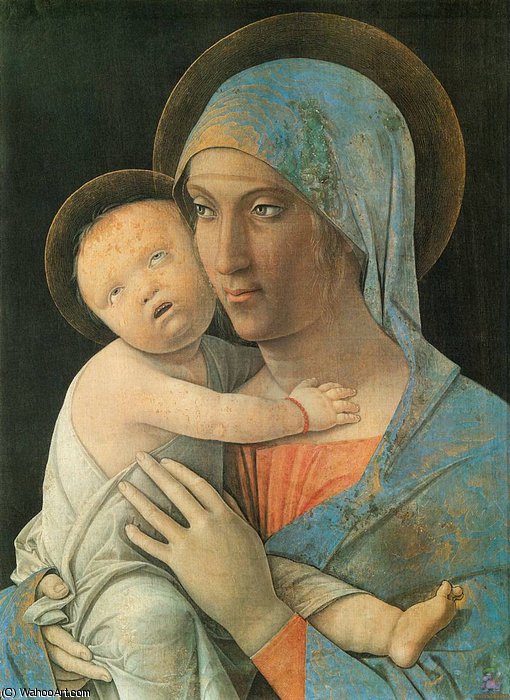
Andrea Mantegna's "Virgin and Child with Saint Anne" isn’t merely a depiction of biblical figures; it’s a testament to an artistic obsession—a deliberate confrontation with the grandeur of antiquity that fundamentally reshaped the visual landscape of Renaissance Italy. Painted around 1495-1506, this monumental altarpiece transcends simple representation, embodying Mantegna's unwavering commitment to archaeological precision and elevating Christian iconography into something profoundly sculptural and psychologically resonant.
- The Archaeological Impulse: Mantegna’s formative years under Francesco Squarcione instilled in him a singular conviction—that true artistic inspiration resided not just in idealized beauty but in the meticulous study of Roman ruins. The workshop itself served as an academy, immersing students like Mantegna in the tangible fragments of imperial Rome—columns, sculptures, and inscriptions—inspiring them to emulate their sculptural qualities and dramatic perspective.
- Stylistic Innovation: Unlike many artists of his time who adhered to prevailing stylistic conventions, Mantegna deliberately rejected Mannerism’s exaggerated poses and distortions. Instead, he championed a style characterized by monumental scale, flattened perspective, and an almost unnerving realism—a technique honed through painstaking observation and informed by the principles of linear perspective rediscovered by Filippo Brunelleschi.
Compositional Drama: Sculptural Form Meets Illusionistic Depth
The painting’s impact derives significantly from its masterful composition. Mantegna employs a flattened perspective—a technique borrowed directly from Roman sculpture—creating an illusion of depth that simultaneously anchors the figures in space and emphasizes their sculptural presence. Saint Anne, Mary, and Jesus are depicted as if carved from stone, their bodies rendered with astonishing anatomical accuracy. This deliberate stylistic choice wasn’t simply about replicating classical forms; it was about conveying a sense of solemn dignity and spiritual contemplation—a reflection of Mantegna's profound respect for the artistic heritage of Rome.
- Symbolic Resonance: The inclusion of the lamb symbolizes Christ’s sacrifice, echoing biblical imagery prevalent in Roman art. Furthermore, Saint Anne’s posture—kneeling with her daughter and grandson—represents humility and maternal devotion—themes central to Christian piety during the Renaissance.
- Emotional Impact: Mantegna's masterful rendering of facial expressions conveys a palpable sense of tenderness and serenity. The gaze of Mary is particularly arresting, conveying an inner stillness that speaks volumes about her unwavering faith and compassion—a quality that continues to captivate viewers centuries later.
Legacy and Influence: Shaping the Visual Language of Renaissance Art
“Virgin and Child with Saint Anne” stands as a cornerstone of Mantegna’s oeuvre and exerted considerable influence on subsequent generations of artists. Its sculptural form, dramatic perspective, and psychological realism established new standards for religious painting—inspiring painters like Leonardo da Vinci and Raphael to explore similar stylistic innovations. Today, reproductions of this iconic artwork serve as enduring reminders of Mantegna's pioneering spirit and his unwavering devotion to the artistic ideals of antiquity—a testament to the transformative power of observation and the enduring beauty of classical inspiration.