A Vision of Romantic Mystery: Anne-Louis Girodet’s “Nymph”
Anne-Louis Girodet de Roussy-Trioson's "Nymph," painted in 1800, isn’t merely a depiction of a beautiful woman; it’s a carefully constructed tableau brimming with the anxieties and aspirations of early Romanticism. Born into a world shaped by loss – orphaned at a young age and raised under the watchful eye of his physician guardian – Girodet's artistic journey was marked by a profound sensitivity to emotion, a trait he would later fuse with the rigorous training instilled in him by Jacques-Louis David. This painting, housed within the Louvre’s collection, stands as a pivotal bridge between the formality of Neoclassicism and the burgeoning emotionalism that defined the Romantic era, offering a glimpse into a world where nature, beauty, and melancholy intertwine.
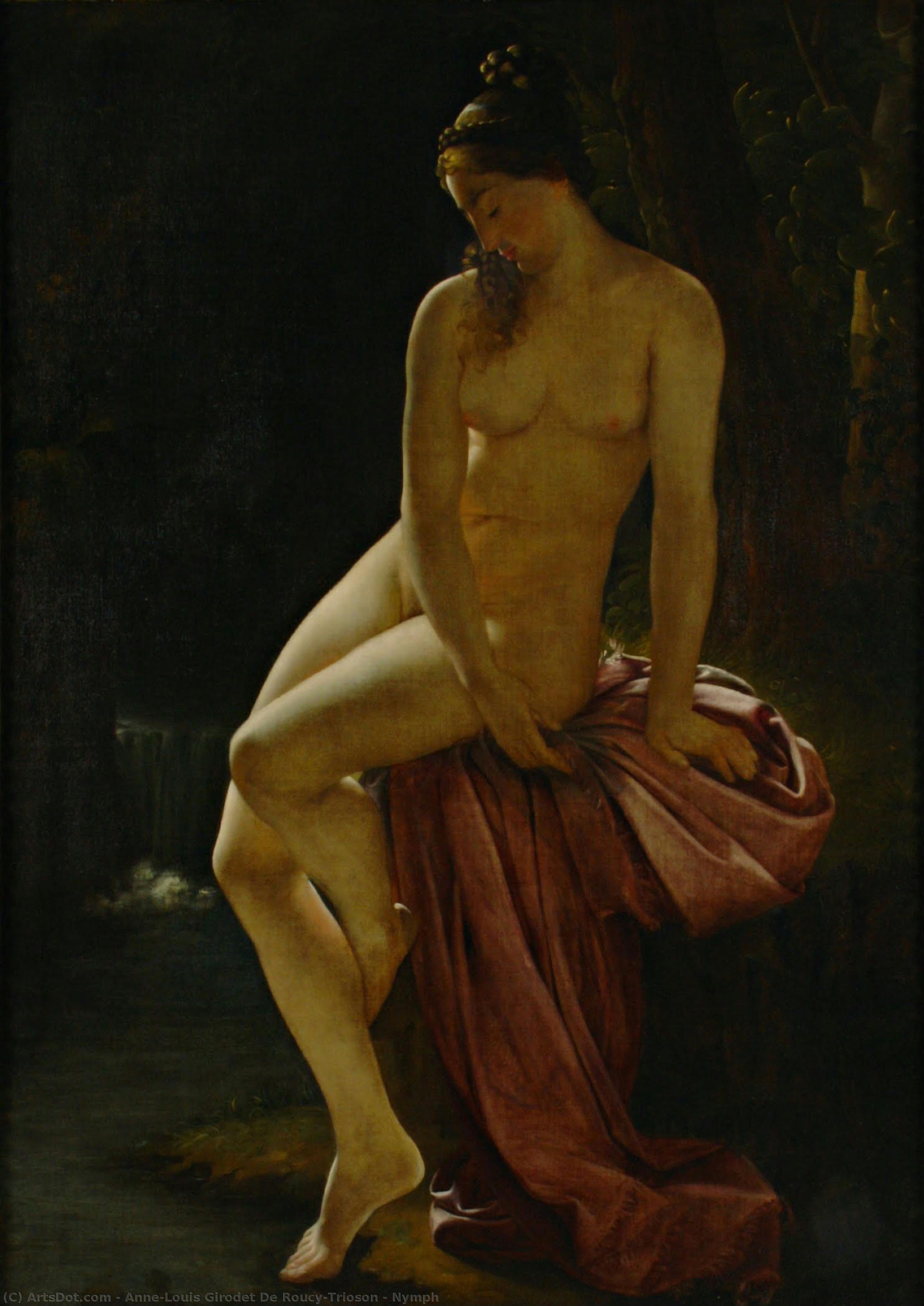
The subject herself is presented with an arresting blend of vulnerability and power. A nude female figure, identified as a Nymph – a creature deeply rooted in Greek mythology, associated with springs, rivers, and the wildness of nature – occupies the central space of the composition. She’s positioned slightly off-center, lending a sense of quiet contemplation to her posture. Her gaze is directed downwards, almost lost in the shadowed depths of the forest, inviting the viewer into an intimate, introspective experience. The lighting, dramatically employed by Girodet, sculpts her form with stark contrasts – pools of light illuminating her skin while leaving much of the background shrouded in darkness. This masterful use of chiaroscuro not only emphasizes the figure’s physicality but also contributes to the painting's overall mood of mystery and longing.
The Language of the Forest: Technique and Composition
Girodet’s technical skill is immediately apparent in the meticulous detail with which he renders both the human form and the surrounding landscape. The oil paint technique, executed with a rich layering of glazes and scumbling, creates an astonishingly tactile surface – one that invites close inspection. The brushstrokes themselves are visible, contributing to a sense of volume and realism, yet never sacrificing the painting’s ethereal quality. Notice particularly the careful rendering of the drapery; it flows organically around the figure, suggesting both movement and restraint. The composition is carefully balanced, utilizing atmospheric perspective – the gradual fading of detail in the distance – to create an illusion of depth that pulls the viewer into the heart of the forest.
The background isn’t simply a backdrop; it's an active participant in the narrative. Dense foliage, rendered with remarkable precision, dominates the scene, creating a sense of enclosure and isolation. The trees themselves seem to lean inwards, almost as if guarding the Nymph within her secluded realm. This deliberate use of landscape reinforces the painting’s themes of nature, solitude, and perhaps even vulnerability – suggesting that she is both embraced by and threatened by the wildness surrounding her.
Symbolism and Romantic Ideals
“Nymph” resonates deeply with the core tenets of Romanticism. The nude figure itself represents a rejection of the rigid moral constraints of Neoclassicism, embracing instead an idealized vision of beauty and sensuality. The forest, often associated with the subconscious and the untamed spirit, symbolizes freedom, mystery, and the power of nature. The Nymph’s downward gaze speaks to introspection and perhaps even melancholy – a common theme in Romantic art, reflecting a heightened awareness of human emotion and the complexities of the inner world.
Furthermore, the painting can be interpreted as an exploration of the relationship between humanity and nature. The Nymph is not simply a beautiful woman; she’s a manifestation of the natural world itself – a symbol of its beauty, its power, and its inherent mystery. Girodet's work reflects a shift away from the rationalism of the Enlightenment towards a more intuitive and emotional understanding of the human experience.
A Timeless Masterpiece: Reproduction and Legacy
“Nymph” remains a captivating artwork, offering viewers a glimpse into the artistic sensibilities of early 19th-century France. Its evocative imagery, masterful technique, and profound symbolism continue to resonate today. ArtsDot offers high-quality reproductions that faithfully capture the painting’s rich textures, dramatic lighting, and emotional depth, allowing you to bring this timeless masterpiece into your home or office. Whether you are an art collector, a design enthusiast, or simply someone seeking inspiration, “Nymph” is a testament to the enduring power of Romantic art.