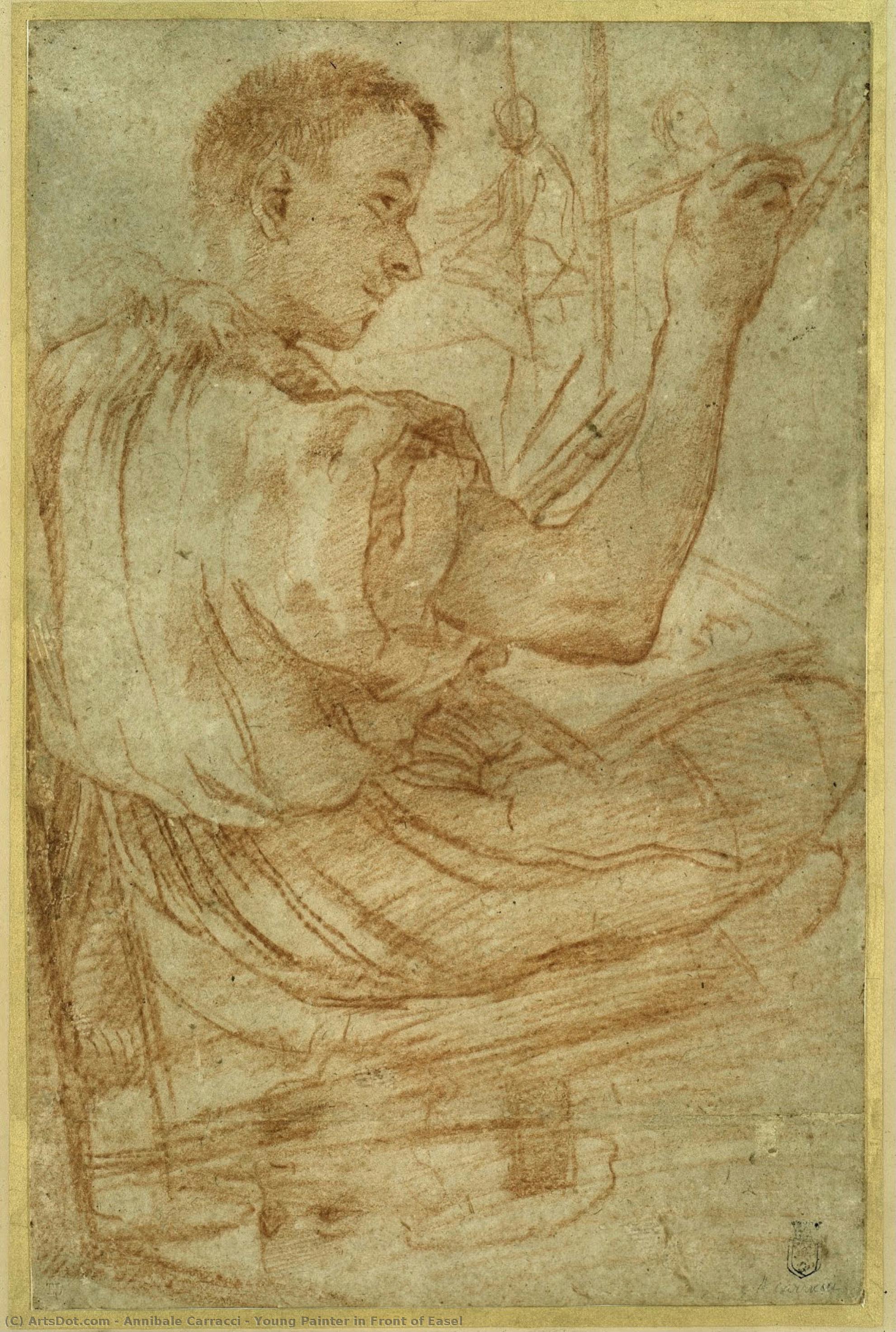
Experience Carracci's naturalism in Young Painter in Front of Easel; discover the Renaissance spirit of Bologna art by owning this masterpiece reproduction.
Eclectic blend of Florentine linear draftsmanship and Venetian color/atmospheric effects; revival of High Renaissance ideals.
Explore the Kupferstichkabinett's stunning collection of prints & drawings spanning centuries! Discover masterpieces by Dürer, Rembrandt & more in Berlin’s vibrant art museum.
A Window into Artistic Process: Annibale Carracci’s “Young Painter in Front of Easel”
The painting "Young Painter in Front of Easel" by Annibale Carracci, a deceptively simple depiction of a solitary artist engaged in his craft, transcends its apparent modesty to offer a profound glimpse into the burgeoning spirit of Renaissance innovation. Completed sometime around 1603-1604, this artwork resides within the New Hermitage Building of Saint Petersburg’s Hermitage Museum, serving as a testament to Carracci's enduring influence on artistic history. Its unassuming composition belies an ambitious conceptual underpinning—a deliberate exploration of the artist’s role and a pivotal contribution to establishing a new paradigm for visual art.
The Genesis of Representation: Technique and Style
Carracci’s masterful execution exemplifies the stylistic ideals championed by his fellow Bolognese artists – Agostino and Ludovico Carracci – who sought to recapture the grandeur of Michelangelo and Raphael while simultaneously grounding their vision in observation and naturalism. The painting is rendered in oil on panel, a technique favored during this period for its ability to achieve luminous color palettes and subtle tonal gradations. Notice the meticulous attention to detail; the artist’s hand deftly captures the textures of the easel, sketchbook, and clothing, demonstrating Carracci's commitment to realism. Furthermore, the painting adheres closely to the principles of *Chiaroscuro*, a technique pioneered by Leonardo da Vinci that utilizes dramatic contrasts between light and shadow to sculpt form and convey emotion—a hallmark of Mannerist art but subtly tempered with Renaissance humanist ideals.
Historical Context: Beyond Virtuosity – A New Artistic Vision
“Young Painter in Front of Easel” emerges from a crucial juncture in artistic history, marking a decisive break from the prevailing Mannerist preoccupation with stylized poses and exaggerated gestures. The Carraccis vehemently rejected the notion that an artist’s worth was solely measured by technical prowess—the celebrated ‘virtuoso’ ideal—arguing instead for a more holistic understanding of artistic endeavor. This painting encapsulates this shift, portraying not merely a craftsman at work but also a self-aware figure contemplating the creative process itself. It speaks to the burgeoning humanist interest in depicting human experience with honesty and psychological depth – an ambition that would become central to subsequent artistic movements.
Symbolism: The Artist as Mediator
The artist’s posture—seated before his easel, sketchbook resting on his knees—is laden with symbolic significance. He is depicted not as a detached genius but as actively engaged in bridging the gap between nature and art. The sketchbook represents the initial conceptual stage of creation, while the mahlstick serves as an instrument for transferring the drawing onto the canvas – mirroring the entire artistic journey from conception to execution. This visual metaphor underscores the Carraccis’ belief that art should strive for clarity and directness, rejecting the convoluted complexities characteristic of earlier Mannerist styles.
Emotional Resonance: Quiet Contemplation and Artistic Integrity
Ultimately, “Young Painter in Front of Easel” resonates with a profound sense of quiet contemplation and artistic integrity. The artist's gaze directs outwards, suggesting an awareness of his role as a conduit between the natural world and artistic expression. This understated depiction invites viewers to consider not just what is seen but also *how* it is seen—a testament to Carracci’s enduring legacy as one of the architects of a new era in Western art. It remains a powerful reminder that true artistry lies not merely in technical skill but in conveying profound ideas and emotions with unwavering sincerity.