The Vision of Anthony Sandys
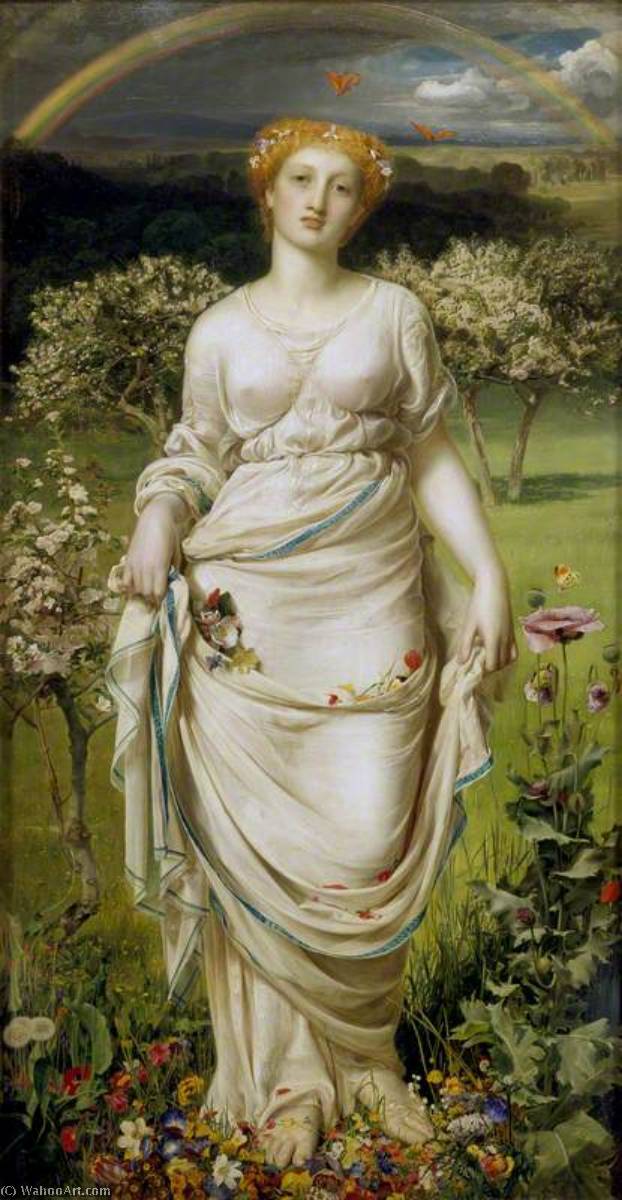
Anthony Frederick Augustus Sandys’s “Gentle Spring,” painted in 1865, isn't merely a depiction of springtime; it’s an immersive experience, a carefully constructed tableau designed to evoke serenity and the cyclical beauty of nature. Commissioned for the Royal Academy exhibition, this oil on canvas immediately draws the viewer into a world steeped in Pre-Raphaelite ideals – a reverence for detail, a fascination with mythology, and a deep connection to the natural world. Sandys, deeply influenced by his friend Dante Gabriel Rossetti, masterfully employs a luminous palette of greens, blues, and yellows, creating an atmosphere that feels both idyllic and subtly melancholic. The painting’s composition is deliberately balanced, guiding the eye through a carefully arranged landscape, culminating in the central figure – a woman embodying the spirit of spring herself.

(Image source: Victorian Web)
A Figure of Myth and Renewal
At the heart of “Gentle Spring” stands a young woman, her reddish-haired beauty framed by a crown of delicate snowdrops – a potent symbol of rebirth and new beginnings. Her flowing gown, rendered in soft whites and blues, suggests both classical grace and a connection to the earth. She’s not simply standing; she's actively engaged with the landscape, holding a ribbon and a branch, gestures that speak to her role as a conduit between the human world and the natural realm. The inclusion of butterflies – symbols of transformation and fleeting beauty – further reinforces this theme. Many art historians believe this figure represents Proserpina, Queen of the Underworld, returning from her annual descent into the darkness, thus embodying the promise of spring’s arrival.
Technique and Detail: A Pre-Raphaelite Approach
Sandys's meticulous technique is immediately apparent. Every element – the texture of the grass beneath the woman’s feet, the delicate folds of her gown, the intricate details of the flowers – has been rendered with painstaking precision. This commitment to realism, characteristic of the Pre-Raphaelites, contrasts sharply with the often idealized representations found in earlier art movements. The artist utilizes a layering technique, building up color and form through numerous thin glazes, creating a remarkable sense of depth and luminosity. Notice how light filters through the trees, casting dappled shadows across the landscape – a testament to Sandys’s understanding of atmospheric perspective. The use of complementary colors—the vibrant reds of the flowers against the cool blues of the sky—further enhances the painting's visual impact.
Historical Context and Legacy
“Gentle Spring” was created during a period of significant artistic experimentation in England, as the Pre-Raphaelite Brotherhood challenged established conventions. Sandys’s work reflects this spirit of innovation, embracing Romantic ideals while rejecting the artificiality of academic art. The painting resides within the Ashmolean Museum of Art and Archaeology in Oxford, a testament to its enduring value. Sandys's life was marked by both artistic success and personal tragedy, including his long-term relationship with Mary Emma Jones, who inspired many of his works. His legacy continues to resonate today, inspiring artists and collectors alike with his masterful command of color, composition, and symbolism.