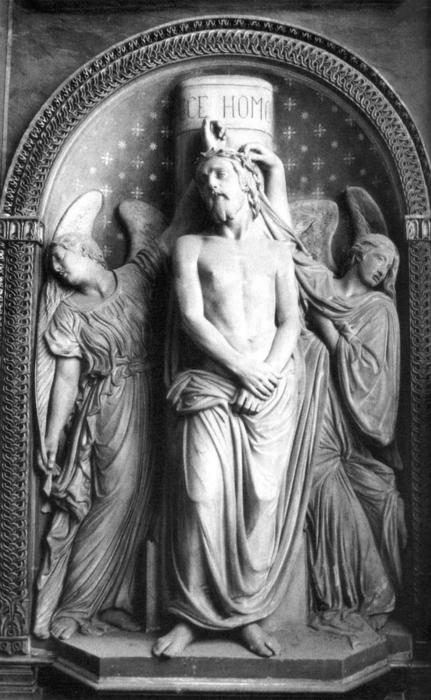
Explore Antoine Étex's 'Ecce Homo,' a monumental marble sculpture depicting Jesus Christ crowned with thorns and symbolizing divine presence, reflecting Neoclassical ideals.
Antoine Étex’s Ecce Homo: A Testament to Neoclassical Grace Amidst Romantic Intrigue
Antoine Étex (1808-1888) stands as a pivotal figure in the transition from the rigid formalism of Neoclassicism to the expressive fervor of Romanticism within French art. While not a revolutionary innovator, Étex’s artistic legacy resides in his masterful ability to synthesize these opposing stylistic currents—a skill evident throughout his oeuvre and particularly poignant in “Ecce Homo,” a monumental marble sculpture group completed in 1856.
- Subject Matter: The artwork depicts Jesus Christ presented to the crowd (“Ecce Homo”), a scene directly drawn from Holy Scripture—a cornerstone of Christian iconography. This depiction embodies profound theological significance, conveying themes of humility, acceptance, and divine grace.
- Style & Technique: Étex’s approach firmly anchors itself in Neoclassical principles – symmetry, idealized forms, and meticulous attention to classical architectural references. However, subtle nuances betray a burgeoning Romantic sensibility, notably in the drapery of the angels which possesses an ethereal fluidity contrasting sharply with the sculpture's angular contours. The sculptor skillfully employed traditional carving techniques, utilizing marble dust and chisels to achieve remarkable detail and textural richness.
Architectural Context & Compositional Harmony
“Ecce Homo” isn’t merely a sculptural representation; it’s an integral part of Saint-Eustache Church in Paris, commissioned during the Second Empire—a period characterized by opulent patronage and ambitious architectural projects. The sculpture's placement within the arched basilica underscores its grandeur and reinforces the overarching sense of solemnity. Étex meticulously crafted the composition to achieve visual balance, centering Jesus’ figure amidst three angelic attendants. This deliberate arrangement reflects the humanist ideals prevalent in Neoclassical art while simultaneously conveying a spiritual depth characteristic of Romanticism.
Symbolic Resonance & Emotional Impact
The raised arms of Jesus are laden with symbolic weight—representing surrender to divine will and acceptance of suffering. The angels flanking Christ embody divine compassion and protection, reinforcing the artwork’s emotional core: reverence for faith and contemplation on themes of sacrifice and redemption. Étex's masterful manipulation of light and shadow enhances these emotive qualities, creating dramatic contrasts that illuminate Jesus’ face and upper body—a deliberate artistic choice designed to evoke a visceral response from the viewer.
A Legacy of Tradition Revisited
Ultimately, “Ecce Homo” exemplifies Étex's enduring contribution to French art history. He didn’t shatter conventions but skillfully adapted them to express the evolving spiritual and aesthetic sensibilities of his time—a testament to artistic integrity and a celebration of classical beauty infused with Romantic passion. Its enduring presence in Saint-Eustache Church serves as a tangible reminder of Étex's profound influence on French artistic culture.