A Moment of Quiet Contemplation
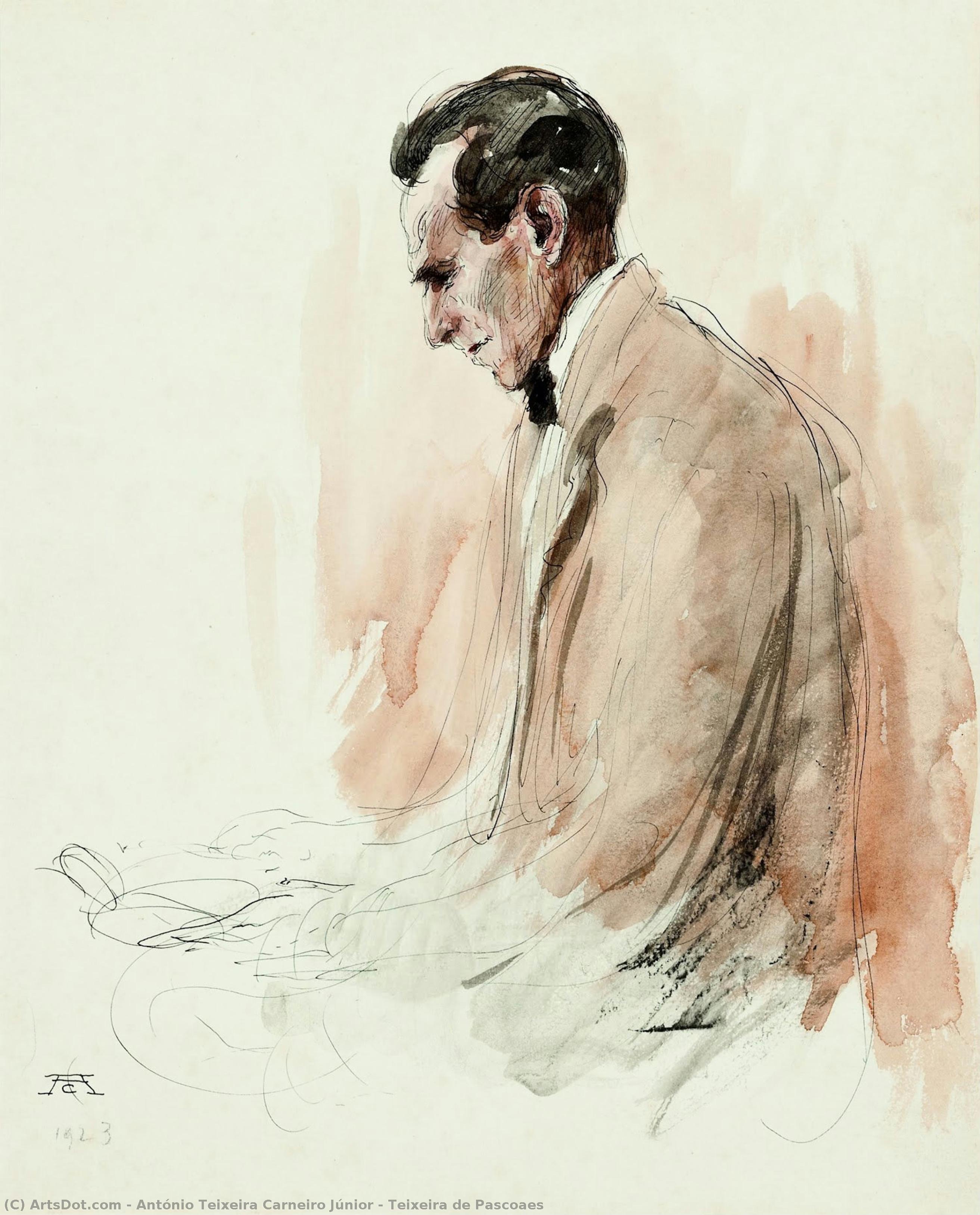
In the delicate, translucent layers of his 1923 watercolor, António Teixeira Carneiro Júnior captures more than just a likeness; he captures a soul in repose. The portrait of Teixeira de Pascoaes presents a man of profound gravity, seated at a desk with a posture that suggests a heavy, thoughtful stillness. Clad in the formal attire of the early twentieth century, the subject’s downward gaze and resting hands invite the viewer into a private sanctuary of reflection. There is an undeniable elegance to the scene, where the structured formality of the suit and tie meets the soft, ethereal quality of the watercolor medium, creating a tension between the external social persona and the internal world of thought.
The composition utilizes the desk as a grounding element in the lower portion of the frame, providing a stable foundation for the subject's contemplative presence. The subtle inclusion of chairs flanking the central figure adds a sense of depth and architectural space to the setting, suggesting a room filled with history and quietude. Through the masterful use of light and shadow, Carneiro Júnior breathes life into the paper, allowing the edges of the figure to blend softly with the surrounding atmosphere, much like a memory beginning to fade at its borders.
The Mastery of Portuguese Expressionism
To understand this piece is to understand the poignant biography of its creator. Born in Amarante and shaped by the solitude of an orphanage, António Teixeira Carneiro Júnior infused his work with a unique psychological depth that became a hallmark of Portuguese Expressionism. In Teixeira de Pascoaes, we see the artist's ability to translate personal themes of loss and spirituality into a visual language of light and shadow. The watercolor technique, often associated with lightness, is used here with unexpected weight, employing subtle washes to build a sense of volume and emotional density.
The historical context of 1923 provides a window into an era of transition, where the traditional portraiture of the past began to merge with the more emotive, subjective explorations of the modern age. For the collector or art enthusiast, this work serves as a bridge between these two worlds. It is not merely a depiction of a man, but a study of the human condition—the way we carry our burdens and our reflections within the formal structures of society. The vintage aesthetic of the watercolor lends the piece an heirloom quality, making it a timeless addition to any curated collection.
An Elegant Addition to Sophisticated Interiors
For interior designers and connoisseurs of fine art, this reproduction offers a sophisticated focal point that commands attention through subtlety rather than spectacle. The muted palette and soft textures of the watercolor medium make it an exceptionally versatile piece for high-end residential or professional spaces. It possesses a quiet authority that complements classical, minimalist, or even contemporary academic decor, providing a sense of historical continuity and intellectual depth to a room.
Integrating such a work into a living space allows for the introduction of a narrative element; it becomes a conversation starter about Portuguese art history and the emotive power of the Expressionist movement. Whether placed in a study, a library, or a formal sitting room, the portrait of Teixeira de Pascoaes brings with it an atmosphere of dignity and peace. It is an invitation to slow down, to reflect, and to appreciate the profound beauty found in moments of silent introspection.