Accompaniment to a Cinematographic Scene, op. 34 - A Symphony of Shadows and Light
Arnold Schoenberg’s “Accompaniment to a Cinematographic Scene,” Op. 34, stands as an arresting testament to the composer's pioneering spirit—a bold foray into film music that simultaneously embodies his revolutionary tonal language and reflects his profound engagement with visual art.
- Historical Context: Composed in 1929 amidst the burgeoning avant-garde movement of Weimar Germany, this opus emerged from a commission by Heinrichshofen Verlag in Magdeburg. Schoenberg’s refusal to compromise artistic integrity—a stance solidified by his unwavering belief in formal independence—contrasted sharply with prevailing cinematic conventions of the time. He deliberately eschewed leitmotivic repetition and narrative structure, prioritizing instead an exploration of thematic concepts like “threatening danger,” “fear,” and “catastrophe.”
- Musical Style: Departing from traditional harmonic progressions, Schoenberg’s music utilizes a twelve-tone row—a cornerstone of atonality—as its foundational element. This systematic arrangement of all twelve chromatic tones eschews tonal centers, creating an unsettling yet intellectually stimulating sonic landscape. The piece unfolds in distinct episodes: an introductory passage, the twelve-tone theme itself, a song form section, rhythmic ostinato passages, and four contrasting episodes culminating in a dramatic climax.
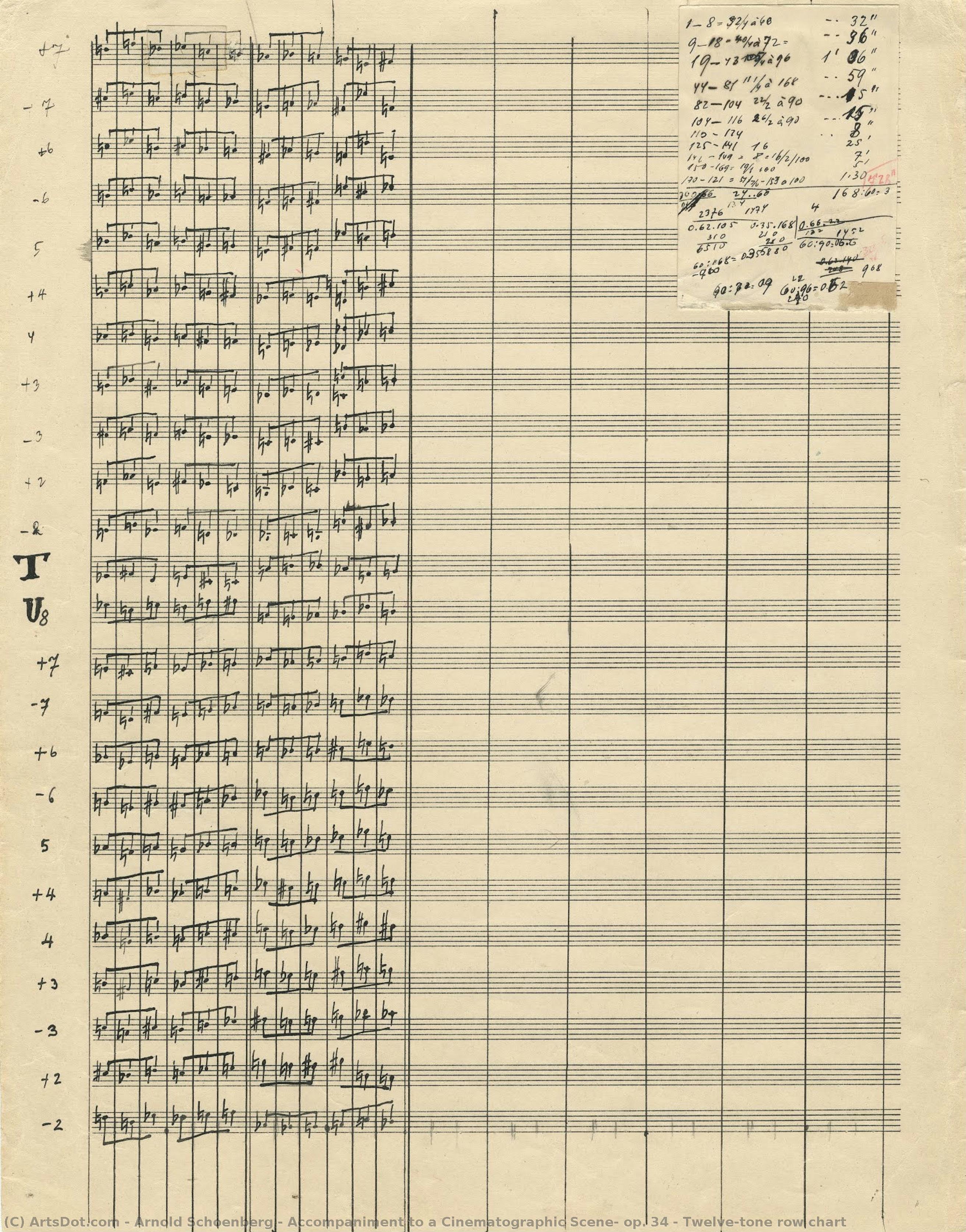
- Technique & Notation: Schoenberg’s meticulous notation reveals his dedication to precision and innovation. He transcribed the twelve-tone row with transposition levels—a technique designed to emphasize tonal relationships despite the absence of conventional harmony—demonstrating his mastery of musical notation while simultaneously challenging established aesthetic norms. The sheet music itself is a visual representation of this conceptual framework, highlighting Schoenberg’s commitment to exploring new expressive possibilities.
- Symbolism & Emotional Impact: Inspired by the cinematic imagery of “threatening danger,” “fear,” and “catastrophe,” Op. 34 seeks to evoke visceral responses from listeners. The music's fragmented structure mirrors the disorientation experienced during moments of crisis, mirroring the visual aesthetic of abstract film. Schoenberg’s deliberate avoidance of tonal resolution underscores his desire to resist comforting illusions, prompting contemplation on existential themes.
- Legacy & Influence: “Accompaniment to a Cinematographic Scene” represents more than just a musical composition; it embodies Schoenberg's broader artistic vision—a fusion of music and visual art that anticipates the expressive ambitions of later avant-garde composers. Its enduring fascination stems from its audacious challenge to harmonic conventions and its profound engagement with psychological states, securing its place as an iconic work within the canon of 20th-century classical music.