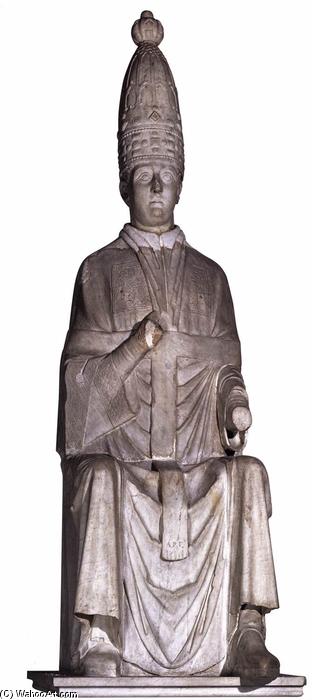
Pope Boniface VIII Blessing - An Exploration of Early Renaissance Faith
Arnolfo di Cambio’s “Pope Boniface VIII Blessing” stands as a testament to the burgeoning artistic fervor of Florence during the early 14th century, specifically commissioned around 1300. This monumental sculpture embodies the spirit of the era—a conscious revival of classical ideals tempered by profound religious devotion—and offers a captivating glimpse into the aesthetic sensibilities of its time.
The artwork depicts Pope Boniface VIII seated upon a simple throne, his hands raised in a gesture of benediction. Crafted primarily from marble – likely sourced locally – Cambio’s masterful technique demonstrates an unwavering commitment to realism blended with stylistic refinement characteristic of Cosmatesque art, which had profoundly influenced Florentine sculpture.
- Material: Marble
- Style: Early Renaissance
- Technique: Carving – Cambio’s meticulous attention to detail is evident in the intricate folds of the papal robes and the exquisitely rendered tiara, mirroring models derived from ancient Roman sculptures.
The sculpture's composition centers around a vertical axis—the Pope’s posture—emphasizing his authority and conveying an aura of solemn dignity. The muted grey tones dominate the color palette, reflecting the prevailing aesthetic preference for understated elegance and highlighting the sculptural form itself rather than dramatic visual effects. Light is diffused evenly across the surface, accentuating textures and contours without resorting to theatrical highlights.
Beyond its formal qualities, “Pope Boniface VIII Blessing” resonates with symbolic significance. The gesture of benediction represents divine grace and papal piety—a powerful emblem of faith during a period marked by intense religious debate and papal ambition. Cambio’s work serves as an enduring reminder of the humanist ideals that underpinned Florentine art while simultaneously honoring the spiritual convictions of its era.
This artwork is not merely a depiction; it's an embodiment of artistic excellence—a masterful fusion of observation, craftsmanship, and theological contemplation. Its serene presence continues to inspire admiration for centuries later, cementing Cambio’s legacy as one of Florence’s most influential sculptors.