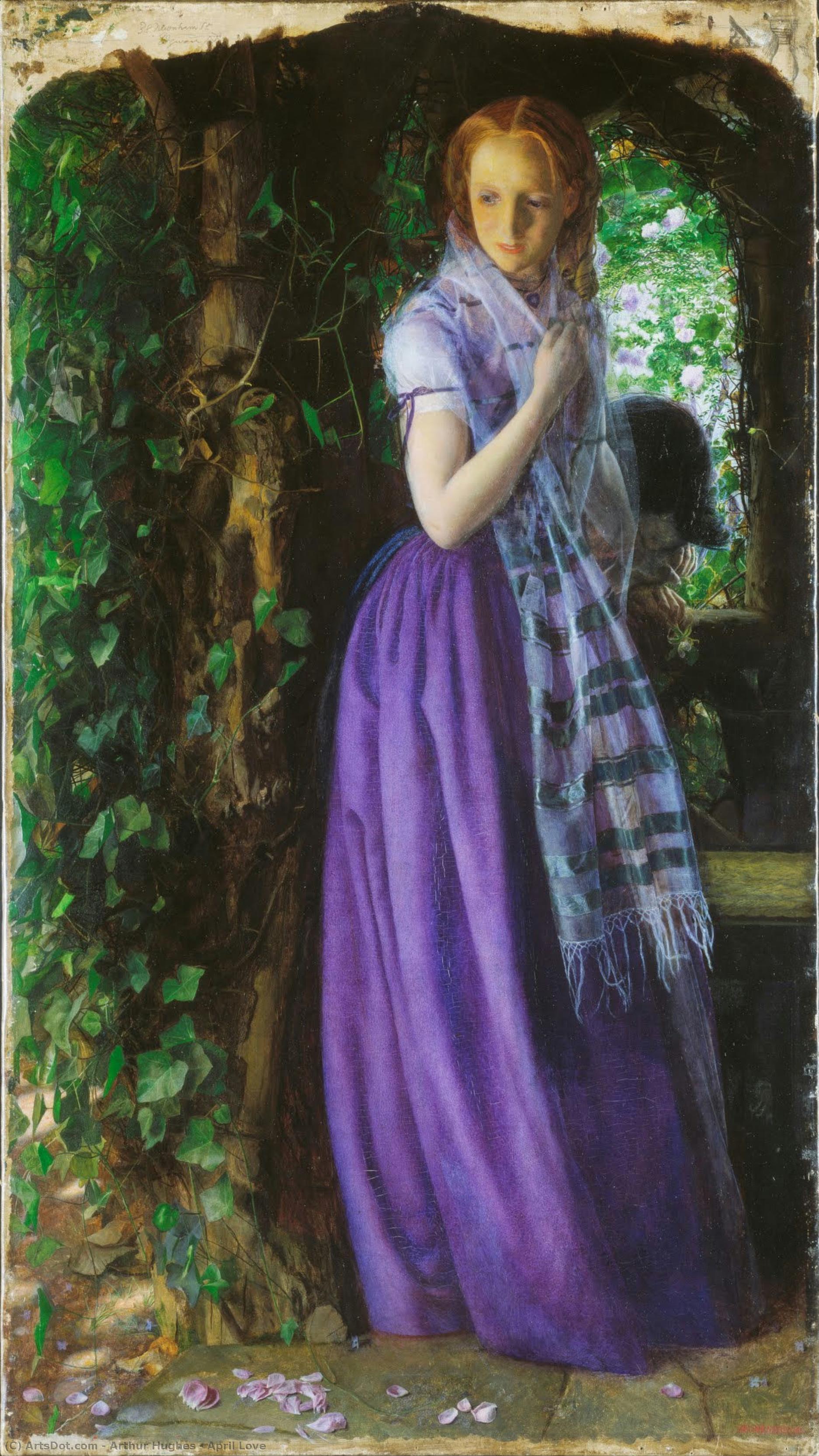
Arthur Hughes’ ‘April Love,’ painted in 1855–6, captures a moment of romantic crisis with masterful detail. Set against an ivy-clad arbor and featuring a woman gazing upwards, the painting embodies Pre-Raphaelite ideals—beauty, emotion, and symbolism—inspired by Tennyson's poem 'The Miller’s Daughter.'
April Love: A Pre-Raphaelite Echo of Fragility
Arthur Hughes’ “April Love,” completed in 1855–6, stands as one of the most poignant expressions of Romantic idealism within the Pre-Raphaelite Brotherhood. Exhibited at the Royal Academy alongside fellow artists like John Everett Millais and Holman Hunt, it immediately captivated audiences with its delicate beauty and subtle narrative—a testament to Hughes’ masterful ability to distill emotion into visual form.
- Subject Matter: The painting depicts a young woman gazing down upon fallen rose petals as her suitor bends to offer a tender kiss. This seemingly simple tableau encapsulates the core theme of courtship and the inherent vulnerability associated with youthful romance.
- Style & Technique: Hughes employed oil paint on canvas, utilizing a technique characterized by meticulous detail and luminous color palettes—a hallmark of Pre-Raphaelite aesthetics. The artist’s careful layering of pigments creates an ethereal atmosphere, capturing the fleeting beauty of springtime and mirroring the ephemeral nature of love itself.
- Historical Context: Hughes' work emerged during a period of intense artistic experimentation and intellectual debate within Britain. Influenced by Tennyson’s poem “The Miller’s Daughter,” which explores themes of loss and regret, Hughes sought to convey not merely visual splendor but also profound psychological insight—a characteristic ambition of the Pre-Raphaelites who rejected academic conventions in favor of direct observation and emotional sincerity.
- Symbolism: The fallen rose petals serve as a powerful symbol of decay and the inevitable end of youthful passion, juxtaposed against the hopeful gesture of the suitor’s hand. Hughes skillfully employs color—particularly the muted hues of lilac and the woman's purple dress—to evoke feelings of melancholy and tenderness, reinforcing the painting’s overarching message about accepting life’s transient beauty.
- Emotional Impact: “April Love” resonates deeply with viewers due to its ability to capture a moment of profound emotional vulnerability. Hughes’ portrayal of longing glances and hesitant expressions invites contemplation on themes of desire, uncertainty, and the bittersweet realization that even the most cherished connections must eventually come to an end—a timeless exploration of human experience that continues to inspire admiration centuries later.
Hughes' meticulous attention to detail—evident in the rendering of the woman’s face and the delicate texture of the fabric—further elevates “April Love” as a masterpiece of Pre-Raphaelite art. Its enduring appeal lies not only in its visual splendor but also in its capacity to evoke empathy and provoke reflection on the complexities of human relationships.