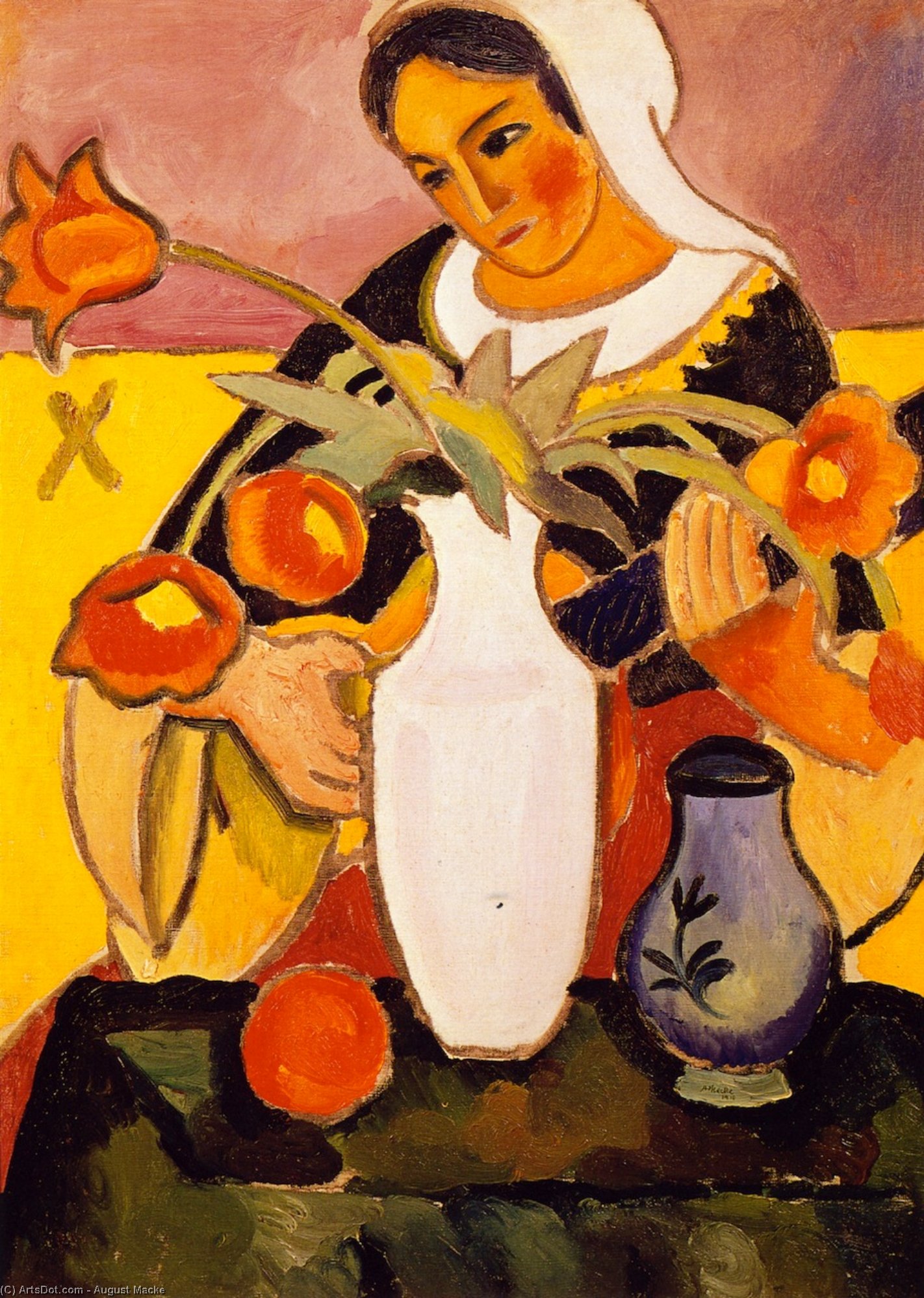
Woman Playing the Lute by August Macke (1910): This captivating portrait depicts a woman delicately holding a vase brimming with vibrant red flowers, complemented by two apples – a testament to Macke’s exploration of Impressionistic influences and his masterful depiction of serene beauty.
Explore the vibrant Expressionist paintings of August Macke (1887-1914). Influenced by Fauvism & Orphism, his works capture modern life with bold color and draftsmanship. A key figure in Der Blaue Reiter.
The Musée National d'Art Moderne (French pronunciation: [myze nɑsjɔnal daʁ mɔdɛʁn]; "National Museum of Modern Art") is the national museum for modern art of France. It is located in the 4th arrondissement of Paris and is housed in the Centre Pompidou.
August Macke’s Woman Playing the Lute: A Portrait of Fragility Amidst Expressionist Boldness
The painting “Woman Playing the Lute,” executed by August Macke in 1910, stands as a poignant emblem of German Expressionism's aesthetic sensibilities – a captivating blend of delicate beauty and unsettling psychological depth. More than just a depiction of an instrument and its performer, it’s a meticulously crafted meditation on vulnerability and artistic contemplation within the turbulent landscape of early twentieth-century Europe.
Subject Matter and Composition
Macke’s subject is remarkably simple: a woman seated gracefully before a vase brimming with vibrant red flowers. Alongside her are two apples – one positioned to her left, the other to her right – creating a balanced visual arrangement that draws the eye inwards. The woman herself wears a white dress adorned with a veil, conveying an aura of serenity and refinement despite the inherent tension within the scene. Macke’s masterful composition utilizes central symmetry, anchoring the figure and vase at the heart of the canvas while subtly directing the viewer's gaze outwards.
Style and Technique: Impressionistic Roots Revisited
Despite firmly establishing himself as a pivotal figure in Expressionism, Macke’s artistic lineage traces back to Impressionism and Post-Impressionism. He skillfully employs loose brushstrokes and dappled coloration—techniques borrowed from Monet and Cézanne—to capture the fleeting effects of light and atmosphere. However, unlike his Impressionist predecessors, Macke injects a palpable sense of unease into the artwork’s surface. The muted yellow background serves not as a comforting backdrop but rather as a subtle counterpoint to the fiery hues of the flowers, amplifying their vibrancy and hinting at an underlying emotional turmoil. Macke's meticulous attention to detail—evident in the rendering of the woman’s face and hands—contrasts sharply with the expressive abstraction of his brushwork.
Historical Context: The Dawn of Expressionism
“Woman Playing the Lute” emerged during a period of profound artistic upheaval, coinciding with the burgeoning movement of German Expressionism. Influenced by Nietzschean philosophy and grappling with anxieties surrounding societal change and impending war, Expressionist artists sought to convey inner psychological states rather than objective representations of reality. Macke’s work embodies this ethos—a deliberate rejection of academic conventions in favor of emotionally charged imagery designed to provoke contemplation and elicit visceral responses from the viewer. The painting reflects the broader cultural preoccupation with themes of fragility, isolation, and the confrontation between beauty and darkness that characterized the era.
Symbolism: Flowers, Apples, and Artistic Reflection
The flowers within the vase symbolize vitality and passion—yet their scarlet intensity is tempered by the woman’s quiet demeanor. They represent not merely aesthetic pleasure but also a yearning for connection amidst emotional detachment. The apples serve as visual anchors, symbolizing knowledge and innocence – qualities threatened by the encroaching darkness of the surrounding environment. Perhaps most powerfully, the lute itself embodies artistic contemplation—a tool for channeling emotion into creative expression. Macke’s portrayal captures the artist's inner world—his vulnerability, his sensitivity to beauty, and his awareness of existential anxieties.
Emotional Impact: A Moment Frozen in Time
Ultimately, “Woman Playing the Lute” transcends mere visual representation; it communicates a profound emotional resonance. The painting evokes feelings of melancholy, introspection, and quiet contemplation – inviting viewers to confront their own inner landscapes. Macke’s masterful execution ensures that this emotional impact persists long after initial observation, cementing its place as an enduring masterpiece of Expressionist art. It remains a testament to the artist's ability to distill complex psychological states into a single, unforgettable image—a poignant reminder of beauty born from sorrow and artistic reflection amidst the uncertainties of the modern age.