August Macke's Evocative Portrait of Urban Life
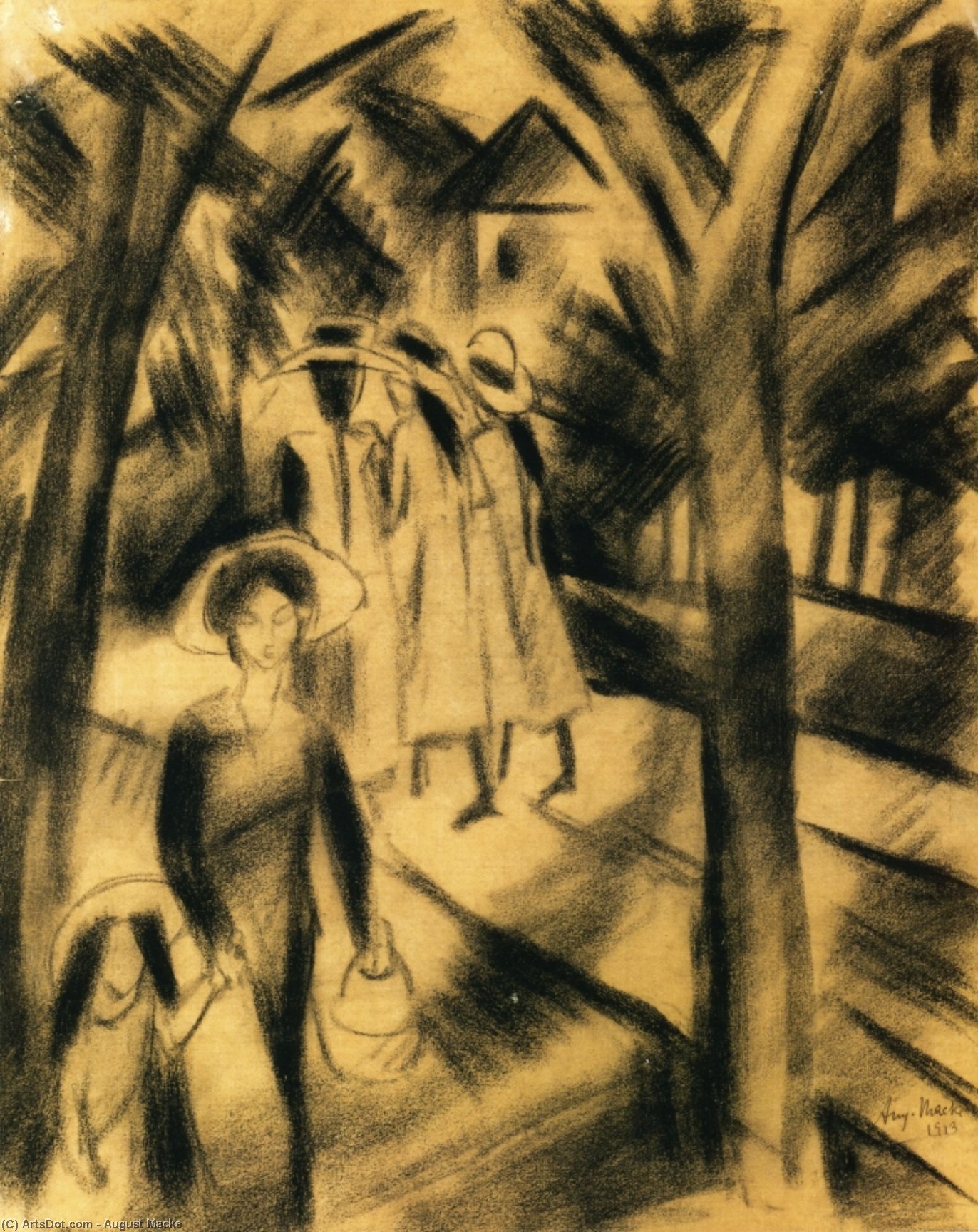
This arresting charcoal drawing, “Woman with Child and Girls on a Road,” offers a poignant glimpse into the heart of early 20th-century urban life through the intensely expressive lens of August Macke. Executed in 1913, just before his untimely death at the age of twenty-seven, the artwork embodies the fervent spirit of German Expressionism – a movement defined by its raw emotionality and rejection of purely representational art. Measuring 32 x 27 cm, this intimate piece immediately draws the viewer into a scene dominated by muted tones and a palpable sense of melancholy, hinting at the transient nature of existence.
- Subject Matter: The composition centers on a group of women and children traversing a narrow road beneath a canopy of trees. This seemingly simple subject matter is imbued with symbolic weight, representing perhaps the passage of time, the everyday struggles of urban life, or the fleeting beauty of human connection.
- Style & Technique: Macke’s style leans heavily into Expressionism, prioritizing emotional impact over photographic realism. The loose lines and distorted forms contribute to a powerfully evocative atmosphere. The artist masterfully employs hatching, cross-hatching, and stippling – techniques that build up tonal values with remarkable precision – creating a rich, tactile surface.
A Symphony of Charcoal: Macke’s Artistic Process
The artwork's power resides largely in the meticulous execution of its charcoal technique. Macke doesn’t simply draw; he sculpts with pigment, layering strokes to achieve a remarkable range of values and textures. The directional lines – particularly those used to define the trees and the figures’ forms – create a dynamic sense of movement and depth, pulling the viewer into the scene. The artist's deliberate use of shadow further enhances this effect, casting an ethereal glow upon the figures and amplifying the artwork’s inherent mystery. This dedication to technique is evident in the rough, almost impasto-like surface created by the accumulation of charcoal dust – a testament to Macke’s passionate engagement with his medium.
Historical Context & Symbolic Resonance
Created in 1913, this drawing sits squarely within the context of German Expressionism's burgeoning movement. The period was one of rapid social and technological change, marked by anxieties about modernity and a desire to grapple with profound philosophical questions. Macke’s work reflects these concerns, offering a nuanced portrayal of urban life that is both beautiful and unsettling. The subdued color palette – dominated by shades of grey and brown – contributes to the artwork's melancholic mood, suggesting a sense of isolation or perhaps a premonition of the impending horrors of World War I, which claimed Macke’s life just months later.
Collecting & Appreciating This Masterpiece
This hand-painted reproduction captures not only the visual essence of August Macke's original drawing but also the emotional depth and artistic skill that defined his work. Whether adorning a gallery wall or gracing a corporate space, this artwork offers a powerful statement – a reminder of the beauty and fragility of human experience. Its evocative imagery and masterful technique make it an ideal addition to any discerning collection, offering both aesthetic pleasure and intellectual engagement.