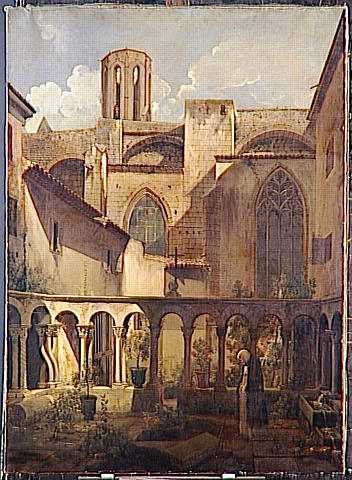
Auguste de Forbin's 'Vue intérieure du cloître Saint Sauveur à Aix-en-Provence' is a meticulously detailed 19th-century academic oil painting depicting the interior courtyard of Saint Sauveur Cloister in Aix-en-Provence. Characterized by earthy tones, strong vertical lines, and atmospheric perspective, this artwork embodies tranquility and reverence for architectural heritage.
Auguste de Forbin: A Painter Caught Between Romantic Idealism and Napoleonic Pragmatism
Auguste de Forbin (1777 – 1841) stands as a fascinating figure in French art history, embodying the complexities of his era—a period marked by turbulent political upheaval and burgeoning artistic innovation. Born into a noble family at Château La Roque-d’Anthéron, Provence, he possessed an innate talent for drawing from a young age, nurtured by a formative friendship with François Marius Granet, a relationship that would endure throughout their lives. This early training instilled in him a sensitivity to observation and detail, qualities that would characterize his artistic endeavors. His oeuvre reflects this dual influence—a yearning for the grandeur of Romanticism tempered by the demands of Napoleonic patronage.
- Subject Matter: Forbin’s primary focus was architectural landscape – specifically, an interior view of a historic cloister. He meticulously captured the serene beauty and tranquil atmosphere of Saint Sauveur Cloister in Aix-en-Provence, aiming to convey not merely visual accuracy but also a profound sense of place and history.
- Style & Medium: The artist adhered to the conventions of 19th-century academic painting, prioritizing realism and meticulous detail. Employing oil on canvas—a technique favored by the École de Beaux-Arts—Forbin achieved remarkable textural richness and luminosity, layering pigments with painstaking precision.
Composition & Perspective: Mastering Atmospheric Depth
The artwork’s composition is centered around a courtyard, showcasing arches, buildings, and a tower rising above. The artist skillfully utilized atmospheric perspective—a technique championed by Jacques-Louis David—to create an illusion of depth. Distant structures appear paler and less defined than those in the foreground, reinforcing the impression of vastness and conveying a sense of timeless grandeur. Strong vertical lines dominate the architectural elements, emphasizing stability and aspiration. Repeating arched patterns contribute to visual harmony and guide the viewer’s gaze upwards towards the tower—a deliberate focal point designed to inspire contemplation.
Color Palette & Texture: Reflecting Tranquility Through Earthy Tones
The color palette is dominated by earthy tones – browns, beiges, ochres, and muted greens. These subdued hues contribute significantly to the painting’s overall mood of serenity and tranquility. Touches of blue in the sky and shadows provide subtle contrast, enhancing realism and adding visual interest. Brushstrokes are visible throughout the canvas, indicative of a traditional oil painting technique—a testament to Forbin's dedication to craftsmanship and his commitment to conveying texture accurately. The artist skillfully blended pigments to create depth and luminosity, capturing the nuances of light and shadow with remarkable subtlety.
Symbolism & Emotional Impact: Capturing Spiritual Reflection
The presence of a monk—a deliberate inclusion—suggests themes of spirituality and contemplation. He stands in the lower right corner, serving as a visual anchor and prompting viewers to consider the contemplative nature of monastic life. Beyond its aesthetic qualities, the painting embodies the spirit of its time—a reaction against the excesses of Romanticism while retaining an appreciation for classical ideals. It invites reflection on beauty, history, and the enduring power of artistic expression.
Historical Context & Legacy
Auguste de Forbin’s work emerged during a period of significant political transformation in France—the Napoleonic era. Despite the pressures exerted by Napoleon Bonaparte's regime, Forbin maintained his artistic integrity, producing works that reflected both his personal vision and the prevailing aesthetic sensibilities of the time. His meticulous attention to detail and masterful use of technique cemented his reputation as one of the École de Beaux-Arts’ most accomplished painters—a legacy that continues to inspire admiration for its beauty and intellectual depth.