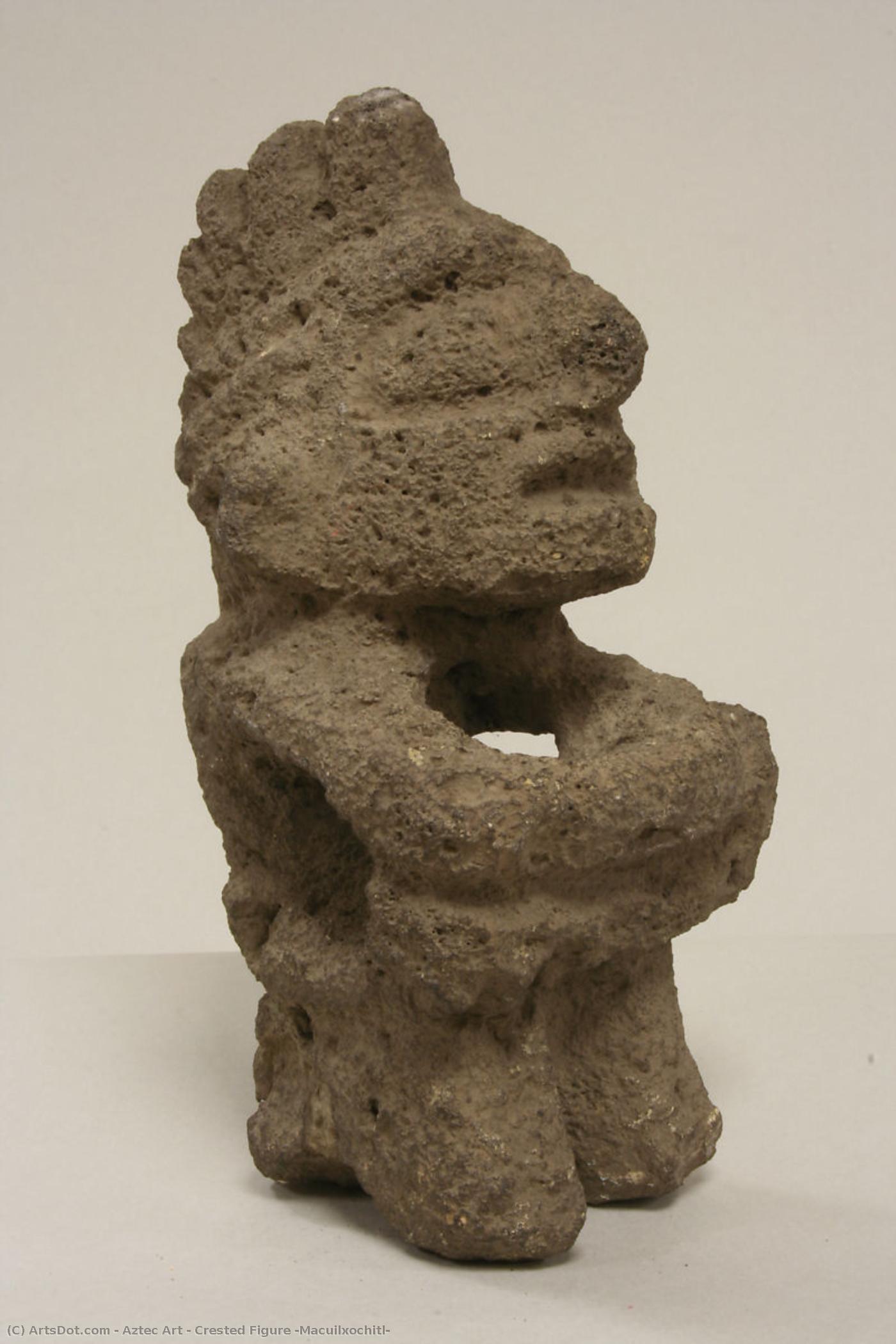
This detailed analysis delves into the artistry of the Aztec Empire, focusing on ‘Crested Figure (Macuilxochitl)’—a monumental sculpture embodying religious beliefs and imperial grandeur. Its stylistic elements, material composition, and historical context illuminate the empire's cultural legacy.
Crested Figure (Macuilxochitl): Echoes of Aztec Cosmology
The photograph presents a striking depiction of an Aztec sculpture titled “Crested Figure (Macuilxochitl),” originating from the 15th–early 16th century during the height of the Mexica Empire. This artwork embodies the artistic spirit of Mesoamerica, reflecting profound religious beliefs and political authority—a testament to the enduring legacy of a civilization that captivated imaginations for centuries.
- Overall Impression: The image captures a sculpture crafted from stone, bathed in diffused light that delicately highlights its contours. Its central positioning within the frame emphasizes its monumental presence, while the neutral beige background serves as an elegant counterpoint, ensuring the figure remains at the forefront of visual attention.
- Composition & Perspective: Shot at a slight upward angle, the sculpture’s placement directs the viewer's gaze upwards, reinforcing its stature and conveying a sense of grandeur. The perspective is relatively flat, prioritizing clarity and minimizing depth perception—a stylistic choice consistent with Aztec artistic conventions that prioritized symbolic representation over realistic depiction.
- Color Palette & Texture: Dominated by earthy tones – shades of brown, grey, and tan – the sculpture’s color palette speaks to the materiality of its creation and aligns seamlessly with the natural environment of Mesoamerica. The surface texture is deliberately rough, mirroring the weathered appearance of ancient stone monuments and hinting at the passage of time—a deliberate element intended to evoke a connection to history and tradition.
Symbolism & Iconography: Decoding Aztec Beliefs
The sculpture’s title, “Macuilxochitl,” derives from Nahuatl roots ("people of many forms"), reflecting the Aztec worldview—a complex tapestry woven with interwoven deities and cosmological concepts. The elaborate headdress adorning the figure symbolizes divine authority and represents a stylized depiction of Quetzalcoatl, the feathered serpent god revered as a bringer of knowledge and civilization. Geometric patterns incorporated into the ornamentation underscore the Aztecs’ fascination with mathematical precision and their belief in underlying order—a characteristic feature of Mesoamerican art that transcends mere decoration to convey profound spiritual meaning.
Technique & Material: Craftsmanship Rooted in Tradition
The sculpture exemplifies Aztec craftsmanship, achieved through meticulous carving techniques utilizing stone or clay. The artist’s hand skillfully manipulated the material, transforming it into a form imbued with both naturalism and deliberate stylization—a hallmark of Aztec artistic practice that prioritized symbolic representation over anatomical accuracy. The rough texture is not merely accidental; it serves as a visual reminder of the sculpture's origins in an ancient culture deeply connected to the earth and its rhythms—a stylistic choice designed to communicate reverence for nature and continuity with past traditions.
Historical Context & Artistic Influence
Created during the Mexica Empire’s zenith (1428–1521), “Crested Figure (Macuilxochitl)” stands as a powerful emblem of Aztec artistic achievement—a legacy that continues to inspire artists and collectors today. Its stylistic elements resonate with earlier Mesoamerican civilizations, notably the Olmecs and Teotihuacan, demonstrating the Aztecs’ engagement in a vibrant artistic dialogue across time and space. The sculpture's enduring appeal lies in its ability to convey not only visual beauty but also the profound spiritual beliefs and cultural values of a civilization that shaped the history of Mexico and Mesoamerica—a timeless masterpiece capturing the essence of Aztec cosmology and artistry.