A Symphony of Nature’s Ephemera
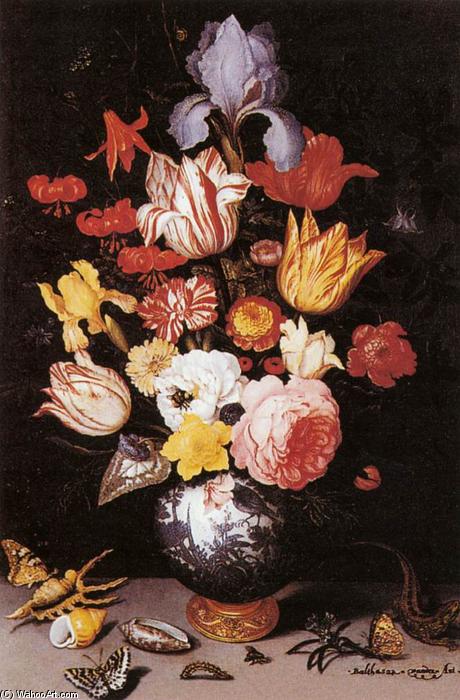
To gaze upon Balthasar van der Ast’s “Flower Still-Life with Shell and Insects” is to step directly into the meticulously ordered, yet wildly abundant, world of the Dutch Golden Age. Painted around 1630, this masterpiece transcends mere botanical representation; it embodies a profound engagement with humanist philosophy and scientific observation. The composition immediately draws the eye into a vibrant tapestry where every petal, every iridescent shell fragment, and every delicate insect seems placed with deliberate artistry. A lush arrangement of tulips, roses, and lilies erupts from a central vase, their colors—ranging from deep reds to soft pinks and pure whites—standing out brilliantly against a somber, dark background. This dramatic use of light and shadow, known as chiaroscuro, lends the flowers an almost three-dimensional presence, making them appear to bloom right before the viewer's eyes.
The painting is not merely a display of beauty but a complex vanitas—a meditation on the fleeting nature of life. While the blossoms represent virtues such as humility and purity, the inclusion of butterflies and moths introduces an element of transience and decay. These small, winged creatures serve as poignant reminders that even the most magnificent bloom is subject to the passage of time. For the discerning collector or interior designer, this duality offers a captivating emotional depth; it provides a focal point that is simultaneously celebratory of life's splendor and reflective of its inevitable end.
The Mastery of Light and Texture
Van der Ast’s technical prowess is most evident in his pioneering approach to the shell painting technique. He did not simply aim for accuracy; he sought to capture the very soul of the objects depicted. Through a painstaking process of layering translucent glazes—a method inherited from his mentor, Ambrosient Bosschaert the Elder—he achieved a breathtaking illusion of depth and luminescence. Each seashell is rendered with subtle gradations of color and tonal variation, capturing that unmistakable iridescent sheen characteristic of mollusks. This meticulous attention to detail allows light to penetrate through multiple thin coats of paint, creating a natural brilliance that mimics the way light interacts with real calcium carbonate surfaces.
This level of precision makes the work an extraordinary choice for high-quality reproductions intended for sophisticated spaces. The texture of the petals, the hard glint of the shells, and the delicate movement of the insects create a sensory experience that enriches any environment. Whether placed in a grand gallery or as a centerpiece in a contemporary living room, this painting brings with it the prestige of the seventeenth-century Netherlands, offering an atmosphere of intellectual curiosity and timeless elegance.