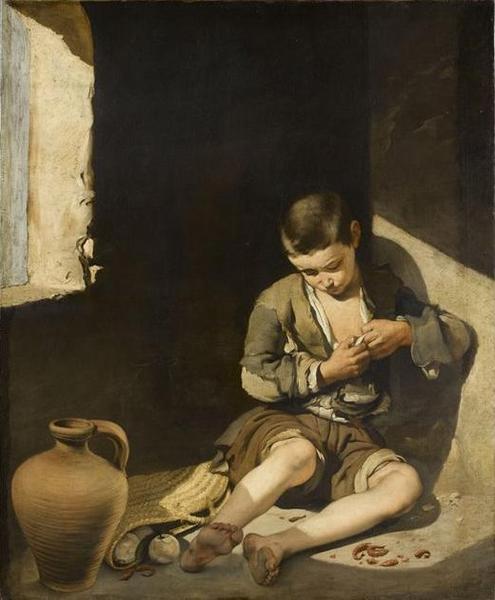
Bartolomé Esteban Murillo’s poignant Baroque masterpiece portrays a vulnerable young beggar bathed in soft light—a testament to innocence and quiet resilience within Seville's artistic landscape. Explore this evocative depiction and bring home a timeless treasure.
Bartolomé Esteban Murillo (1618-1682) was a celebrated Spanish Baroque painter known for his luminous religious scenes, tender genre paintings, and idealized depictions of everyday life in Seville.
Explore the Louvre Museum in Paris! Home to iconic masterpieces like the Mona Lisa & Venus de Milo, journey through art history from ancient Egypt to Renaissance icons. Plan your visit today!
A Portrait of Innocence Amidst Shadows: Exploring Murillo’s “Le jeune mendiant”
The painting "Le jeune mendiant," attributed to Bartolomé Esteban Murillo, stands as a poignant emblem of Baroque artistry—a testament to the era's preoccupation with piety and its masterful depiction of human emotion. Executed in oil on canvas sometime around 1670, this seemingly simple scene transcends mere representation; it’s an invitation into a contemplative space where vulnerability and resilience intertwine. Murillo’s oeuvre is celebrated for its luminous softness and profound psychological depth, qualities exquisitely realized in “Le jeune mendiant,” cementing his place as one of Spain's most beloved artists.
Subject Matter and Narrative Resonance
At first glance, the artwork presents a straightforward depiction: a young boy seated humbly before a window, clutching a jug filled with scattered food. Yet, Murillo’s genius lies in elevating this commonplace tableau into something far more significant. The subject matter—a mendicant child—was deliberately chosen to embody Christian virtues of compassion and charity, reflecting the moral concerns prevalent during Murillo's lifetime. More than just portraying poverty, the boy’s gaze directs upwards towards the window light, suggesting an inner contemplation – a yearning for solace or perhaps a quiet acceptance of his circumstances. This subtle gesture speaks volumes about Murillo’s ability to imbue even the most humble subject with dignity and spiritual awareness.
Baroque Style: Light, Shadow, and Emotional Intensity
The painting firmly anchors itself within the Baroque stylistic tradition, particularly as championed by Murillo himself. Characteristic of this period is the dramatic use of chiaroscuro—the masterful interplay between light and dark—which dominates the composition. The window serves not merely as a source of illumination but as a conduit for divine grace, casting ethereal rays upon the boy’s face and upper torso while enveloping the background in velvety shadows. This technique wasn't simply about visual spectacle; it was designed to evoke profound emotional responses from the viewer, mirroring the Baroque fascination with capturing the complexities of human experience.
Technique and Material Considerations
Murillo’s meticulous approach to painting is evident in every brushstroke. He employs a loose, expressive technique—a hallmark of his style—characterized by subtle gradations of color and delicately blended textures. Glazes – thin layers of translucent paint – were skillfully applied to achieve luminous effects and imbue the canvas with an unparalleled richness. The artist’s mastery extends beyond mere pigment; he meticulously renders fabrics and skin tones, capturing their tactile qualities with remarkable accuracy. This dedication to craft underscores Murillo's commitment to conveying not just what he saw but also how it felt—a profound connection between observation and emotion that distinguishes his work from many of its contemporaries.
Symbolism Beyond the Surface
The scattered food symbolizes more than mere sustenance; it represents scarcity and vulnerability – themes central to Christian morality. The boy’s posture, seated calmly before the window, embodies humility and acceptance. Murillo subtly communicates a message of spiritual fortitude amidst hardship, reminding us that true beauty resides not only in outward appearance but also in inner resilience. “Le jeune mendiant” is thus an enduring meditation on compassion, faith, and the human spirit's capacity for grace—a timeless masterpiece that continues to inspire awe and contemplation centuries after its creation.