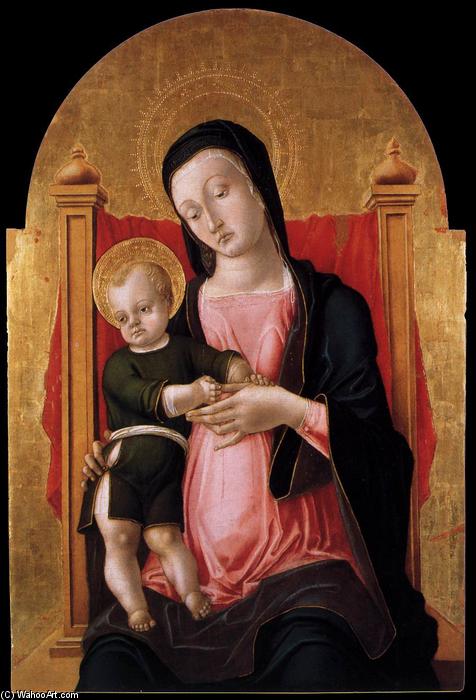
Bartolomeo Vivarini was a Venetian painter who flourished during the Early Renaissance, leaving behind a legacy of stunning religious artworks like ‘Madonna Enthroned’ (1482). His workshop produced masterpieces showcasing Venetian artistic innovation and devotion. Explore reproductions of his celebrated paintings on ArtsDot.
Admire Bartolomeo Vivarini’s masterful ‘Madonna Enthroned’ (1482) – Ven
Madonna and Child by Bartolomeo Vivarini
Fra Angelico’s legacy extends far beyond his serene depictions of paradise; it resides in the profound spiritual depth he instilled within every canvas, and Bartolomeo Vivarini stands as a testament to this enduring tradition. Born around 1440 in Murano, Venice—a crucible of artistic innovation during the Quattrocento—Vivarini’s formative years were steeped in the vibrant atmosphere of Venetian art, where humanist ideals intertwined with Byzantine influences. Unlike many artists of his time preoccupied with courtly patronage, Vivarini found solace and purpose within the walls of San Giorgio Maggiore, dedicating himself to monastic life and channeling his artistic energies into glorifying God. This singular devotion profoundly shaped his oeuvre, resulting in paintings that radiate an unmistakable aura of piety and contemplation.
- Subject Matter: The Madonna and Child remains one of Christianity’s most enduring symbols—a depiction of Mary cradling Jesus Christ, representing divine motherhood and the incarnation of God incarnate. Vivarini's rendition captures this iconic theme with meticulous detail, emphasizing the sacred bond between mother and son.
- Style: Vivarini’s style embodies the Venetian Renaissance aesthetic, characterized by its luminous color palette—primarily reds, blues, and golds—and masterful use of perspective to create a sense of spatial realism. However, unlike some contemporaries striving for strict geometric precision, Vivarini favors a softer, more expressive approach, prioritizing emotional resonance over rigid formalism.
- Technique: Executed in tempera on wood—a technique favored by Venetian artists during the period—Vivarini’s painting demonstrates remarkable skill and patience. The meticulous layering of pigments ensures exceptional color vibrancy and durability, preserving the artwork's beauty for centuries to come. Gold leaf is lavishly applied throughout the composition, enhancing its opulent grandeur and symbolizing divine illumination.
The painting itself portrays Mary seated upon a throne-like structure adorned with crimson cushions—a deliberate gesture signifying her regal dignity and spiritual authority. Her drapery flows gracefully around her form, rendered in shades of pink and blue, creating an illusion of movement and conveying a sense of serenity. Vivarini’s masterful depiction of Mary's gaze—direct and unwavering—establishes an intimate connection between the Virgin Mother and the viewer, inviting contemplation on themes of faith and compassion. Held securely in Mary’s arms is Jesus Christ, depicted as a youthful child dressed in robes trimmed with white—a striking contrast against Mary’s vibrant attire. The golden halo encircling Jesus' head underscores his divine nature, reinforcing the painting’s central theological message.
Historical Context: Vivarini’s Madonna and Child emerged during a period of significant artistic ferment in Venice—a city that served as a beacon of humanist scholarship and artistic creativity. Venetian artists were increasingly influenced by classical ideals, incorporating elements of Greek sculpture and architecture into their paintings. Simultaneously, Byzantine traditions persisted, particularly in the use of iconography and symbolism—practices rooted in centuries-old Christian beliefs. This confluence of influences resulted in artworks that simultaneously celebrated human dignity and revered divine majesty.
Symbolism: The painting’s rich symbolism speaks to fundamental theological concepts—namely, divine grace and maternal compassion. The throne symbolizes Mary's royal status as Queen of Heaven, while the crimson cushions represent her sacrificial love for humanity. The golden halo signifies Jesus Christ’s divinity and eternal glory, underscoring the transformative power of faith. Overall, Vivarini’s Madonna and Child transcends mere representation; it embodies a profound spiritual vision—a testament to the enduring beauty and significance of Christian iconography.
- Emotional Impact: Viewing Vivarini's Madonna and Child evokes feelings of peace, reverence, and compassion—qualities that resonate deeply within the human spirit. The painting’s luminous colors and masterful composition inspire contemplation on themes of faith, love, and divine grace.
A photograph of this masterpiece is available at
Wahida Art, allowing for a detailed appreciation of its artistic merits. Reproductions of Vivarini’s Madonna and Child offer an opportunity to bring this timeless artwork into your home—capturing its ethereal beauty and conveying its profound spiritual message.