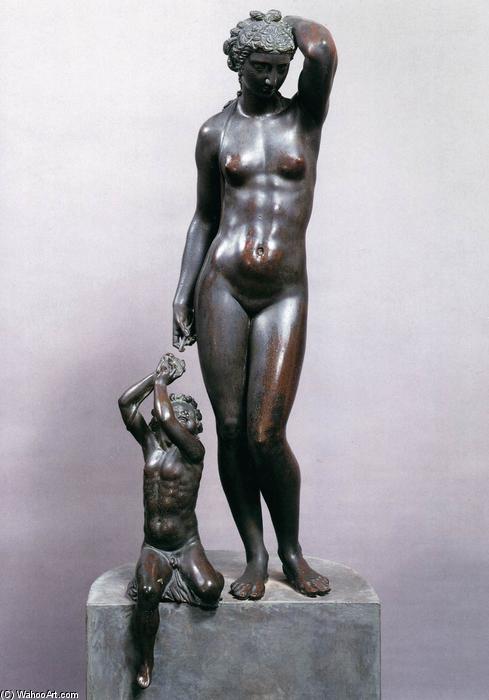
Benvenuto Cellini's 'Danaë and her Son Perseus,' a monumental bronze sculpture depicting Zeus's divine intervention and Perseus's heroic triumph over Medusa, embodies Mannerist artistry and reflects Renaissance ideals.
Benvenuto Cellini (1500-1571): Master goldsmith & sculptor of the Mannerist era, famed for 'Perseus' & the exquisite Cellini Salt Cellar. Explore his art & life!
Explore Renaissance sculpture's heart at the Museo Nazionale del Bargello! Marvel at masterpieces by Donatello & Michelangelo in Florence’s historic Palazzo del Bargello.
Danae and her Son Perseus: A Renaissance Masterpiece
Benvenuto Cellini’s “Danaë and her Son Perseus” stands as an emblem of the Florentine Mannerist style—a period marked by dramatic flair, stylized forms, and intellectual complexity. Completed in 1545-53 for Cosimo I de' Medici, this bronze sculpture transcends mere depiction; it embodies a profound meditation on mythology, heroism, and divine intervention. Cellini’s ambition was to elevate the sculptural tradition beyond the idealized beauty of the High Renaissance, achieving instead an expressive power that captivated audiences and cemented his legacy as one of Florence’s foremost artists.
Historical Context & Commission
The sculpture emerged during Cosimo I's reign—a pivotal moment in Florentine history characterized by consolidating Medici rule and fostering artistic patronage. Cellini meticulously crafted the piece responding to the prevailing aesthetic sensibilities of the time, mirroring the grandeur and ambition of the Medicis’ court. As Cellini recounts in his autobiography, he sought to honor Cosimo’s prestige through a monumental artwork that would rival those produced by Michelangelo and Donatello—artists who had already established themselves as titans of sculpture during the High Renaissance. The commission itself served as an impetus for innovation, pushing Cellini to explore new techniques and conceptual approaches.
Technique & Material Considerations
Cellini’s mastery of bronze casting exemplifies the advancements achieved during his era. He employed a method known as lost-wax casting—a painstaking process involving creating a wax model followed by encasing it in clay and pouring molten metal into the mold. This technique allowed for exceptional detail and textural richness, capturing the musculature of Perseus and the serene beauty of Danaë with remarkable precision. The sculpture’s surface is polished to a luminous sheen, reflecting light and enhancing its three-dimensional form—a testament to Cellini's dedication to achieving visual perfection. Furthermore, the use of ivory and ebony for the pedestal underscores the sculptor’s meticulous attention to material selection and craftsmanship.
Symbolism & Narrative Depth
“Danaë and her Son Perseus” recounts the myth of Zeus disguised as golden rain impregnating Danaë—a tale rife with symbolism concerning divine paternity, maternal vulnerability, and heroic triumph. Cellini deliberately employed stylistic conventions characteristic of Mannerism to convey these themes—including exaggerated proportions, asymmetrical poses, and emotionally charged expressions. Perseus’s upward gaze symbolizes aspiration and hope—his outstretched hand reaching for Medusa's severed head embodies courage and determination. Danaë’s posture conveys serenity and grace—reflecting the protective embrace of motherhood. The sculpture’s central motif—the decapitated Medusa—represents vanquished evil and serves as a potent reminder of Perseus’s heroic feat. Cellini’s deliberate inclusion of mythological references underscores his artistic ambition to engage viewers intellectually and emotionally, elevating the sculpture beyond mere visual spectacle.
Emotional Impact & Artistic Legacy
“Danaë and her Son Perseus” continues to resonate with audiences today—capturing the spirit of Renaissance idealism while simultaneously conveying a palpable sense of drama and emotion. Cellini’s sculpture stands as an enduring testament to his artistic genius—a masterpiece that exemplifies Mannerist style and embodies the humanist values championed by Cosimo I de' Medici. Its placement in Piazza della Signoria—amongst other monumental sculptures commissioned by the Medicis—further reinforces its significance as a cornerstone of Florentine art history. The sculpture’s luminous surface, refined craftsmanship, and evocative narrative continue to inspire admiration and contemplation—solidifying Cellini’s place among the greatest sculptors of his time.