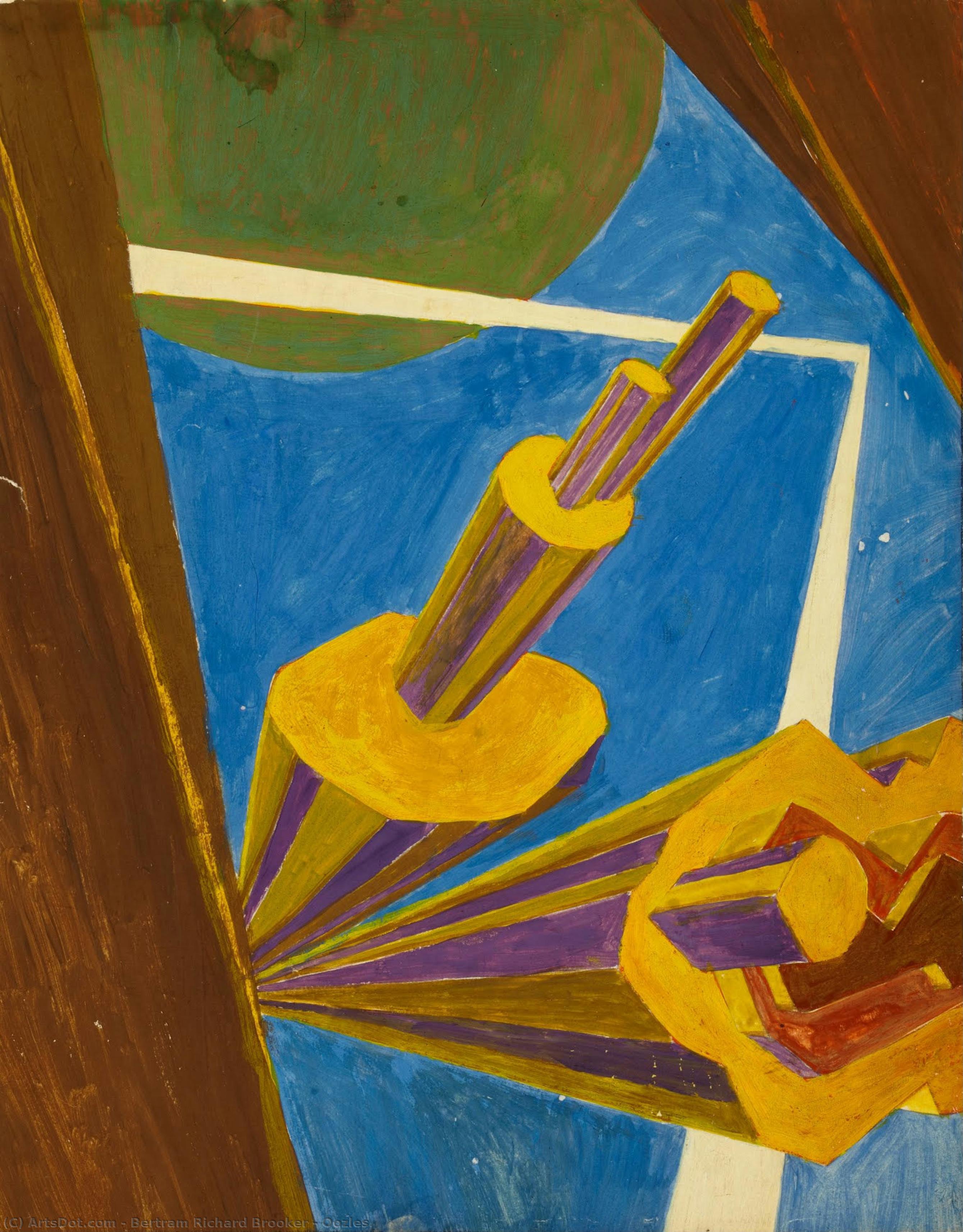
A Visionary Dance of Form and Color
In the vibrant landscape of early twentieth-century abstraction, few works capture the whimsical yet structured essence of the avant-garde quite like Oozles. Created in 1924 by the pioneering English-Canadian artist Bertram Richard Brooker, this masterpiece serves as a mesmerizing window into a world where geometry and imagination collide. At first glance, the eye is immediately drawn to the central, luminous yellow tube, a bold architectural element that anchors the composition. Flanked by smaller, rhythmic tubular forms, the piece orchestrates a visual melody of shapes that seem to float within a dreamlike space. The presence of a large, deep blue circle in the upper left corner provides a profound sense of cosmic depth, acting as a celestial anchor that contrasts beautifully with the bright, energetic yellows and primary tones that define the work.
The technique employed by Brooker in Oozles reflects his unique departure from the rigid constraints of academic realism. Moving away from the heavy shadows of traditional painting, he embraces a flattened perspective and a simplified, almost primitive aesthetic that breathes life into every stroke. The application of color is deliberate and impactful, utilizing high-contrast palettes to create a sense of movement and optical vibration. This approach—a hallmark of his transition from Cubism toward a more personal, abstract language—allows the viewer to experience the painting not as a depiction of physical objects, but as an exploration of pure energy and balance. For the discerning collector or interior designer, this piece offers a sophisticated interplay of light and form that can serve as a striking focal point in any modern setting.
The Legacy of a Canadian Pioneer
To understand the emotional resonance of Oozles, one must consider the historical context of Bertram Richard Brooker’s illustrious career. As a polymath—a novelist, poet, and graphic designer—Brooker brought a unique, multi-sensory perspective to his canvas. His journey from the industrial roots of Croydon, England, to the vast horizons of the Canadian prairies allowed him to synthesize European modernism with a North American sense of scale and spontaneity. During the 1920s, when the art world was reeling from the radical shifts of Cubism and Futurism, Brooker carved out a niche by embracing a "naive" abstraction that felt both accessible and profoundly experimental.
The symbolism within Oozles remains delightfully enigmatic, inviting endless interpretation. The tubular structures may evoke the industrial machinery of a burgeoning modern age, or perhaps they represent organic, biological forms seen through a microscopic lens. This ambiguity is precisely what gives the artwork its enduring emotional impact; it evokes a sense of wonder and curiosity, much like a visual puzzle waiting to be solved. For those seeking to adorn their homes with art that inspires conversation and intellectual engagement, a high-quality reproduction of this Brooker classic brings a piece of art history’s most daring era directly into the contemporary living space, blending timeless prestige with a bold, avant-garde spirit.