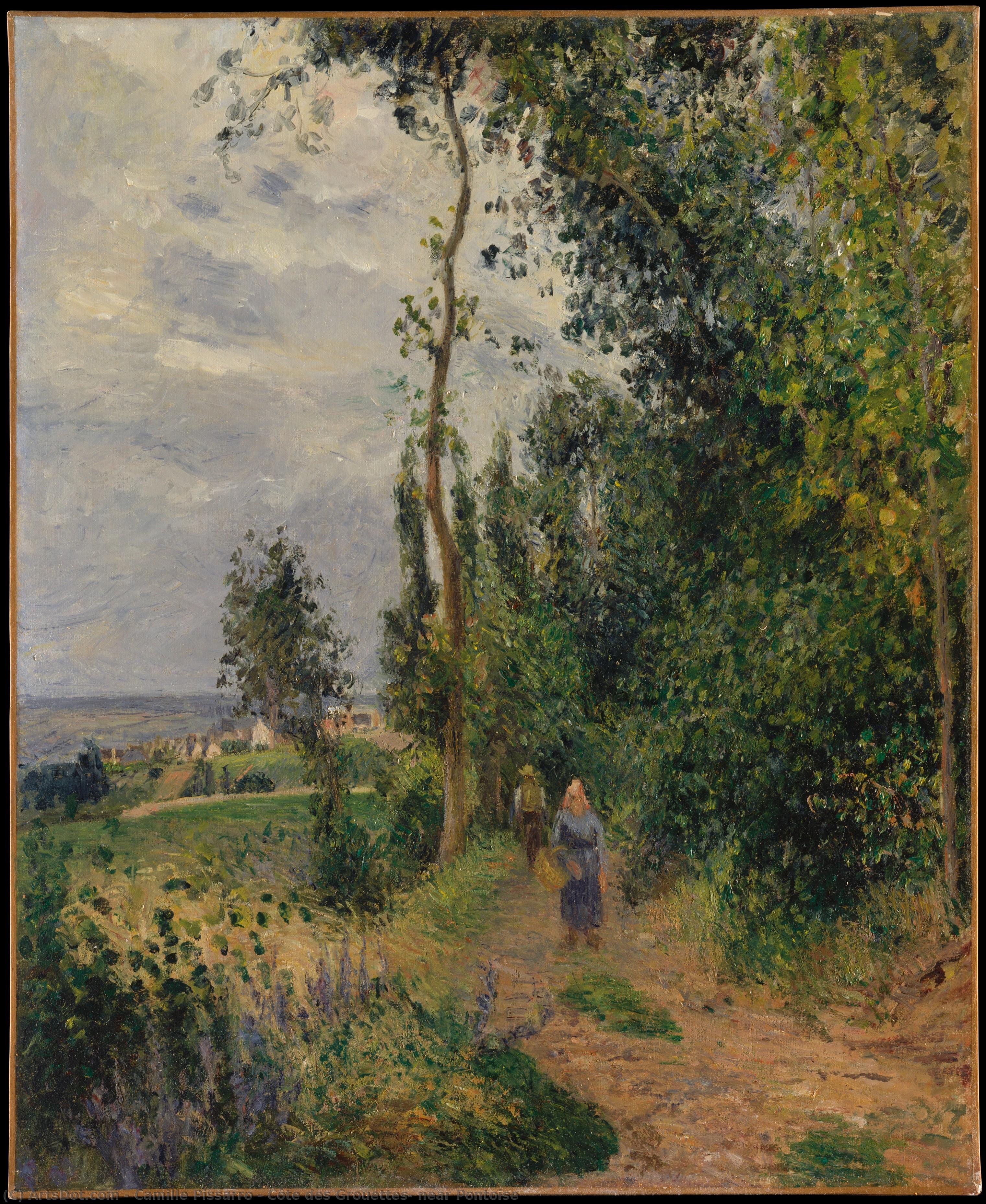
Côte des Grouettes, near Pontoise: A Glimpse of Rural Tranquility
Camille Pissarro's Côte des Grouettes, near Pontoise, painted in 1878, is a captivating oil on canvas that embodies the essence of rural life and the beauty of nature. This piece, measuring 74 x 60 cm, resides within the esteemed collection of The Metropolitan Museum of Art in New York City. It offers viewers an intimate look into Pissarro's observations of the French countryside during a pivotal period in art history.
Subject and Composition
The painting depicts a serene landscape centered around a path winding through rolling hills, flanked by trees and lush vegetation. Two figures are leisurely strolling along this path, while a horse grazes peacefully in the distance. The scene is characteristic of Pissarro's depictions of Pontoise and its surrounding areas, which he meticulously documented for nearly two decades beginning in 1866. While the precise location remains elusive today, identified by his son Ludovic-Rodo, it exemplifies the artist’s fascination with capturing everyday moments within a rural setting.
A vibrant patch of purple flowers at the lower left corner adds a touch of color and life to the canvas, suggesting a springtime scene. The composition is carefully balanced, drawing the viewer's eye along the path towards the distant buildings on the horizon, creating a sense of depth and perspective.
Impressionistic Technique and Style
Côte des Grouettes exemplifies Pissarro’s mastery of Impressionist techniques. The brushstrokes are loose and visible, eschewing precise detail in favor of capturing the fleeting effects of light and atmosphere. The color palette is dominated by muted greens and browns, punctuated by touches of blue and gray in the sky, creating a harmonious and tranquil mood.
Pissarro’s use of broken brushstrokes and layered colors builds form and depth, conveying a sense of movement and vibrancy within the seemingly still landscape. The diffused lighting, resulting from the overcast sky, further enhances the painting's atmospheric quality, evoking a feeling of peaceful solitude.
Historical Context and Symbolism
This artwork was created during a period when Pissarro was actively contributing to the Impressionist movement, which challenged traditional artistic conventions. The focus on depicting everyday life—villagers walking along paths through the landscape—highlighted the pulse of rural existence and celebrated the beauty of the natural world.
Symbolically, the path represents a journey or progression, while the figures suggest human connection within nature. The painting reflects a broader cultural shift towards realism and an appreciation for the simple pleasures of life, moving away from idealized depictions of historical or mythological subjects.