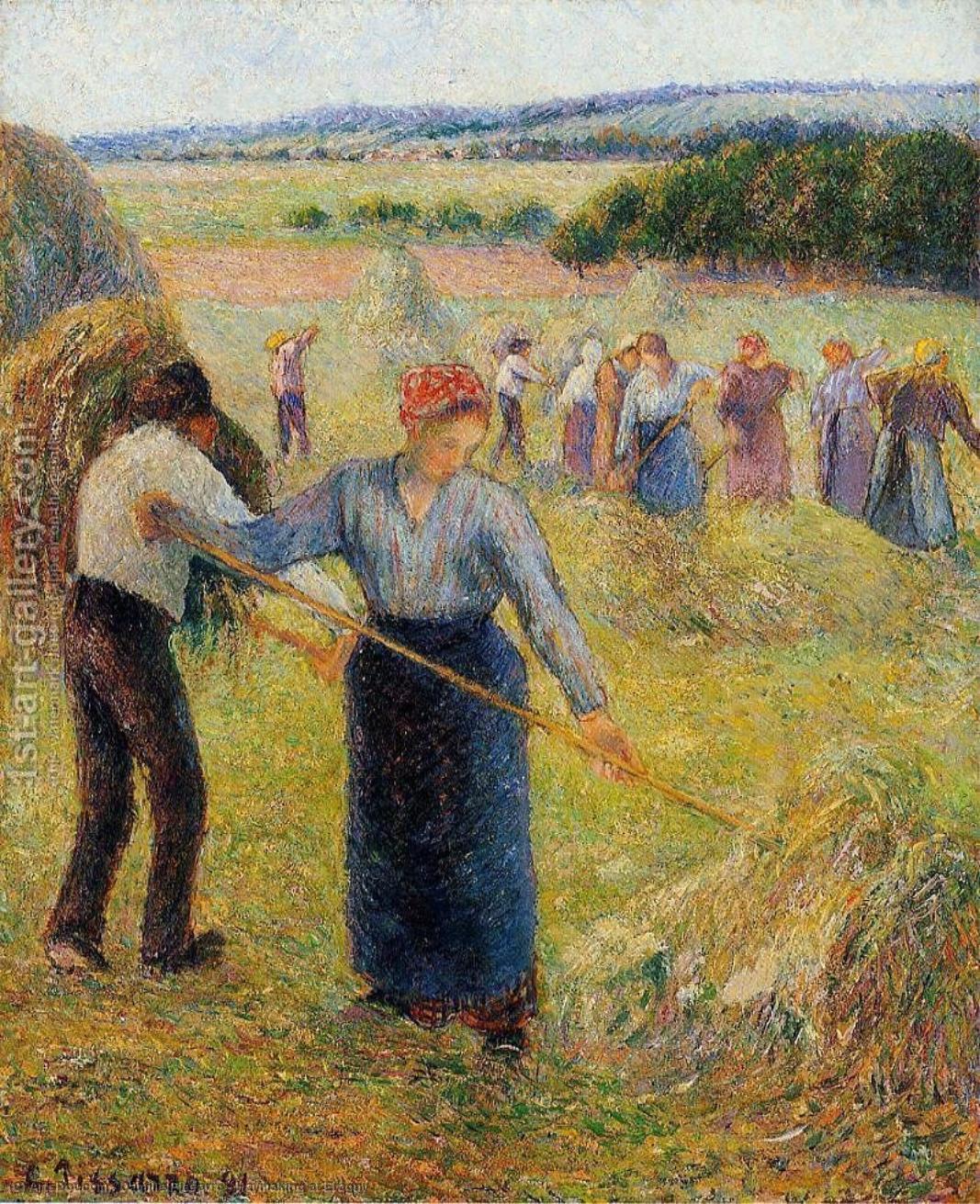
Haymaking at Eragny – A Symphony of Light and Labor
Camille Pissarro’s “Haymaking at Éragny,” painted in 1891, stands as an enduring emblem of Impressionism—a movement that revolutionized painting by prioritizing fleeting moments of perception over meticulous realism. More than just a depiction of rural activity, it's a profound meditation on the beauty inherent in everyday life and the harmonious collaboration between man and nature.
Composition and Technique: Capturing Ephemeral Light
The canvas bursts with vibrant hues—greens dominate the meadow, punctuated by yellows and browns representing the harvested haystacks. Pissarro’s masterful technique is immediately apparent; he employs short, broken brushstrokes that dance across the surface, creating an illusion of movement and capturing the dappled sunlight filtering through the foliage. These strokes aren't blended smoothly but rather juxtaposed to simulate how light refracts and transforms as it passes through air and vegetation—a cornerstone of Impressionist philosophy.
Historical Context: The Rise of Impressionism
Painted during a period of significant artistic experimentation, “Haymaking at Éragny” reflects the broader intellectual currents of its time. Impressionists like Pissarro rejected academic conventions, rejecting idealized landscapes and historical narratives in favor of scenes from contemporary life. They sought to convey not just what they saw but how they *felt*—a reaction against the rigid formalism of earlier artistic traditions.
Symbolism: Harmony and Resilience
Beyond its visual splendor, “Haymaking at Éragny” carries symbolic weight. The haystacks represent abundance and sustenance, mirroring the cyclical rhythms of agricultural life. Simultaneously, the figures engaged in labor embody resilience and perseverance—a celebration of human effort contributing to a larger natural order. Pissarro’s careful placement of individuals within the frame emphasizes this interconnectedness.
A Legacy Enduring Beauty
The Musée des Beaux-Arts André Malraux (MuMa) in Le Havre houses an exceptional collection of Impressionist paintings, including “Haymaking at Éragny,” offering visitors a chance to immerse themselves in the artistic spirit of the Belle Époque. Its enduring appeal lies not only in its aesthetic qualities but also in its ability to transport us back to a moment of profound beauty and contemplative observation—a testament to Camille Pissarro’s genius.
- Artist: Camille Pissarro
- Year: 1891
- Style: Impressionism
- Medium: Oil on Canvas
- Dimensions: 47 x 38 cm
- Location: Musée des Beaux-Arts André Malraux (MuMa), Le Havre, France
Further exploration of Pissarro’s oeuvre includes “Peasant Women Planting Stakes” and “Fog, Eragny,” showcasing his unwavering dedication to portraying the natural world with sensitivity and artistic innovation.