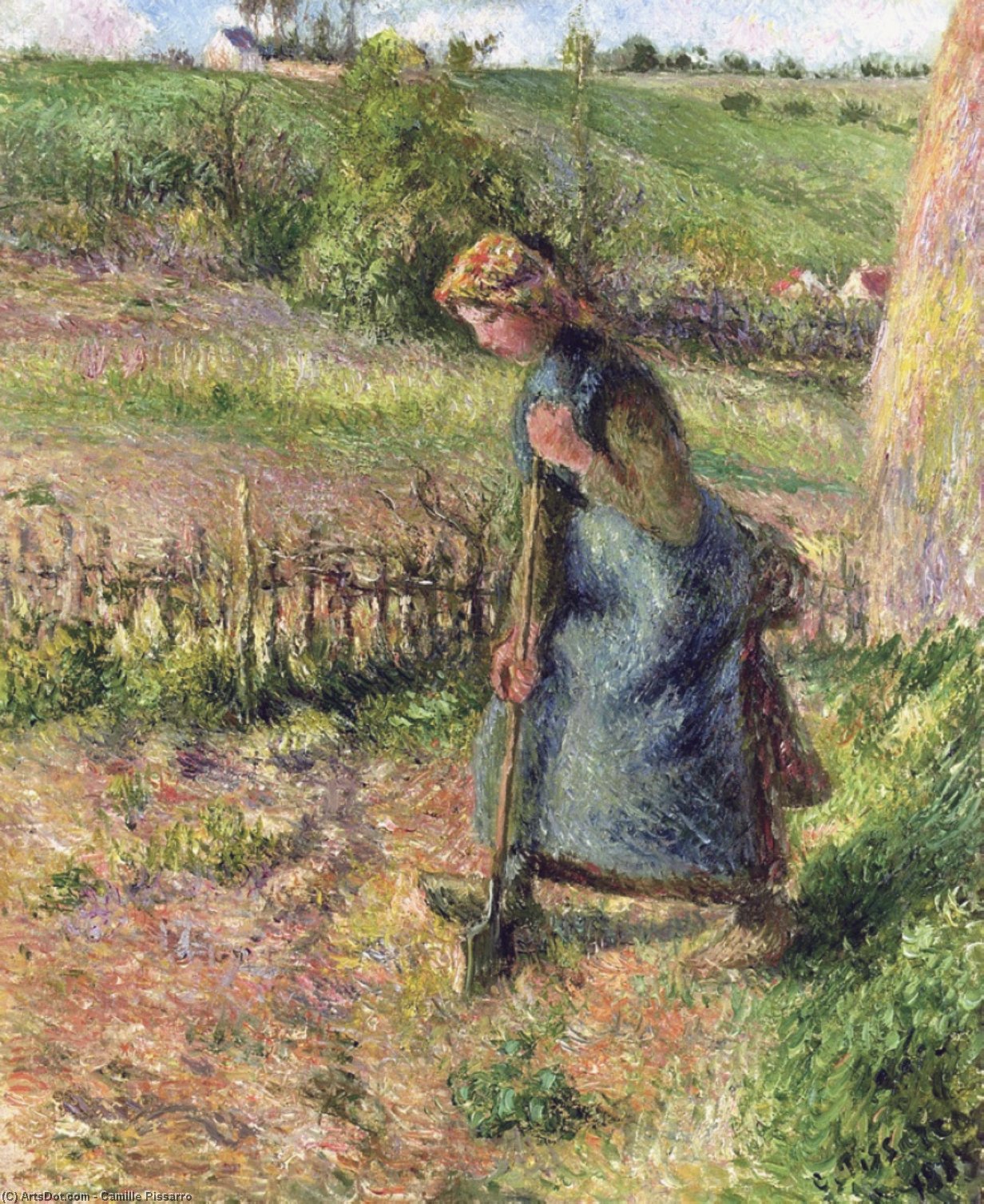
Woman Digging (1883) – A Symphony of Rural Tranquility
Camille Pissarro’s “Woman Digging,” painted in 1883, stands as an enduring emblem of Impressionism—a movement that sought to capture fleeting moments of beauty and emotion rather than striving for photographic realism. More than just a depiction of agricultural labor, this canvas embodies the core tenets of Pissarro's artistic vision: an unwavering devotion to observing nature and translating its subtleties onto canvas.
The Scene Unfolds: Rural Life Captured in Light
The painting portrays a solitary woman diligently tending to her garden plot. Positioned slightly off-center, she moves away from the viewer’s gaze as she bends over her task, clutching a spade—a tool symbolizing perseverance and connection to the earth. The setting is quintessential rural France: a simple farmhouse fence delineates the perimeter of the field, while a solitary tree adds depth and textural interest to the composition. Two figures appear in the background, subtly anchoring the scene and providing context without dominating it.
Impressionist Technique: Light and Color as Narrative
Pissarro’s masterful technique exemplifies Impressionism's core principles. Loose brushstrokes—characteristic of the era—blend together to create an atmospheric haze that softens the contours of the landscape and figures alike. The artist skillfully employs a palette dominated by muted greens, yellows, and blues, reflecting the dappled sunlight filtering through the foliage. These colors aren’t intended to represent precise hues but rather to convey the feeling of warmth and serenity—a palpable sense of tranquility that pervades the entire scene.
Symbolism Within Simplicity: A Reflection of Modernity
“Woman Digging” transcends mere representation; it speaks to broader themes of labor, resilience, and harmony with nature. The woman’s posture conveys a quiet dignity—a connection to tradition and an acknowledgement of the cyclical rhythms of rural existence. As a movement reacting against academic art's rigid conventions, Impressionism championed everyday subjects and explored how light influenced perception. Pissarro’s work aligns perfectly with this ethos, presenting a beautifully rendered snapshot of life in harmony with its surroundings.
Legacy and Influence: A Masterpiece Revisited
The Musée des Beaux-Arts André Malraux in Le Havre houses an impressive collection of Impressionist paintings, including “Woman Digging,” ensuring that Pissarro’s contribution to art history continues to inspire generations. His stylistic blend—realistic observation combined with expressive brushwork—established a precedent for subsequent artists and solidified his place as one of the foremost figures in shaping modern painting.
- Artist: Camille Pissarro
- Year: 1883
- Style: Impressionism
- Medium: Oil on Canvas
- Dimensions: 46.3 x 38.1 cm
This painting remains a testament to Pissarro’s ability to distill the essence of rural life into a visually arresting and emotionally resonant artwork.