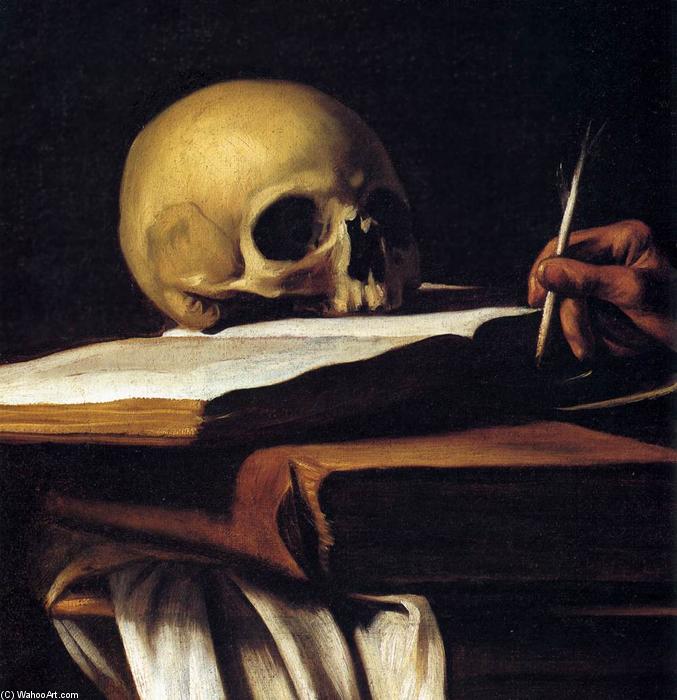
A Moment of Profound Reflection: Unveiling Caravaggio’s *St Jerome (detail)*
This compelling detail from Michelangelo Merisi da Caravaggio's *St. Jerome* offers a powerful glimpse into the artist’s revolutionary approach to religious painting and his mastery of psychological realism. Completed in 1606, during a turbulent period in both Caravaggio’s life and the Catholic Church’s history, this work transcends mere depiction; it invites us into a deeply personal moment of contemplation with one of Christianity's most important figures.
The Composition & Technique: A Masterclass in *Tenebrism*
Caravaggio isolates St. Jerome within a dramatically darkened space, employing his signature technique of *tenebrism* – an extreme contrast between light and dark. This isn’t simply about creating visual drama; it focuses our attention relentlessly on the saint's face and hands, illuminated as if by a divine spotlight. The composition is strikingly intimate, cropping in tightly on Jerome at his desk. The skull, books, pen, and parchment are rendered with meticulous detail, their textures almost palpable. This close-up view intensifies the emotional impact, drawing the viewer into Jerome’s world of scholarship and spiritual struggle. The oil on canvas medium allows for rich color depth and subtle gradations of light and shadow, hallmarks of Caravaggio's style.
Symbolism & Meaning: Mortality, Knowledge, and Faith
The symbolism within this detail is potent and layered. The skull serves as a *memento mori*, a stark reminder of mortality and the fleeting nature of earthly existence. It underscores the importance of Jerome’s scholarly pursuits – his translation of the Bible into Latin (the Vulgate) – as an attempt to create something lasting in the face of inevitable death. The books represent accumulated knowledge and wisdom, while the pen signifies the act of recording and preserving this understanding for future generations. The very act of writing becomes a defiance of time’s passage.
Historical Context: A Time of Religious Reformation
Caravaggio painted *St. Jerome* during the Counter-Reformation, a period of intense religious renewal within the Catholic Church in response to the Protestant Reformation. His work, while deeply devout, departs from the idealized and often ornate style prevalent at the time. Instead, he presents a raw, human portrayal of faith – one marked by introspection, doubt, and a profound awareness of mortality. This realism resonated with audiences seeking a more direct and emotionally engaging connection to their religious beliefs.
Emotional Impact & Artistic Legacy
*St. Jerome (detail)* is not merely a painting; it’s an experience. The intense focus on the saint's face, coupled with the stark lighting and symbolic objects, evokes feelings of solemnity, contemplation, and even melancholy. Caravaggio’s ability to capture such profound human emotion in paint is what sets him apart as one of the most influential artists in Western history. His innovative use of light and shadow, his dramatic compositions, and his unflinching realism profoundly impacted generations of artists, including Peter Paul Rubens, Jusepe de Ribera, and Rembrandt.
Bringing Caravaggio’s Masterpiece into Your Space
- A Timeless Investment: Owning a high-quality reproduction of *St. Jerome (detail)* is an opportunity to bring the power and beauty of Baroque art into your home or office.
- Interior Design Inspiration: The painting’s dramatic lighting and somber palette make it a striking focal point for any room, complementing both traditional and contemporary décor.
- A Conversation Starter: This iconic image is sure to spark discussion and admiration among guests.
- A Celebration of Art History: Displaying this reproduction demonstrates an appreciation for the enduring legacy of Caravaggio and his contribution to art history.
This detail from *St. Jerome* stands as a testament to Caravaggio’s genius – a powerful reminder of our shared humanity, our mortality, and the enduring search for meaning in a complex world.