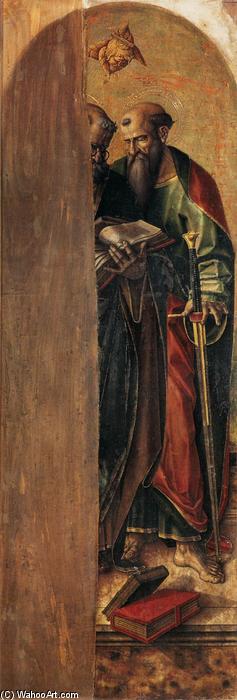
The painting
St Peter and St Paul by
Carlo Crivelli is a remarkable work of art that showcases the artist's skill and attention to detail. Created in 1490, this tempera painting measures 208 x 73 cm and is currently housed at the
Gallerie dell'Accademia in Venice, Italy.
Composition and Symbolism
The painting features two prominent figures,
St Peter and
St Paul, standing together in a harmonious composition.
St Peter is depicted holding a book, while
St Paul has a cross on his shoulder. The use of symbolism in this painting is evident, with the book representing knowledge and the cross signifying faith.
The background of the painting features several smaller figures, including a person near the top left corner and another towards the bottom right. A bird can also be seen flying above the scene, adding a sense of movement and life to the image. The play of
light and shadow in this painting is particularly noteworthy, with Crivelli using chiaroscuro to create a sense of depth and volume.
Artistic Style and Technique
Carlo Crivelli's artistic style is characterized by his use of
tempera and his attention to detail. His paintings often feature intricate details and symbolism, making them rich in meaning and interpretation. For more information on Crivelli's style and technique, visit
Carlo Crivelli: St Peter and St Paul (detail) on ArtsDot.
Some of the key features of this painting include:
- The use of symbolism to convey meaning and themes
- The play of light and shadow to create depth and volume
- The attention to detail and intricate design
For more information on the importance of
light in painting, visit
Light in painting on Wikipedia. To explore more paintings by
Carlo Crivelli, visit
Carlo Crivelli: St Jerome and St Augustine on ArtsDot.