A Symphony of Light and Shadow: Exploring Caspar David Friedrich’s “Chalk Cliffs on Rügen”
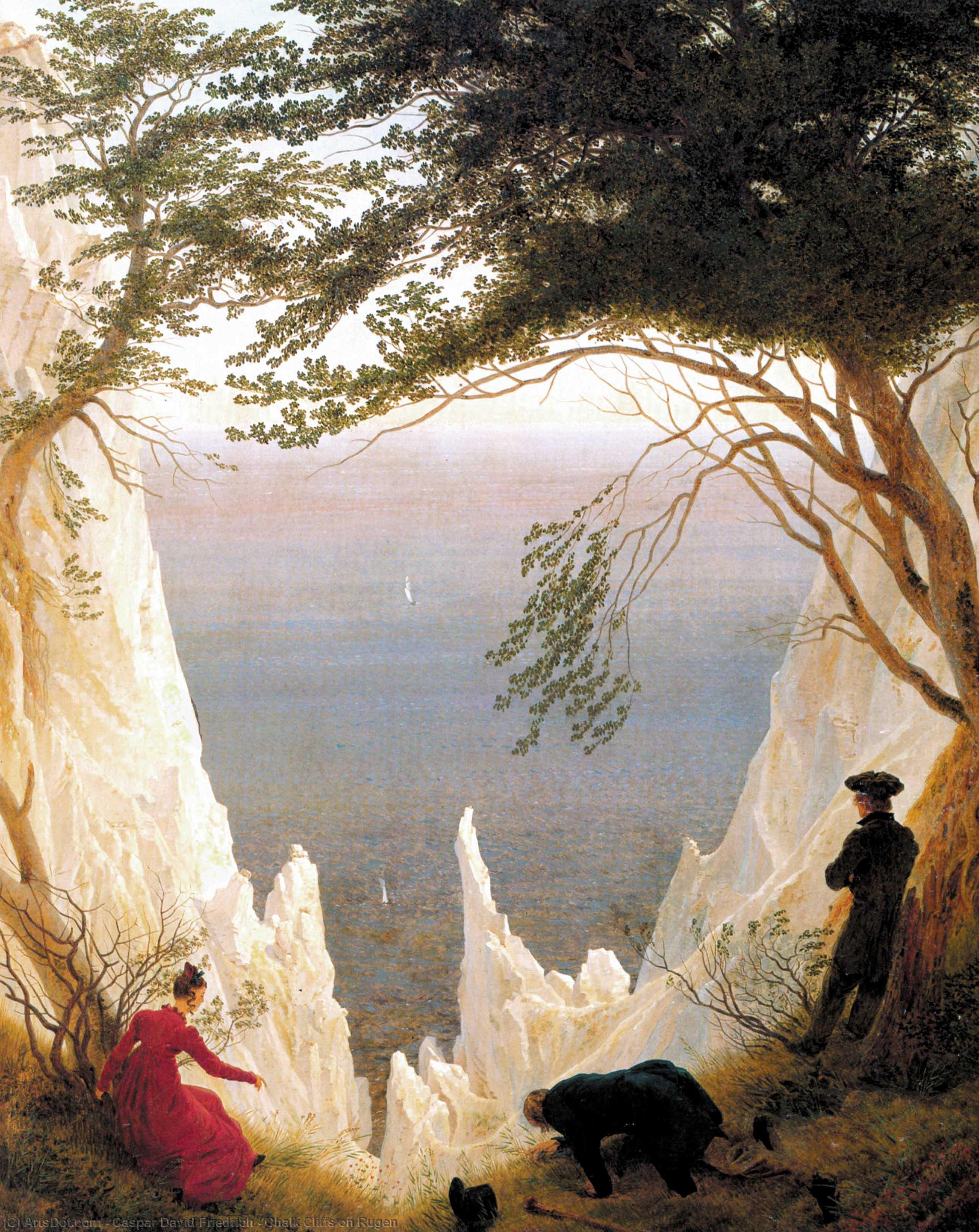
Caspar David Friedrich's "Chalk Cliffs on Rügen," painted in 1818, isn’t merely a landscape; it’s an immersive experience—a carefully constructed meditation on the sublime power of nature and the human condition. This oil-on-canvas masterpiece, currently residing within the Oskar Reinhart Collection in Winterthur, Switzerland, transcends simple representation, inviting viewers into a realm where beauty intertwines with melancholy and awe. The painting captures a fleeting moment along the rugged coastline of Rügen Island in the Baltic Sea, yet it speaks to universal themes of solitude, contemplation, and the profound connection between humanity and the natural world – themes deeply rooted in the burgeoning Romantic movement.
At first glance, the scene presents a deceptively tranquil tableau. Two figures—a man and a woman—stand poised on a precipice overlooking the vast expanse of the sea. Their postures are subtly suggestive: the man, slightly ahead, appears to be gazing into the distance with an almost mournful intensity, while the woman turns her head as if listening for something beyond the horizon. This isn’t a scene of active engagement; rather, it's one of quiet observation and profound introspection. The composition is masterfully balanced—the vertical thrust of the cliffs anchors the eye, drawing attention to the horizontal sweep of the sea and sky. Friedrich employs a technique known as *contre-jour*, placing the figures in shadow while highlighting the brilliant light reflecting off the water, creating an immediate sense of drama and depth.
Friedrich’s masterful use of chiaroscuro—the dramatic interplay of light and dark—is central to the painting's emotional impact. The muted tones of the chalk cliffs contrast sharply with the vibrant blues and greens of the sea and sky, intensifying the sense of depth and creating a palpable atmosphere. This technique isn’t simply about visual effect; it serves to evoke a feeling of mystery and uncertainty, mirroring the complexities of human experience. The distant coastline of Rügen is rendered with remarkable detail, yet remains subtly obscured by atmospheric haze, reinforcing the painting's theme of the infinite—a reminder that there are always mysteries beyond our immediate perception.
The Romantic Spirit: Context and Symbolism
“Chalk Cliffs on Rügen” emerged during a pivotal moment in European history – the early 19th century, a time marked by political upheaval and social change. Friedrich’s work is inextricably linked to the German Romantic movement, which sought to reject the Enlightenment's emphasis on reason and embrace emotion, intuition, and the power of nature. Romanticism wasn’t simply about celebrating beauty; it was a profound reaction against industrialization and urbanization, a yearning for an idealized past and a deep appreciation for the untamed wilderness. Friedrich, as a key figure in this movement, used his art to explore these themes, often imbuing his landscapes with symbolic meaning.
The figures themselves are laden with symbolism. The man and woman represent humanity’s relationship with nature—a desire to connect with something larger than oneself. Their contemplative poses suggest a longing for spiritual understanding and an awareness of mortality. The small boats visible in the distance, appearing almost as fleeting mirages, symbolize the soul's journey towards eternity. Friedrich himself is often interpreted as representing the artist’s own quest for meaning—a solitary figure grappling with the mysteries of existence.
Technique and Artistic Influence
Friedrich’s meticulous attention to detail is evident in every brushstroke. He employed a layered technique, building up the image gradually through numerous thin glazes of paint, creating a remarkable sense of luminosity and depth. His use of color is particularly noteworthy—he masterfully captures the subtle shifts in tone and hue that characterize the Baltic Sea landscape. The painting’s composition also demonstrates Friedrich's innovative approach to landscape art; he moved away from the traditional conventions of academic painting, favoring a more subjective and expressive style.
“Chalk Cliffs on Rügen” exerted a profound influence on subsequent generations of artists. Its exploration of light, shadow, and atmosphere paved the way for Impressionism and other modern movements. Artists like J.M.W. Turner and Albert Bierstadt were deeply inspired by Friedrich’s work, adopting his techniques and themes to create their own evocative landscapes. The painting's enduring appeal lies in its ability to resonate with viewers on a deeply emotional level—a testament to Friedrich’s genius as a painter and a poet of the natural world.
Bringing “Chalk Cliffs on Rügen” Home: Reproduction Options
ArtsDot offers meticulously crafted, hand-painted reproductions of "Chalk Cliffs on Rügen," allowing you to bring this iconic masterpiece into your own space. Our skilled artists replicate Friedrich’s nuanced techniques and atmospheric effects with exceptional precision, capturing the painting's original beauty and emotional depth. We offer a range of sizes and canvas materials to suit your individual preferences and budget. Each reproduction is created using archival-quality pigments on premium canvas, ensuring that it will retain its vibrancy and integrity for generations to come. Explore our collection today and discover how you can own a piece of art history.
To learn more about Caspar David Friedrich and his artistic legacy, please visit https://ArtsDot.com/Artists/Caspar_David_Friedrich. You can also view a high-resolution image of “Chalk Cliffs on Rügen” at /en/art/show/art-9gehk5-en/.