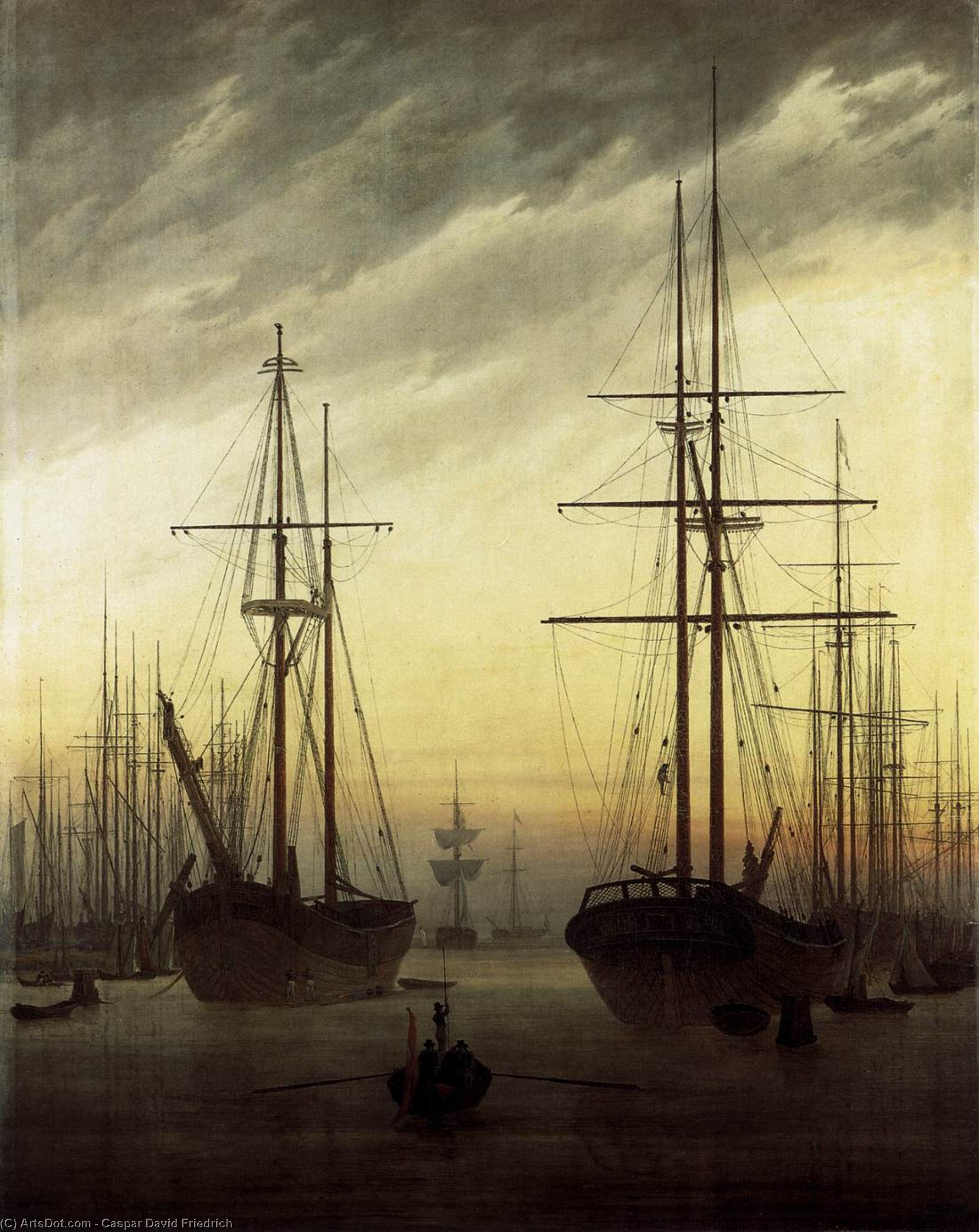
A melancholic maritime scene of boats under a dramatic gray sky captures the sublime essence of Caspar David Friedrichs Romantic masterpiece, inviting you to bring this profound sense of tranquility into your home.
Caspar David Friedrich (1774-1840): German Romantic painter of evocative landscapes & symbolic art exploring nature, spirituality & the sublime. Pioneer of the movement.
A Tranquil Reflection: Exploring Caspar David Friedrich’s “View of a Harbour”
Caspar David Friedrich's "View of a Harbour" (1815), housed in the Kunsthalle Hamburg, stands as an emblem of Romantic landscape painting—a genre characterized by its preoccupation with emotion and sublime grandeur. More than just a depiction of maritime scenery, it’s a carefully constructed meditation on solitude, contemplation, and the relationship between humanity and nature. Friedrich's artistic journey began amidst considerable personal hardship; orphaned at a young age after losing his mother and siblings, he carried an indelible mark of grief that permeated his creative output. This sensitivity to loss fueled his unwavering belief in the power of art to convey profound spiritual truths—a conviction that would define his entire oeuvre.
The Style and Technique: Romantic Precision
Friedrich’s distinctive style eschewed academic conventions prevalent during his time, prioritizing expressive brushwork over meticulous realism. He employed a technique known as “Atmospheric Perspective,” skillfully manipulating tonal values to create an illusion of depth—a cornerstone of Romantic landscape painting. Thick impasto strokes dominate the foreground, conveying textural richness and immediacy, while hazy washes of color soften the distant horizon, suggesting infinite space and ethereal beauty. The artist meticulously observed natural phenomena, particularly light and shadow, capturing their subtle nuances with remarkable accuracy. This dedication to observation wasn’t merely technical; it stemmed from a deep reverence for the natural world—a conviction that nature possessed inherent moral authority and could inspire awe and wonder.
Historical Context: Weimar Romanticism
“View of a Harbour” emerged during Weimar Romanticism, an artistic movement centered in Germany's Duchy of Saxe-Coburg and Gotha. Influenced by philosophers like Johann Wolfgang Goethe and Friedrich Nietzsche, Weimar Romanticists rejected Enlightenment rationalism, embracing instead intuition, imagination, and emotion as pathways to understanding the human condition. Friedrich’s work reflects this broader intellectual climate—a yearning for transcendence amidst the anxieties of industrialization and urbanization. The painting captures a moment of stillness—a pause in the ceaseless flow of life—inviting viewers to contemplate their own place within the vastness of creation.
Symbolism: Echoes of Spiritual Reflection
Beyond its visual splendor, “View of a Harbour” is laden with symbolic significance. The solitary figure standing on the shore represents humanity grappling with existential questions—seeking solace and guidance in the contemplation of nature. The distant harbour lights symbolize hope—a beacon illuminating the darkness of uncertainty. The calm waters mirror the inner landscape of the viewer’s mind, encouraging introspection and fostering a sense of serenity. Friedrich's masterful use of color—primarily muted blues and greys—underscores the painting’s melancholic mood, conveying both beauty and sorrow simultaneously.
Emotional Impact: A Momentary Escape
Ultimately, “View of a Harbour” succeeds in transporting viewers to another realm—a space where earthly concerns dissolve into contemplation and spiritual awareness. The painting evokes feelings of tranquility, solitude, and wonder—inspiring admiration for the sublime grandeur of the natural world. It serves as a poignant reminder that true fulfillment lies not in conquering nature but in harmonizing oneself with its rhythms—embracing the beauty of impermanence and accepting the inevitability of loss. A reproduction of this iconic artwork offers an opportunity to bring Friedrich’s vision into your home, fostering a connection to timeless artistic ideals.