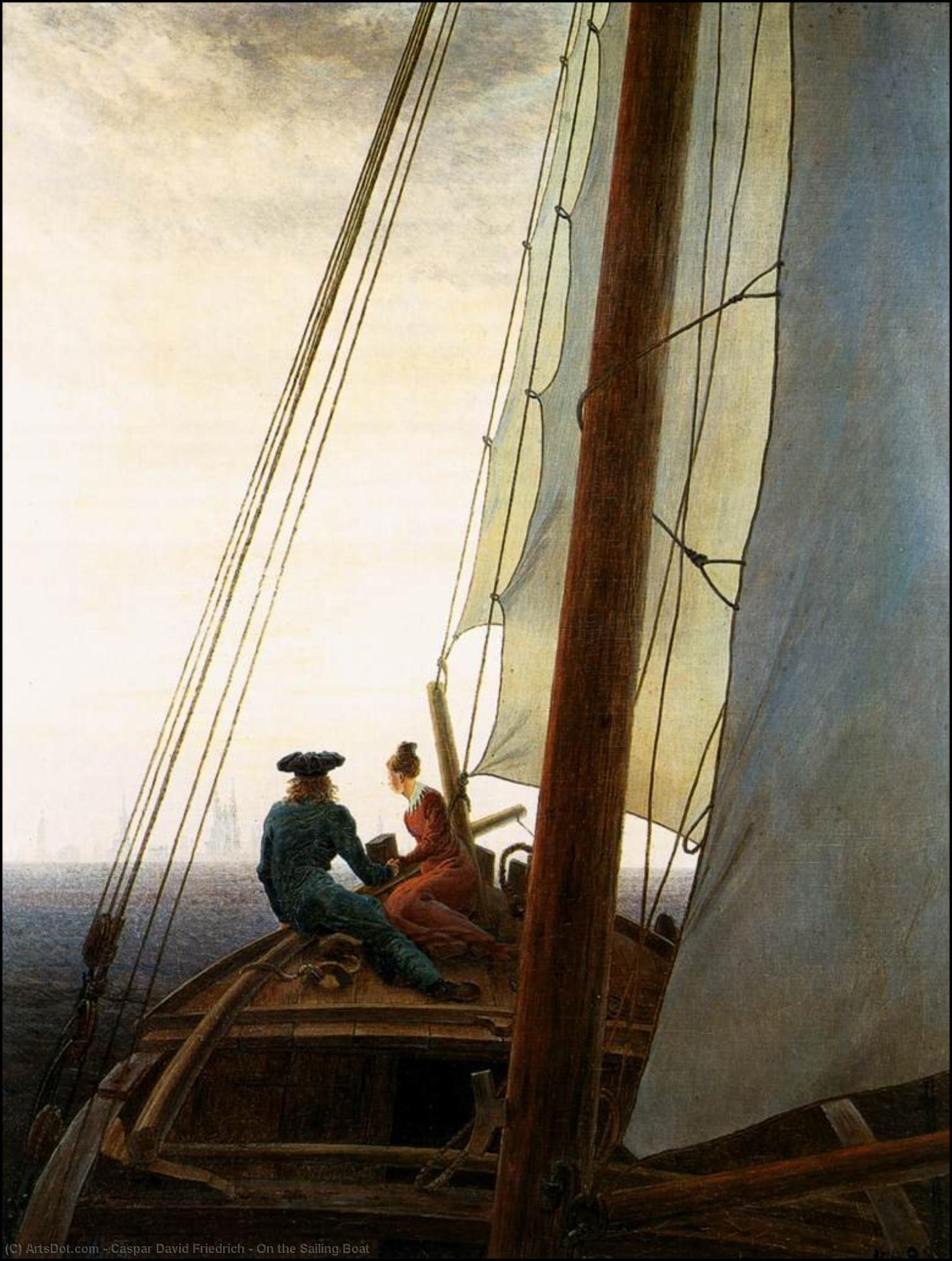
On the Sailing Boat
Caspar David Friedrich, a renowned German Romantic painter, is celebrated for his captivating landscapes that often blend elements of nature with subtle hints of human presence. One such masterpiece is
"On the Sailing Boat", created in 1819 and housed at
The Hermitage in St. Petersburg, Russia.
A Closer Look at "On the Sailing Boat"
This oil on canvas painting measures 71 x 56 cm and presents a serene scene of a sailing boat with two figures aboard. The composition is characterized by its simplicity and tranquility, reflecting Friedrich’s ability to evoke deep contemplation through his art. -
Composition: The sailboat is the central focus, with one person seated at the front and another standing in the middle. In the background, several sails are visible, adding depth to the scene. -
Figures: Besides the two main figures on the boat, there are three additional people depicted: one on the left side, another at the top right corner, and a third near the center of the boat. -
Details: A clock is positioned towards the bottom left corner of the image, which may symbolize the passage of time or the importance of timing in navigation.
Artistic Significance
Friedrich's work often explores themes of solitude, nature, and the human condition. "On the Sailing Boat" exemplifies these themes by juxtaposing the peacefulness of the natural setting with the presence of humans engaged in a quiet activity. -
Nature and Solitude: The painting highlights Friedrich’s emphasis on the beauty and serenity of nature, inviting the viewer to contemplate their place within it. -
Human Presence: The figures in the boat and the surrounding landscape underscore the relationship between humans and their environment, suggesting a harmonious coexistence.
Other Works by Caspar David Friedrich
Friedrich's oeuvre includes several notable works that share similar themes and motifs: -
"Moonrise by the Sea": Another serene landscape featuring a moonlit sea scene. -
"The Sisters on the Balcony": A painting of two women contemplating nature from a balcony. -
"Morning in the Mountains": A majestic depiction of a mountainous landscape at dawn.
Technical Considerations
Friedrich’s masterful technique is evident in the meticulous rendering of textures and colors. The painting utilizes impasto—thickly applied paint—to create a palpable sense of surface irregularity, mirroring the ruggedness of the rocky shoreline and emphasizing the materiality of the natural world. Careful attention to tonal gradation contributes to the overall atmospheric mood, conveying both luminosity and shadow with remarkable precision. Friedrich’s palette is restrained yet expressive, dominated by muted blues, greens, and browns—colors that evoke the coolness of twilight and the stillness of contemplation. The artist skillfully employs chiaroscuro—the dramatic interplay between light and dark—to sculpt the forms of the sailboat and its figures, enhancing their visual impact and conveying a profound sense of emotional depth.
Historical Context
“On the Sailing Boat” emerged during the Romantic era, a period marked by an intense fascination with emotion, imagination, and individualism. Friedrich’s artistic vision reflects the broader cultural currents of his time—a reaction against Enlightenment rationalism and a renewed appreciation for spirituality and sublime beauty. The painting aligns itself with the Romantic preoccupation with confronting mortality and contemplating the grandeur of God's creation. It embodies the movement's desire to capture subjective experience and convey profound psychological states, mirroring the anxieties and aspirations of an age grappling with rapid social change. Friedrich’s work stands as a testament to the enduring power of art to inspire awe and provoke reflection on fundamental questions about human existence.
Concluding Remarks
“On the Sailing Boat” remains a timeless masterpiece—a poignant meditation on solitude, faith, and the sublime beauty of nature. Its understated elegance and evocative symbolism continue to resonate with viewers today, cementing Friedrich’s legacy as one of the most influential landscape painters in European art history. For those seeking to immerse themselves in the artistic spirit of Romanticism or desiring a stunning reproduction of this iconic image,
visit ArtsDot for an unparalleled collection. To explore similar artistic expressions from contemporaries like Mikhail Vasilyevich Lukin—known for his portraits and landscapes—consider delving into his oeuvre.