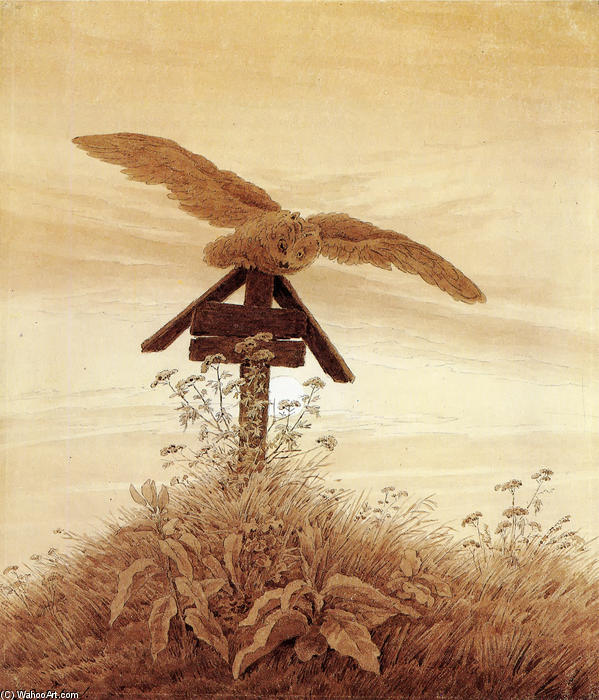
Owl on Grave: A Meditation on Mortality in Romantic Landscape
Caspar David Friedrich, a titan of German Romanticism, stands as an unparalleled interpreter of the sublime—that profound feeling of awe and terror inspired by nature’s grandeur. Among his enduring masterpieces,
Owl on a Grave (1837) transcends mere visual representation to embody the core tenets of this influential artistic movement. This painting isn’t simply depicting a scene; it's inviting contemplation about life’s ephemeral nature and humanity’s relationship with eternity.
Composition and Symbolism: The Language of Silence
Friedrich meticulously crafted
Owl on a Grave’s composition to maximize its expressive power. Dominating the canvas is an owl perched atop a weathered wooden post or grave marker—a deliberate choice reflecting the pervasive preoccupation with death and decay within Romantic thought. The owl's downward gaze establishes a palpable atmosphere of introspection, prompting viewers to confront existential questions. Complementing this central figure are subtle additions: another bird nestled in the upper left corner – likely symbolizing vigilance and perhaps mirroring the owl’s solemn posture – and a solitary flower positioned on the right side, injecting a touch of fragile beauty into the otherwise austere landscape. The owl itself carries profound symbolic weight, representing wisdom, death, and the afterlife—themes central to Romantic spirituality. Similarly, the grave marker serves as a poignant reminder of mortality, grounding the viewer in the inescapable reality of human existence.
Artistic Style and Technique: Gothic Influence Meets Pencil Precision
Friedrich’s artistic style is characterized by its embrace of gothic elements – particularly the dramatic interplay of light and shadow – to evoke feelings of melancholy and spiritual contemplation. He skillfully employs pencil as his medium, achieving remarkable detail and textural nuance. This technique allows him to capture the subtle nuances of atmospheric perspective, conveying a sense of depth and realism that distinguishes it from earlier neoclassical styles. The muted palette—primarily browns, greys, and ochres—further reinforces the painting’s solemn mood and aligns with Friedrich's desire to depict nature as an arena for profound spiritual experience. Unlike many Romantic painters who favored bold brushstrokes and vibrant colors, Friedrich prioritized tonal gradation, creating a visual harmony that underscores the painting’s contemplative character.
Context and Significance: Friedrich’s Vision of Humanity’s Place in Nature
Friedrich's artistic endeavors were deeply rooted in the intellectual currents of his time—specifically the burgeoning Romantic movement’s rejection of Enlightenment rationalism in favor of emotion and intuition. He championed the notion that art should inspire awe and reverence for the natural world, mirroring a broader cultural shift toward valuing experience over dogma. Like Turner and Constable before him, Friedrich sought to capture not merely what he saw but how it *felt*.
Caspar David Friedrich’s paintings frequently featured solitary figures dwarfed by expansive landscapes—a deliberate strategy designed to convey the insignificance of human existence against the backdrop of cosmic grandeur. This visual motif powerfully communicates the Romantic preoccupation with confronting mortality and contemplating the sublime—the experience of encountering something beyond comprehension that simultaneously inspires terror and delight.
Preservation and Display: A Testament to Artistic Legacy
The original
Owl on a Grave resides within the Pomerania State Museum, Greifswald, Germany—a repository of art and cultural heritage that houses over 14,000 years of Pomeranian history. The museum’s architectural ensemble—characterized by its harmonious blend of Gothic and neo-classical styles—provides an ideal setting for appreciating Friedrich's masterpiece alongside other significant artworks from the Romantic era. Its careful curation ensures that future generations can experience the enduring beauty and intellectual depth of this iconic painting.
Experience the beauty and symbolism of Caspar David Friedrich's "Owl on a Grave" through ArtsDot’s handmade oil painting reproductions.