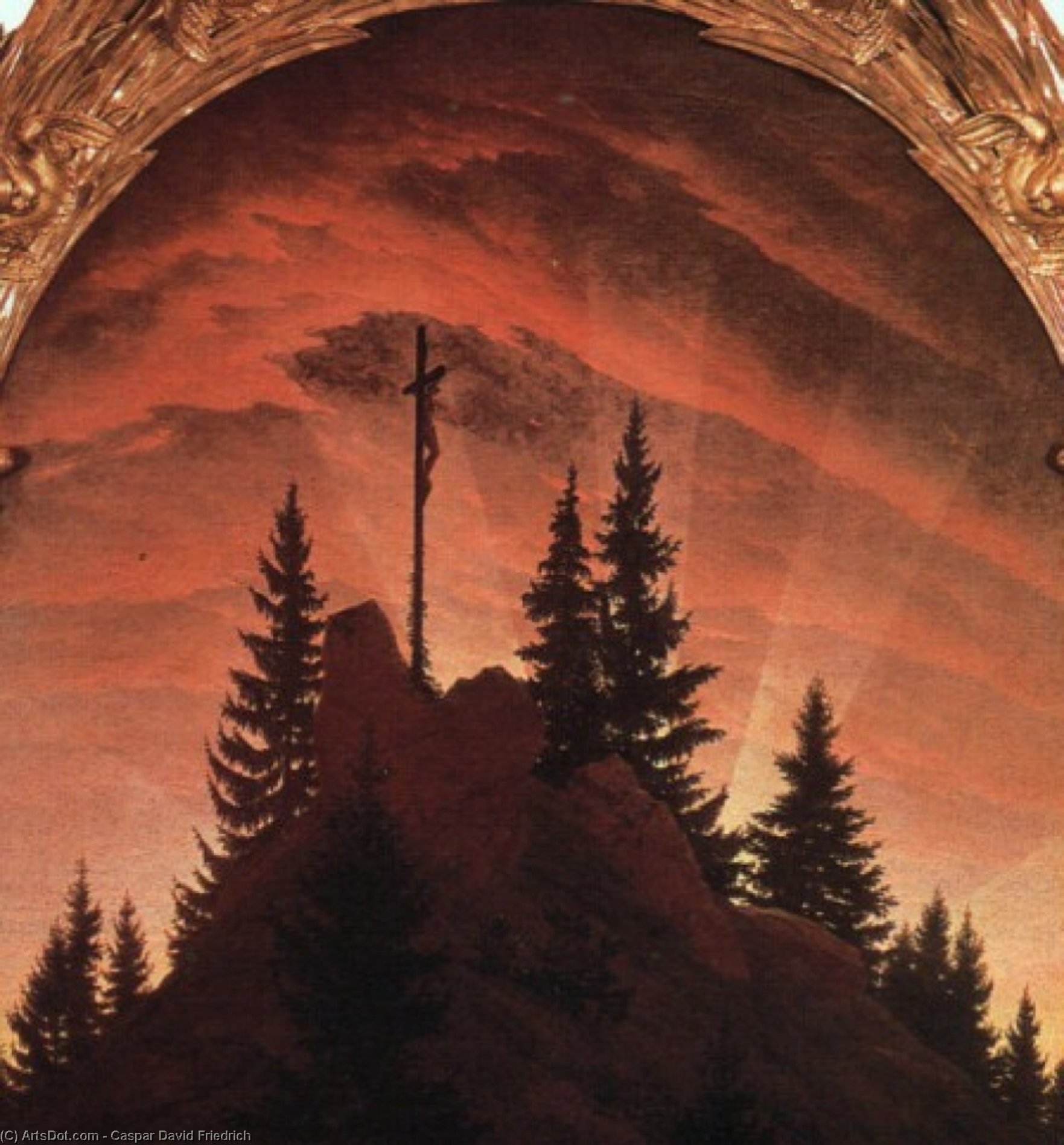
The Cross in the Mountains
Caspar David Friedrich stands as one of Germany’s most revered Romantic painters, and his magnum opus, The Cross in the Mountains, embodies the very essence of this artistic movement. Created in the early 19th century amidst a fervent spiritual revival, this monumental oil painting transcends mere landscape depiction—it aspires to convey profound emotion and theological contemplation.
Friedrich’s unparalleled ability to capture the sublime beauty of nature while simultaneously hinting at divine presence distinguishes him from his contemporaries. The artwork's genesis lies in Friedrich’s deeply personal convictions, reflecting a preoccupation with mortality and an unwavering faith that permeated his artistic endeavors.
Symbolism and Composition
The painting presents a dramatic alpine vista dominated by a towering cross positioned atop a rocky peak against a breathtaking orange sky. The compositional strategy is characterized by deliberate contrast—light versus dark hues—to establish depth and atmospheric perspective, transporting the viewer to an ethereal realm.
The cross itself serves as a central motif, symbolizing Christianity and representing faith’s unwavering resilience amidst adversity. Its placement at the apex of the mountain underscores its significance as a beacon of spiritual aspiration. Beyond visual splendor, The Cross in the Mountains speaks to a broader philosophical inquiry into humanity’s relationship with God and the sublime.
- Friedrich meticulously crafted the painting using meticulous brushstrokes—a technique that prioritizes tonal gradation and textural nuance. The artist's careful observation of geological formations and atmospheric conditions informed his depiction, resulting in an image imbued with palpable realism despite its spiritual intent.
- The painting’s color palette is dominated by muted hues—ochres, browns, and reds—creating a subdued yet emotionally resonant atmosphere. These colors harmonize seamlessly to evoke feelings of solemnity and contemplation, mirroring the artist's own contemplative disposition.
- Furthermore, Friedrich’s masterful use of light—particularly the radiant rays emanating from behind the cross—amplifies its symbolic power. This luminous element symbolizes divine illumination and underscores the painting’s overarching theme of spiritual transcendence.
Romanticism championed emotion, imagination, and individualism, propelling Friedrich to prominence as a visionary artist whose works continue to inspire generations.
To delve deeper into Friedrich's life and artistic trajectory, explore his page on ArtsDot. Don’t miss the captivating portrayal of Morning by Caspar David Friedrich, another remarkable masterpiece showcasing the artist’s ability to capture the majesty of nature and elicit profound emotional responses.
Consider visiting National Museum of Korea in Seoul, South Korea—where you can admire a stunning collection of artworks, including paintings by Kim Hong-do, a celebrated Korean painter whose works exemplify the expressive spirit of Romanticism.
Finally, appreciate The Cross in the Mountains—available as a meticulously crafted oil painting reproduction on ArtsDot—allowing art enthusiasts to possess a tangible connection to this iconic artwork’s enduring legacy.
For a comprehensive understanding of Friedrich's artistic philosophy and stylistic innovations, consult his biographical entry on Wikipedia.