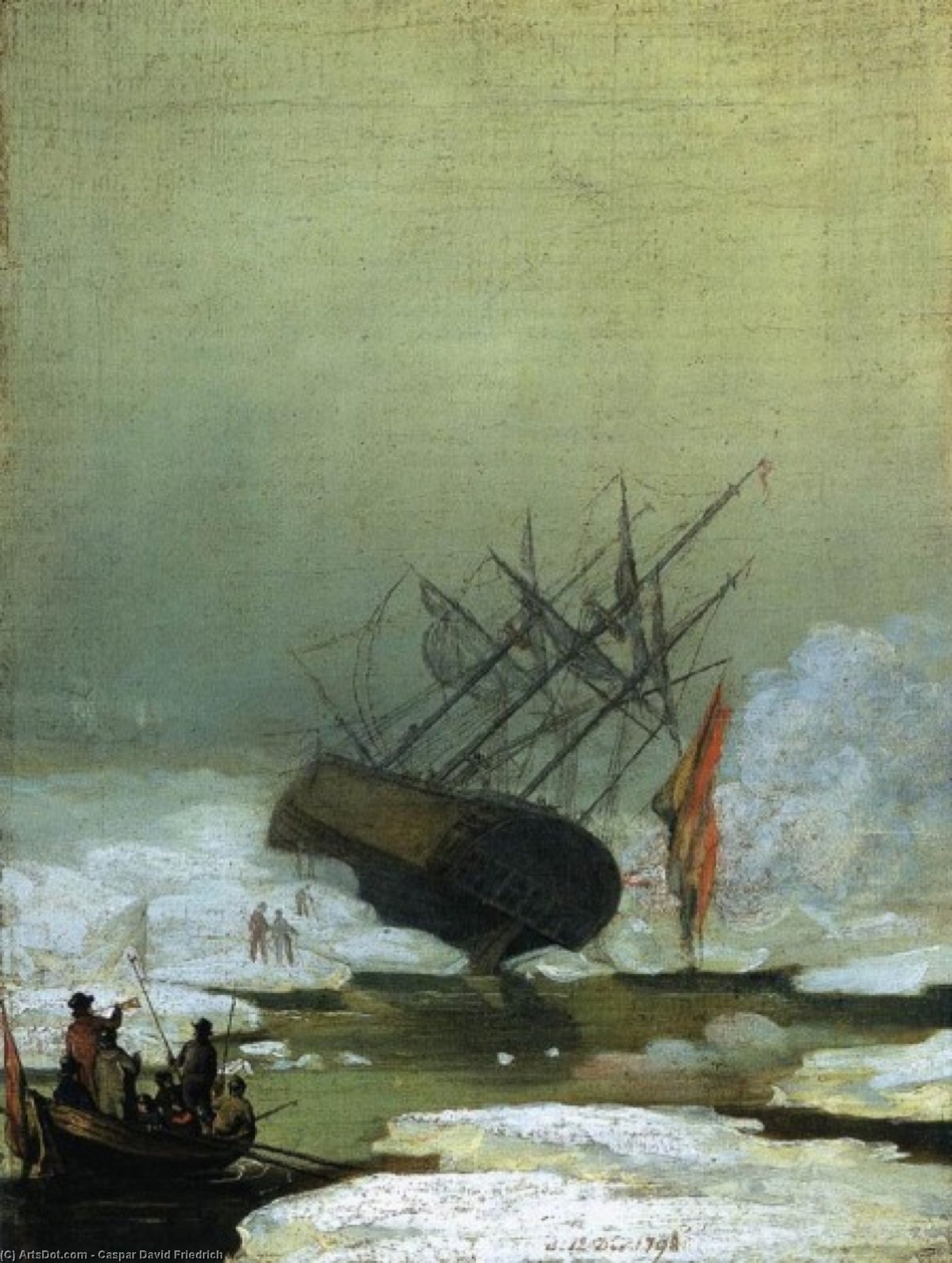
The Sea of Ice: A Meditation on Solitude and Transcendence
Caspar David Friedrich’s “The Sea of Ice,” painted circa 1823-1824, stands as a cornerstone of Romantic landscape painting—a visual embodiment of the movement's preoccupation with sublime beauty and profound contemplation. This monumental canvas depicts a desolate Arctic expanse dominated by towering ice formations, punctuated by a solitary figure standing on the frozen shoreline.
Friedrich’s artistic vision was deeply rooted in his philosophical engagement with Kantian epistemology, specifically the concept of “das Ding an sich”—the thing-in-itself—which transcends sensory experience and hints at a higher order of reality. He sought to capture not merely what he saw but rather what the landscape evoked within him – a feeling of awe mingled with melancholy, reflecting humanity’s insignificance against the immensity of nature.
- Style: Friedrich's style is characterized by meticulous detail combined with atmospheric perspective. He employs a muted palette—primarily blues and whites—to convey the chilling grandeur of the Arctic environment.
- Technique: Executed in oil on canvas, “The Sea of Ice” demonstrates masterful brushwork that builds up layers of texture to simulate the icy surface and create a sense of depth. Friedrich’s use of glazing techniques enhances luminosity and contributes to the painting's ethereal quality.
- Historical Context: Created during the Romantic era (roughly 1800-1850), “The Sea of Ice” reflects the broader intellectual currents of its time—a reaction against Enlightenment rationalism and a renewed interest in spirituality and emotion. It aligns with Friedrich’s broader artistic project to explore themes of isolation, contemplation, and the relationship between humanity and God.
Symbolism: Echoes of Spiritual Reflection
Beyond its aesthetic beauty, “The Sea of Ice” is laden with symbolic significance. The solitary figure—often interpreted as representing humankind—is dwarfed by the overwhelming scale of the icy landscape, symbolizing both vulnerability and transcendence. The distant horizon line reinforces this sense of vastness and emphasizes the insignificance of human concerns in comparison to the eternal forces of nature.
The ice itself serves as a metaphor for purity, stillness, and resistance—representing the challenges faced by individuals confronting existential questions. Friedrich’s deliberate omission of any visible signs of life underscores the painting's focus on inner experience rather than outward observation.
Emotional Impact: A Portrait of Inner Turmoil
"The Sea of Ice" resonates deeply with viewers due to its ability to evoke feelings of solitude, melancholy, and awe. Friedrich’s masterful depiction of light and shadow creates a dramatic interplay that captures the psychological tension inherent in confronting the sublime—the experience of encountering something beyond human comprehension.
It's a painting that invites contemplation on mortality, faith, and the enduring power of nature to inspire wonder and provoke introspection. Collectors and interior designers appreciate its timeless appeal and its capacity to transform any space into a sanctuary for quiet reflection – mirroring Friedrich’s own profound engagement with the spiritual dimension of existence.