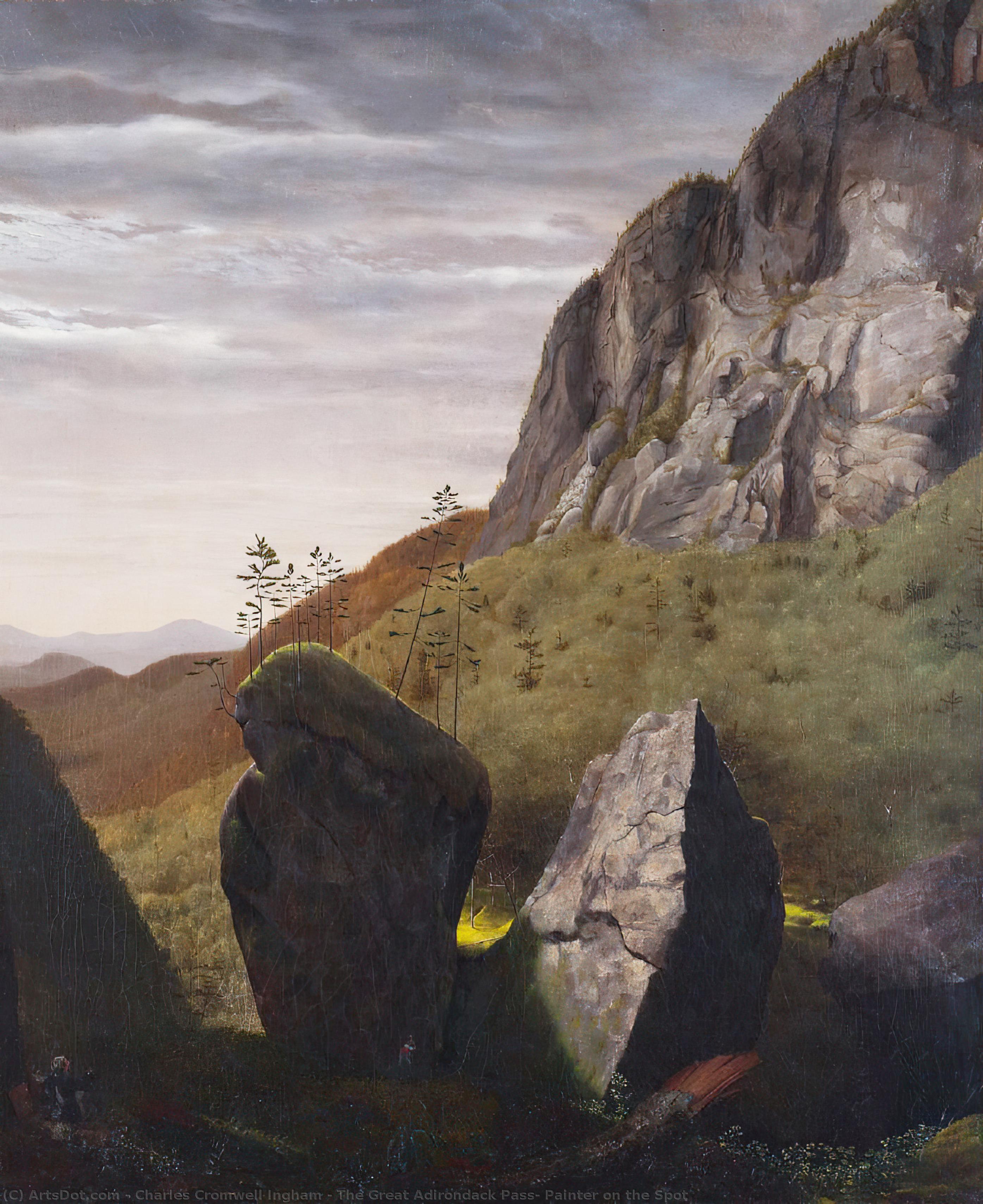
The painting
The Great Adirondack Pass, Painter on the Spot by
Charles Cromwell Ingham is a seminal work that introduced the largest wilderness in the eastern United States to the national consciousness. Created in 1837, this oil-on-canvas masterpiece measures 122 x 102 cm and is housed at the
Adirondack Museum in the United States.
Historical Context and Significance
Ingham's painting was first exhibited at the National Academy of Design in 1839, where it garnered significant attention from travelers and artists alike. The Adirondack Pass, also known as Indian Pass, is a breathtaking natural feature that divides the precipitous cliff of Wallface Mountain from Mount McIntyre, located some five miles southwest of Mount Marcy. Ingham's journey to create this painting was not without its challenges. He joined New York State Geologist Ebenezer Emmons in August 1837 as part of the state's Natural History Survey. The arduous trek to the location was so demanding that Ingham reportedly fainted during the expedition. Despite these difficulties, he persevered and executed the painting "on the spot," capturing the essence of this majestic landscape.
Artistic and Cultural Impact
The John H. Bufford lithograph of
The Great Adirondack Pass, Painter on the Spot was published in Ebenezer Emmons' widely read New York State Natural History Survey Report of 1838. This publication further amplified the painting's influence, making it a celebrated representation of American wilderness. Thirty years later, Alfred Billings Street referenced the painting and print in his travelogue
The Indian Pass, praising its graphic accuracy: "I wish to bear testimony to the graphic accuracy of the engraving of the loftiest point of the Indian Pass. . . . It is a perfect photograph of the magnificent sight."
Visual Elements and Composition
The painting features a landscape dominated by mountains with a rocky terrain. A large mountain looms in the background, accompanied by a smaller one to its left. Scattered rocks are visible throughout the scene, both near the foreground and further back. Trees add depth to the natural scenery of the mountainside, creating a serene atmosphere that captures the beauty of nature.
Conclusion
The Great Adirondack Pass, Painter on the Spot by
Charles Cromwell Ingham is a masterpiece that not only introduced the Adirondacks to the national consciousness but also stands as a testament to the artist's dedication and skill. This painting continues to inspire awe and appreciation for the natural beauty of America's wilderness. For those interested in exploring more artworks,
The Great Adirondack Pass, Painter on the Spot by Charles Cromwell Ingham is available for viewing at ArtsDot. Additionally,
Naval Ships setting Sail With A Revenue Cutter Off Berry Head by Thomas Luny and
self portrait by Ivan Nikolaevich Kramskoy are also noteworthy pieces in the ArtsDot collection.
- Artist: Charles Cromwell Ingham
- Painting Title: The Great Adirondack Pass, Painter on the Spot
- Museum: Adirondack Museum
- Year: 1837
- Medium: Oil On Canvas
- Dimensions: 122 x 102 cm
This article provides a comprehensive overview of the painting's historical context, artistic significance, and visual elements. It also highlights the importance of ArtsDot in preserving and showcasing such masterpieces for art enthusiasts worldwide.