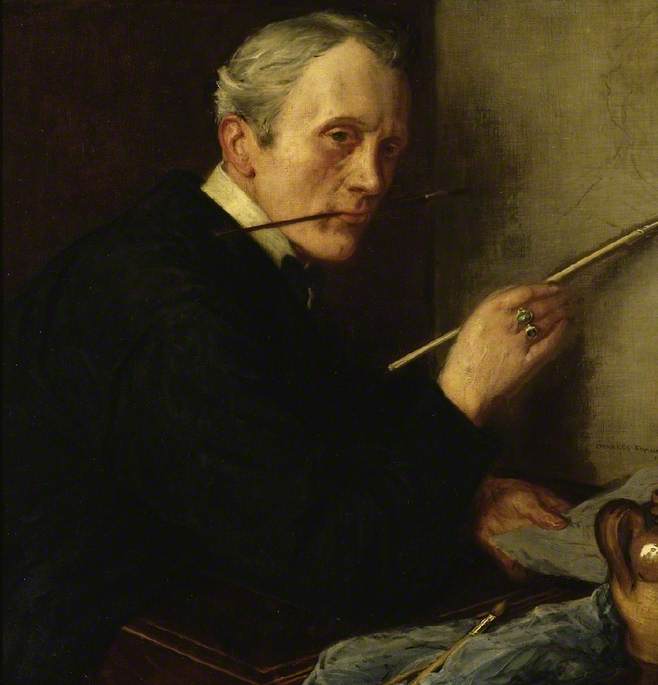
Charles Haslewood Shannon’s ‘Self Portrait’ (1917) captures a contemplative Victorian artist in Venetian Impressionist style, seated with symbolic elements like maps and sketches. Explore this masterful oil painting and bring home a piece of art history.
A Window into Victorian Self-Reflection: Examining Charles Haslewood Shannon’s “Self Portrait”
Charles Haslewood Shannon (1863-1937), a British artist deeply rooted in the artistic currents of his time, produced "Self Portrait," an oil painting completed in 1917. This artwork offers a fascinating glimpse into the Victorian era's preoccupation with introspection and artistic innovation—a testament to Shannon’s masterful command of technique and his engagement with influential stylistic movements like Venetian Impressionism. The canvas measures 69 x 68 cm, showcasing a meticulously rendered depiction of the artist himself amidst a carefully constructed domestic scene.
- Subject Matter: The portrait presents Shannon as a contemplative figure—seated at a table laden with objects – a bowl, a cup, and a book – gazing intently at a map or sketching on the wall behind him. This deliberate positioning speaks to the artist’s desire to capture not merely his physical appearance but also his intellectual pursuits and creative process.
- Style & Technique: Shannon's style aligns closely with Venetian Impressionism, evident in his use of diffused light and subtle color harmonies. He eschewed the heavy tonal palette characteristic of earlier Victorian art, opting instead for a brighter, more transparent approach—a conscious decision influenced by his artistic companions, Charles Ricketts and George Meredith.
The inclusion of symbolic elements further enriches the artwork’s narrative. The map symbolizes ambition and exploration – both intellectual and perhaps personal – mirroring Shannon's own artistic journey. Similarly, the sketchbook represents creativity and documentation, highlighting the artist’s commitment to capturing fleeting moments and translating visual impressions onto canvas. Even the seemingly mundane objects on the table—the bowl, cup, and spoons—contribute to a sense of realism and domestic tranquility, grounding the portrait within a recognizable context.
Historical Context: Shannon's creation of “Self Portrait” occurred during a period marked by significant artistic experimentation and social change. The Victorian era witnessed a burgeoning interest in psychology and self-awareness, fueled by thinkers like Sigmund Freud—themes that resonate subtly within the artwork’s contemplative gaze. Simultaneously, Shannon was navigating the evolving landscape of British art, responding to the influence of Venetian masters and establishing himself as a prominent figure in the decorative arts.
Shannon's meticulous attention to detail—particularly in capturing the nuances of light and color—demonstrates his dedication to mastering the techniques of Impressionism. The resulting painting possesses an emotional impact that transcends mere visual representation; it invites viewers to contemplate questions of identity, ambition, and artistic expression. “Self Portrait” remains a compelling example of Victorian art’s ability to convey profound psychological insight alongside aesthetic beauty – a timeless masterpiece reproduced faithfully on ArtsDot for discerning collectors and interior designers alike.